1

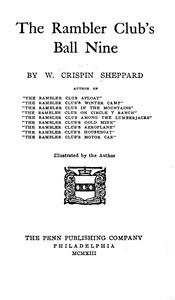
The Rambler Club's ball nine — Inside the Classic
(0 User reviews)
877
Project Gutenberg
2022
Not confirmed
High school students -- Juvenile fiction; Boys -- Societies and clubs -- Juvenile fiction; Baseball stories
Readers of public-domain and historical texts
Project Gutenberg digital edition
en
Edition facts
Words
54,099
Reading time
236 min
Text sections
6
For The Rambler Club's ball nine — Inside the Classic, the stored edition analysis reports 54,099 words, 3 hr 56 min estimated reading time, and 6 detected text sections.
The text analysis averages about 12.1 words per sentence, while the detected sections provide another way to judge how the source is divided.
Project Gutenberg metadata also associates the work with “High school students -- Juvenile fiction,” connecting these edition facts with the source record’s subject description.
Source:
Project Gutenberg record #69654
This editorial note examines W. Crispin Sheppard's diction, dialogue, and descriptive choices in The Rambler Club's Ball Nine, focusing on how the author builds factional tension through verbal sparring, character-specific speech patterns, and the strategic use of setting details in the excerpts.
Editorial Edition Score
4.7/5
★★★★★
★★★★★
Calculated from edition completeness, EPUB availability, text structure and catalogue metadata. Not a user rating.
How this score is calculated
- Description quality20 pts
- Title & short description10 pts
- Source metadata20 pts
- Text length15 pts
- Chapters / structure15 pts
- EPUB file integrity20 pts
Total of 100 points, scaled to a 2.5-5.0 range. Editions with an empty description or a missing EPUB file are not scored.
Edition quality
Read the Text
Rodgers was batting out with remarkable precision.
"Say, Nat, that chap is a corker," he declared. "Stand wherever you please, and he'll put the horse-hide right into your hands. Gee--see that!"
"Why, the way Blake picked up Dave's grounder--one handed, too! By Jove, it was a scorcher! Where are you going, Roycroft?"
"To bat," answered Earl, with a laugh. "Come on, Spearman."
"Good! Try to knock me down. I'll show you a few fancy stunts, Nat."
"We are reserving ours until Saturday week," returned Wingate. "That's right, Tom. Snicker all you want. But it's the snickers which come after the game that count."
Tom's reply was not audible, as there was too much noise. Some hundred schoolboys, whose vocal organs were in excellent condition, seemed to be desirous of learning just how much sound they could produce at a given moment.
Bob Somers had pulled down one of Joe Rodgers' drives after a long, hard run, and although the force of the impact had sent him rolling over and over on the ground, the sphere was safe in his hands.
"Bully--bully!" cried Tom, as the shouts subsided. "See you later, Nat."
"Hold on, Tommy," said Wingate. A quizzical smile was playing about his lips. A restraining hand seized Tom Clifton's wrist. "Anything the matter with your optics to-day, son?"
"Why?" queried Tom, in surprise.
"Haven't they lighted on anything yet, eh?"
"Yes; a whole lot of dandy plays."
"That isn't what I mean."
The earnest manner of his companion made Tom eagerly scan the field. He saw a dozen balls flying about in all directions, students in purple and white sweaters dashing from place to place, and "Jack Frost" engaged in sending in a variety of curves to Phil Brentall, the backstop. He also saw the ball being snapped from first to third and back again with great rapidity.
But the fact that he was not looking in the right direction was speedily impressed upon his mind when Nat shoved him around in a most unceremonious fashion.
"Now what do you see?" demanded Nat.
"Gee whiz--goodness gracious!" cried Tom--"Mr. Rupert Barry."
A tall, thin man, who, although somewhat elderly, seemed to walk with all the alertness of youth, was directing his course toward the players. He wore a long, faded, dusty-looking black coat and a derby hat of an equally old appearance.
Mr. Rupert Barry, one of the best known and wealthiest citizens of Kingswood, had retired from active business many years before, and, with only a man and wife who acted as housekeepers, resided in a stately mansion which crowned the summit of a hill. Mr. Barry was not partial to visitors. Only a select few had entered his doors. Those who did spoke enthusiastically of a collection of bric-Ã -brac and paintings which his house contained.
None of the present generation remembered having ever seen Mr. Barry in other than his old-fashioned coat and derby hat. It was a standing puzzle whether the coat and hat refused to be worn out, or whether, by some mysterious process, he was able, year in and year out, to procure garments of exactly the same color and texture.
Mr. Barry seldom appeared without a dog to keep him company. And these animals, which had succeeded one another up to the present time, generally possessed but little beauty.
On this occasion the dog which kept close to the elderly gentleman's heels was a large, shaggy creature of a yellowish hue, with a quarrelsome look in his eye.
"Now it's time to get out on the field and pull off some of those pretty stunts, Tom," advised Nat Wingate. "It may make him take down a few of those no-trespassing signs on that lot of his."
"That's right," laughed Tom. "It fairly bristles with 'em. 'Trespassers dealt with according to law'; 'Private property'; 'No thoroughfare'; 'Keep out'; 'Any one found depositing ashes or refuse on this lot will be prosecuted.' Have I missed any, Nat?"
"Just one," chuckled Wingate, "over on the northeast corner: 'Intruders will be promptly ejected.' It's a wonder he hasn't a few Gatling guns planted around."
"And just to think," mused Tom, "he's going to give that field to us!"
"Well, I like your cheek," blazed out Nat. "You must think you're the whole show. Do you know what my idea is?"
"Guess I will in a minute."
"Mr. Barry knows it's such a safe proposition that you fellows will get trimmed all around----"
"Oh, get out, you 'Pie-eater'!" howled Tom. "Take a doughnut. It looks like a cipher--meaning nothing for you!"
"We can eat up lots of things besides doughnuts," said Nat, sarcastically. "I'm going to trail Mr. Rupert Barry."
W. Crispin Sheppard builds the central conflict of The Rambler Club's Ball Nine not through play-by-play baseball action but through charged dialogue and pointed exchanges. In the excerpted scene, the school's athletic association faces a challenge from a faction called the "outlaws," and Sheppard lets the argument unfold almost entirely in back-and-forth speech. The author marks each speaker with distinct verbal tics: Owen Lawrence's fierce, clipped challenges, Tom's explosive outbursts, and Roger Steele's conciliatory but firm refusals. Even the narrator's interjections—"howled Tom, whose pent-up wrath had once more gotten the better of him"—reinforce the emotional stakes. The setting itself, a room in "an uproar," becomes a character, with the door flying open to admit Captain Ralph Bunderley, whose booming voice and physical presence abruptly shift the scene's energy. Sheppard's authorial choices in diction and description thus prioritize the social dynamics of the school over the mechanics of the game.
Dialogue as a Weapon
Sheppard uses dialogue not merely to advance plot but to dramatize power struggles. The excerpt shows characters speaking in overlapping, confrontational volleys. Owen Lawrence's lines are short and aggressive—"Afraid, eh? Have to crawl?"—while Roger Steele's responses are measured and evasive: "Our policy is not determined by rules or red tape, Brown." The author tags each speech with an adverb or gesture: "fiercely," "in a conciliatory manner," "mildly." These tags guide the reader's interpretation of tone without relying on interior monologue. The effect is a scene that feels like a verbal boxing match, where every retort lands with a specific emotional weight. Sheppard also uses collective responses—"A unanimous 'No!' cut crisply above the buzz of conversation"—to show group solidarity. The dialogue thus becomes the primary vehicle for character revelation and conflict escalation.
Character-Specific Speech Patterns
Each character in the excerpt speaks with a distinctive rhythm and vocabulary. Tom Clifton, for instance, uses exclamatory, informal language: "I never heard of such nerve in my life. Get out, 'Crackers'!" His outbursts are punctuated by the narrator's commentary on his "pent-up wrath." In contrast, Brown adopts a more calculated, rhetorical style: "Frankly, brutally, and to the point: you won't play us because you and every member of the nine is afraid." He escalates from persuasion to outright challenge. "Crackers" (Earl Roycroft) shifts from mildness to indignation, his voice "suddenly depart[ing]" from its earlier tone. Sheppard also uses nicknames like "Vanitas" and "Crackers" to signal in-group dynamics and rivalries. These speech patterns create a social map of the school: the hotheaded, the diplomatic, the sly, and the blunt. The author does not need to describe personalities at length; the dialogue itself does the work.
The Role of Physical Description in Emotional Scenes
Sheppard's descriptive choices in the excerpt are minimal but strategically placed. The room is described only as being "in an uproar," with the Somers party attempting "by sheer force of noise" to drown out the opposition. This vague but evocative phrase lets readers imagine the chaos. More striking is the entrance of Captain Ralph Bunderley: "the form of a big, burly man was sharply outlined against the bright outdoor light." The silhouette image—a dark figure framed by light—creates a theatrical moment of interruption. The captain then "strode heavily across the floor, making for the point of loudest noise." His physicality ("big, burly," "strode heavily") contrasts with the verbal sparring of the boys. Sheppard uses this entrance to break the tension and shift the scene's energy. The description of Bunderley's voice—"bellowed"—matches his imposing presence. These details show Sheppard's economy: a few precise physical cues can alter the entire mood of a scene.
The Function of the Narrator's Interjections
Sheppard's narrator occasionally steps in to comment on the action, shaping the reader's perception of events. For example, after Tom's outburst, the narrator notes that "his pent-up wrath had once more gotten the better of him." This line does not merely describe Tom's state; it judges his lack of control. Similarly, when Brown raises his voice, the narrator reports: "He raised his voice. 'The boys have no use for a team with a yellow streak.'" The narrator's interjection here emphasizes the deliberate escalation. The most telling interjection comes during the commotion: "Benny Wilkins was thoroughly charmed. He noted, too, with satisfaction, that the 'outlaws' seemed to be in no hurry to leave." This brief shift to Benny's perspective offers a moment of comic relief and hints at his role as an observer. These interjections are rare but effective, providing a layer of commentary that guides the reader without overwhelming the dialogue-driven scene.
The excerpts from The Rambler Club's Ball Nine reveal an author attentive to the nuances of verbal conflict and group dynamics. Sheppard's choices in diction—the clipped challenges, the measured refusals, the sudden shifts in tone—create a vivid portrait of school politics. Readers attentive to these patterns will find that the baseball itself is almost secondary to the social maneuvering. The novel rewards those who listen closely to how characters speak and what their words reveal about loyalty, ambition, and resentment.
I've often thought that the verbal jostling in The Rambler Club's Ball Nine, all that crackling factional pride, finds a gentler echo in the steady, quiet ambition of The boys of Columbia High in track athletics — Key Ideas to Explore. Both are simply about boys learning the weight of their own words and strides.
There are no reviews for this eBook.
There are no comments for this eBook.
Reader reflection
Take a moment to reflect on this book
Create a short personal record of your experience with this book.
Your progress
0
/
10
2
What was your overall reaction to the book?
3
Would you encourage someone else to read it?
4
What was the reading difficulty like?
5
How original did the book feel?
6
How strongly did the book affect you emotionally?
7
How did the reading compare with what you expected?
8
How personally connected did you feel to the book?
9
In one sentence, what did you learn?
10