1

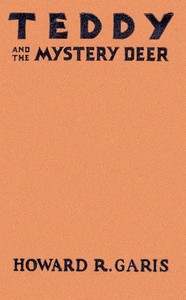
Teddy and the Mystery Deer — Background and Themes
(0 User reviews)
1383
Project Gutenberg
2019
Not confirmed
Boys -- Juvenile fiction; Mystery fiction; Deer -- Juvenile fiction
Readers of public-domain and historical texts
Project Gutenberg digital edition
en
Edition facts
Words
35,191
Reading time
154 min
Text sections
27
This digital edition of Teddy and the Mystery Deer — Background and Themes is described by source-level measurements including 35,191 words, 2 hr 34 min estimated reading time, and 27 detected text sections.
The text analysis averages about 10.7 words per sentence, while the detected sections provide another way to judge how the source is divided.
Project Gutenberg metadata also associates the work with “Boys -- Juvenile fiction,” connecting these edition facts with the source record’s subject description.
Source:
Project Gutenberg record #60461
Teddy Benson and his chums investigate a deer that raids gardens, encountering a lasso-wielding man with star heel plates. The opening chapters establish the boys' methodical approach to mystery-solving, including wind-testing model airplanes and forming a club. Later excerpts show them consulting cobbler Mr. Crispen, who proposes a humane box trap.
Editorial Edition Score
4.8/5
★★★★★
★★★★★
Calculated from edition completeness, EPUB availability, text structure and catalogue metadata. Not a user rating.
How this score is calculated
- Description quality20 pts
- Title & short description10 pts
- Source metadata20 pts
- Text length15 pts
- Chapters / structure15 pts
- EPUB file integrity20 pts
Total of 100 points, scaled to a 2.5-5.0 range. Editions with an empty description or a missing EPUB file are not scored.
Edition quality
Read the Text
rectly east,” Teddy answered.
“Then Mason’s meadow will be the place to have the test,” suggested Dick. “There’s plenty of room there.”
“Yes,” Teddy agreed, “if we start on the far side--away from the woods. Can’t start in the middle of the meadow.”
“Why not?” asked Dick.
He did not glance up at his chum. Dick, who was short and rather stout, was twisting the propeller blades of his own toy plane. He was winding the rubber bands which, when they untwisted, would serve as the motor of the little craft. “Why can’t we begin the race in the middle of the meadow, Teddy? That’s the clearest place.”
“Well, if you want your plane to shoot over in the woods, and maybe get lost, let it go from the middle of Mason’s meadow,” said Teddy. He tested the rudders of his craft.
Dick, who had put the clamp on his rubber engine, looked up to laugh as he said:
“Say, Teddy, you don’t think, that these planes of ours will fly from the middle of Mason’s meadow away over to the woods on the far side, do you?”
“I don’t know about your plane, but mine will,” stated Teddy confidently. “I’m not so sure,” he went on, as he carefully tested the tautness of the stretched rubber bands, “I’m not so sure but what we had better go down to the lake beach. There’s a longer stretch to fly from down there. But of course the wind is wrong. The planes would have to go over the water.”
“And since mine doesn’t happen to be a hydroplane, I’m not for that,” declared Dick. “But you make me laugh when you say your plane will go all the way across Mason’s meadow and into the woods.”
“I don’t want my plane to go into the woods,” spoke Teddy calmly. “But I’m pretty sure it will if I let it have all the power I can give it. I didn’t wind it up as tight as I could.”
“Well, if your plane is as good as you think it is, why don’t you enter it in the races for the Johnson cup?” asked Dick.
“Maybe I will,” Teddy answered as he made another adjustment to his craft’s rudders.
“Say, don’t you know that only the very best planes go in that contest this September?” asked Dick. “Your little one wouldn’t have a chance!”
“Maybe it would,” spoke Teddy. “We’ll know more after we have our own little race today down in Mason’s meadow. Did you see anything of Joe?”
“I passed his house on my way here,” Dick answered. “He was doing something to his plane and said he’d be right over. We can wait. I’ve got to fix my rudder a little.”
“And I think I’ll take off one of my rubber bands and put on another,” Teddy remarked. “One of ’em looks a little bit frayed. I don’t want my plane to slow up.”
“You want it to go all the way to the woods, I suppose,” laughed Dick.
“Oh, it’ll go there. Maybe yours will, too,” said Teddy. “The wind is getting stronger,” he added. Again he wet his finger and held it up as a test. “It’s going to be a strong tail wind,” he went on. “I wouldn’t be surprised if all three of our planes got to the edge of the woods, anyhow.”
“You have a pretty good opinion of our planes,” chuckled Dick.
“Why not?” Teddy asked as he let his propeller slowly unwind. He wanted to take the tension off the rubber bands in order to insert a new one.
Dick did not answer his chum. But he looked up long enough to say: “Here comes Joe!”
“Good!” exclaimed Teddy. “Now we can have the race. Hurry, Joe!” he shouted. “The wind’s just right and it’s getting stronger. Hurry!”
“Coming!” answered Joe Denton.
The three chums were soon busy making final adjustments to their toy planes in the yard of Teddy Benson’s home. Most of the activities of the three centered around Teddy’s home. He was the leader of his crowd, always the first to propose something new. He had done it when he suggested they have a race of their model planes. The boys had been making model planes for some time.
At first they made only small ones, which were launched by being tossed into the air. These planes went only a short distance.
The story begins not with the mystery deer but with Teddy Benson testing the wind by wetting his finger before flying a model airplane. This small, precise action—checking wind direction before launching a toy—signals a methodical, observant protagonist. The opening chapter, titled "Lost," introduces Teddy and his chum Dick Kelly as they prepare to fly their planes in Mason's meadow, away from the woods. The dialogue is brisk and practical, with Teddy correcting Dick's assumption about where to start the flight. The boys' careful planning and attention to detail foreshadow how they will later approach the deer mystery: step by step, with logic and teamwork.
Wind, Planes, and a Methodical Start
The first chapter establishes a pattern of careful observation. Teddy wets his finger to test the wind, then chooses a launch site "on the far side—away from the woods." This isn't random play; it's deliberate problem-solving. The boys discuss rubber band tension and propeller catches, showing they understand mechanical cause and effect. When Dick questions Teddy's choices, Teddy explains his reasoning without frustration. This collaborative, logical dynamic carries into the mystery. The early pages also introduce the setting—a small town with woods, meadows, and neighbors like Mrs. Traddle—without heavy exposition. Details emerge through action: the meadow is good for flying because it has "plenty of room." The reader learns the world alongside the characters, through what they do.
The Cobbler's Trap: A Shift in Strategy
Midway through the excerpts, the boys consult Mr. Crispen, the cobbler. He dismisses their focus on the "man with star heel plates" who lassoed Teddy, arguing instead for a trap. His language is blunt and physical: he "snapped the gnarled thumb and finger of his right hand sharply" to emphasize catching the deer. The boys object to steel traps, fearing injury, and Mr. Crispen clarifies he means a box trap—a humane enclosure. This exchange reveals the story's ethical dimension: the boys want to solve the mystery without harming the animal. Mr. Crispen's past as a trapper of bears and bobcats adds credibility, but his admission that he never caught a deer leaves room for uncertainty. The plan is set for that night.
Voice and Repetition: "A Trap?"
A notable stylistic feature is the repeated, echoed question "A trap?" When Mr. Crispen first suggests a trap, the text reads: "‘A trap?’ questioned Teddy. And his chums also murmured: ‘A trap?’" This triple echo—Teddy, then the group—emphasizes their surprise and hesitation. Garis uses this technique sparingly but effectively, marking moments of collective reaction. Later, when Mr. Crispen says catching a deer in a box trap is like catching a bear, Teddy asks, "Did you ever catch a bear?" The cobbler's response—"Of course I did!"—is followed by a chuckle and a boast about catching "real bears out in the West." The dialogue carries a rhythmic, almost theatrical quality, with characters often repeating key words or phrases to build suspense or humor.
Clues and Red Herrings: The Lasso Man
The excerpts introduce a mysterious man who lassoes Teddy, wearing boots with star-shaped heel plates. This detail—the heel plate clue—is treated as a tangible lead, but Mr. Crispen advises the boys to "trail that cowboy later" and focus on the deer. The narrative thus sets up a potential red herring: the lasso man may be unrelated to the garden raids. The boys' willingness to pivot from one clue to another shows their flexibility. The cobbler's authority as an adult ally is established through his practical know-how, but his dismissal of the heel plate clue may or may not be correct. Readers are left to wonder whether the lasso man will reappear and how his actions connect to the deer.
As you read, pay attention to how the boys gather and weigh evidence—from wind direction to heel plates to trap design. The story rewards careful noticing of small details, both in the characters' observations and in the author's word choices. The mystery unfolds through dialogue and action rather than interior monologue, so watch for what characters do and say, not just what they think. The excerpts end with the trap being set, but the outcome remains unknown.
Reading about Teddy and the boys consulting Mr. Crispen, I remembered my own father’s workshop—the smell of leather and patience. That careful, humane approach to a problem echoed a quiet passage in Reuben Stone's discovery — A Reader’s Guide, where a character pauses before acting. Both books feel like old friends, trusting you to sit with a thought.
There are no reviews for this eBook.
There are no comments for this eBook.
Reader reflection
What was your reading experience?
Capture what you thought, learned, and would like to remember.
Your progress
0
/
10
2
What was your overall reaction to the book?
3
Would you recommend this book to another reader?
4
How easy was the book to follow?
5
Do you expect to return to this book?
6
How clear did the writing feel?
7
What did you appreciate most?
8
How useful were the ideas in this book?
9
What changed or sharpened your thinking?
10