1

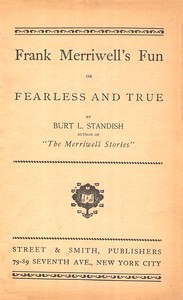
Frank Merriwell's Fun; Or, Fearless and True — Text and Context
(0 User reviews)
136
Project Gutenberg
2020
Not confirmed
Football -- Juvenile fiction; College students -- Juvenile fiction; Yale University -- Juvenile fiction; Merriwell, Frank (Fictitious character) -- Juvenile fiction
Readers of public-domain and historical texts
Project Gutenberg digital edition
en
Edition facts
Words
52,929
Reading time
231 min
Text sections
24
The catalog record for Frank Merriwell's Fun; Or, Fearless and True — Text and Context provides practical reading context through 52,929 words, 3 hr 51 min estimated reading time, and 24 detected text sections.
The text analysis averages about 11.7 words per sentence, while the detected sections provide another way to judge how the source is divided.
Project Gutenberg metadata also associates the work with “Football -- Juvenile fiction,” connecting these edition facts with the source record’s subject description.
Source:
Project Gutenberg record #63537
An editorial note on the structure, recurring images, and scene transitions in Burt L. Standish's Frank Merriwell's Fun, focusing on the initiation ritual and its theatrical staging.
Editorial Edition Score
4.8/5
★★★★★
★★★★★
Calculated from edition completeness, EPUB availability, text structure and catalogue metadata. Not a user rating.
How this score is calculated
- Description quality20 pts
- Title & short description10 pts
- Source metadata20 pts
- Text length15 pts
- Chapters / structure15 pts
- EPUB file integrity20 pts
Total of 100 points, scaled to a 2.5-5.0 range. Editions with an empty description or a missing EPUB file are not scored.
Edition quality
Read the Text
ard by the little group of laughing students that was passing down the walk in front of Battell, one of the halls at Yale.
“Don’t nothithe them,” lisped Lew Veazie, turning his back on the passing group. “They are verwy cheap.”
“Be generous, be generous!” said Rupert Chickering, with clasped hands. “We should pity them, instead of speaking of them with scorn. They can’t help being what they are.”
“Your campaign against Merriwell does not seem to thrive?” said Hull, addressing Gene Skelding, who was leaning against the fence and scowling blackly at the passing students.
“I’m waiting,” muttered Gene. “I’ll get him yet.”
“There are others who are waiting,” said Ives impatiently. “That fellow Badger must have given up his ambition to down Merriwell.”
“Don’t mention him!” cried Ollie Lord, standing on his tiptoes in an attempt to look tall and imposing, although he was barely five feet in height. “He insulted me! I felt like killing him on the spot!”
“You mutht westwain your angwy pathions, deah boy,” simpered Lew. “You thould not allow yourthelf to become dangerous.”
The idea of Ollie becoming very dangerous was extremely ludicrous, but nobody in the group cracked a smile. The Chickering crowd took themselves seriously.
“Badger,” said Ives, “is a bluff. But I did think that Bertrand Defarge might take some of the wind out of Merriwell’s sails.”
“Defarge got it in the neck,” muttered Skelding, “and he’s as quiet as a sick kitten now.”
“They say Merriwell played with him after the fashion of a cat playing with a mouse,” spoke Ives, gently caressing his bang, which fell in a roll over his forehead quite to his eyebrows.
The trouble with the Frenchman was that he thought Merriwell knew nothing at all about fencing,” declared Skelding.
“Is there anything in the world that Merriwell knows nothing at all about?” exclaimed Tilton Hull, looking over the top of his wonderfully high collar despairingly.
“Sure thing,” nodded Skelding, scowling. “His weak point will be found some time, and then he’ll go down with a crash. Every man has a weakness, you know.”
“I take extheptionth!” cried Lew Veazie, with great vigor. “I weally defy anybody to dithcover my weak point.”
“Claret punch,” said Ollie Lord.
“Well, you can’t thay a word,” grinned Lew.
Merriwell and his party had passed on. Rattleton had called attention to Chickering’s crowd, but Frank did not even deign to glance at the group by the fence.
“They are not worth noticing,” he said. “Don’t mind them, anybody.”
“I’d like to eat that little runt Veazie!” exclaimed Bink Stubbs.
“Well, he’d make you sick if you did!” returned Danny Griswold.
“We were speaking of the money question,” grunted Browning. “Which side of that question are you on, Jones?”
“The outside,” answered Dismal sadly. “Haven’t received a remittance from the governor since Jonah swallowed the whale.”
“You’re in hard luck.”
“Will a tenner help you out?” asked Frank.
“All right,” said Merry; “come up to the room. Come along, all of you.”
“There’s another fellow,” grunted Browning, pointing to a student who was sitting all alone on the end of the fence in front of Durfee, “who looks as if he might be on the outside of the money question.”
The person referred to looked forlorn and dejected.
“I’ve noticed him often,” said Merry. “He never seems to travel with anybody.”
“You mean that nobody travels with him,” said Rattleton.
“It’s all the same. He doesn’t associate with other students.”
“On the contrary, other students do not associate with him.”
“He has a bad name,” said Griswold.
“You don’t mean to say that that has anything to do with the fact that he has no associates?”
“Well, the name seems to fit him.”
“They say his father has served a term in the jug for larceny.”
Merry was interested.
“And is that the reason why he has no associates here?”
“Then there are others?”
“His nature seems to fit his name.”
“Things have a habit of disappearing when he’s round.”
“What! Do you mean that he’s light-fingered?”
“Well, nobody’s ever caught him yet, but he has that reputation.”
Frank’s interest increased.
“You say that his father has served time for larceny, and that this poor fellow has a bad name? If nobody has caught him at anything crooked, why should he be ostracized?”
“Well, the fellows here don’t care about associating with anybody who has such a father.”
Frank Merriwell's Fun opens with a carefully orchestrated initiation scene that relies on theatrical darkness, sudden noises, and a grotesque demon face. The sequence moves from a password exchange to a mock sacrifice, then to a brightly lit scarlet chamber where over a hundred sophomores await. This rapid shift from terror to festivity establishes a pattern: the narrative frequently alternates between suspenseful buildup and comic release, using physical props—a hand over the mouth, a bolt turning, a fiery visage—to punctuate each phase.
Staging the Initiation
The initiation in the excerpt is built like a stage play. The setting moves from total darkness to a scarlet room, with sound effects (thunder, a bang) and a scripted dialogue between Frank and the “fiend.” The questions “Do you google?” and answers “Because why” mimic a ritualistic nonsense exchange, reinforcing the order’s absurdity. The master of ceremonies calls for salutes and a leather medal, blending mock solemnity with schoolboy humor. This theatricality recurs throughout the book: scenes often begin with a description of a space—a room, a field, a campus corner—then fill it with coordinated action and dialogue.
Recurring Images of Confinement and Release
Images of confinement appear repeatedly: the freshman Ready is pushed into a dark room, a door closes with a bolt, and a hand silences him. Yet each confinement leads to a sudden opening—a door swings, light floods in, and the captive joins a feast. The scarlet chamber itself, with its stained walls and long table, becomes a space of both threat and reward. This pattern of enclosure and emergence mirrors the book’s episodic structure, where characters are trapped in predicaments (a hazing, a football play, a misunderstanding) only to break free through wit or teamwork.
Movement Between Scenes
The narrative moves briskly from one set piece to the next, often via a character’s entrance or a shouted command. In the initiation, the transition from darkness to light is immediate: “a door swung open before them, permitting light to shine in.” Elsewhere, scene shifts are signaled by a change in location (from dormitory to athletic field) or by a new character arriving with news. The book’s 24 text sections suggest a rhythm of short, self-contained episodes, each ending with a hook or a punchline. This structure keeps the plot moving without lingering on description.
Voice and Dialogue as Structural Markers
Dialogue drives the action. Frank’s lines are often declarative and commanding (“We are worthy, faithful friend”), while the freshman Ready remains mostly silent, observing. The exchange with the fiend uses a call-and-response pattern that mimics a coded language. This verbal play—rhyming, nonsense, mock formality—appears in other scenes, where characters trade quips or issue challenges. The voice of the narrator stays neutral, letting dialogue carry the tone. Readers should attend to who speaks and how, as these exchanges often signal a shift in power or a turn in the plot.
Readers will find that the book’s pleasures lie in its rapid scene changes and its reliance on theatrical set pieces. Pay attention to how each episode begins: often with a character moving into a new space or a sudden sound. The scarlet chamber episode, with its blend of menace and merriment, is a microcosm of the whole—a controlled chaos that Frank Merriwell navigates with confidence. The structure rewards attention to entrances, exits, and the props that mark each scene.
Sometimes I think about how Standish stages that initiation scene, all those ritual gestures and shifting lights, and it reminds me of the quiet machinery behind any story’s thrall. There’s a similar feeling I get from Red love — Edition Insights—not a lesson, just a familiar ache, like recognizing an old photograph’s faded edges. Funny how patterns keep reappearing, even when we’ve forgotten where we first saw them.
There are no reviews for this eBook.
There are no comments for this eBook.
Reader reflection
How will you remember this book?
Save your reaction, strongest insight, and memorable passage.
Your progress
0
/
10
2
Did this book hold your interest?
3
Is this a title you would suggest to others?
4
How demanding did the text feel?
5
Did you gain anything practical from the text?
6
Do you expect to return to this book?
7
Did any part of the book stay with you emotionally?
8
How original did the book feel?
9
What is the main idea you are taking away?
10