1

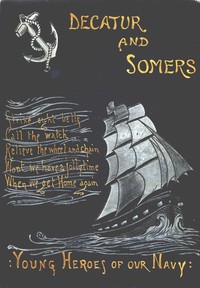
Decatur and Somers — Story, Setting & Ideas
(0 User reviews)
362
Project Gutenberg
2020
Not confirmed
United States -- History -- Tripolitan War, 1801-1805 -- Juvenile fiction; Decatur, Stephen, 1779-1820 -- Juvenile fiction; Somers, Richard, 1778-1804 -- Juvenile fiction
Readers of public-domain and historical texts
Project Gutenberg digital edition
en
Edition facts
Words
46,142
Reading time
201 min
Text sections
6
The source record for Decatur and Somers — Story, Setting & Ideas measures this digital text at 46,142 words, 3 hr 21 min estimated reading time, and 6 detected text sections.
The text analysis averages about 22.6 words per sentence, while the detected sections provide another way to judge how the source is divided.
Project Gutenberg metadata also associates the work with “United States -- History -- Tripolitan War, 1801-1805 -- Juvenile fiction,” connecting these edition facts with the source record’s subject description.
Source:
Project Gutenberg record #63209
Molly Elliot Seawell's 1894 historical fiction follows Stephen Decatur and Richard Somers through the Tripolitan War, blending naval detail with character portraits. The opening chapters establish the frigate United States ('Old Wagoner') and the youthful eagerness of midshipmen, while later excerpts show the planning of the Philadelphia raid. Catalog subjects emphasize juvenile fiction, but the text's tone and vocabulary suggest an older audience.
Editorial Edition Score
4.7/5
★★★★★
★★★★★
Calculated from edition completeness, EPUB availability, text structure and catalogue metadata. Not a user rating.
How this score is calculated
- Description quality20 pts
- Title & short description10 pts
- Source metadata20 pts
- Text length15 pts
- Chapters / structure15 pts
- EPUB file integrity20 pts
Total of 100 points, scaled to a 2.5-5.0 range. Editions with an empty description or a missing EPUB file are not scored.
Edition quality
Read the Text
The blue and beautiful Delaware Bay, bathed in a faint haze, looked its loveliest, one evening about sunset, in June, 1798. The sky above was clear, and, although there was no moon, the stars were coming out brilliantly in the sky, that was of a darker blue than the water. The sun had gone down, but the west was rosy yet. The green, low-lying country around looked ineffably peaceful, and the only sound that broke the charmed silence was the rattling of the capstan as a noble frigate, lying in the stream, hove up her anchor.
Although the brief, enchanted twilight was over all the earth and sea, the graceful outlines of this lovely frigate were clearly defined against the opaline sky. She was stoutly sparred, but in such exquisite proportions that from her rail up she had the delicate beauty of a yacht. But one look at her lofty hull, and the menacing armament she carried showed that she could take care of herself in a fight, as well as run away when she had enough of it. Every rope and every spar was “ship-shape and Bristol fashion.” Her bright work shone like gold, and the rows of glistening hammocks in the nettings were as white as snow. Everything about her was painted an immaculate white, except the hull, which was a polished black. A gorgeous figure-head ornamented her keen bows, and across her stern, in great gold letters, was her name—United States. Such, indeed, was her official name, but from the day she had first kissed the water she had been nicknamed “Old Wagoner,” because of the steadiness with which she traveled. Other vessels might be delayed by vexing calms, but “Old Wagoner” was pretty sure to strike a favoring breeze that seemed specially reserved for her. And when old Boreas was in a rage, it was in vain that he poured out all the fury of his tempests upon her. She could go through a roaring gale like a stormy petrel, and come out of it without losing a sail or a spar.
A little way off from “Old Wagoner” lay a trim and handsome little sloop-of-war carrying twenty guns—the Delaware—a fit companion for the great frigate. On both ships were indications of speedy departure, and all the orderly bustle that accompanies making sail on a ship of war. The boats were all hoisted in except the first cutter, and that was being pulled rapidly through the fast-darkening water. In it was a very young lieutenant, who was afterward to distinguish himself as Commodore Stewart, and two young midshipmen, just joined, and each of the three was destined to add something to the reputation that “Old Wagoner” gained in after-years, of having been a nursery of naval heroes.
Both of these young midshipmen were about eighteen. One of them—Decatur—looked older, from his height and strength, as well as from his easy and confident address. The other one—Somers—seemed younger, because of a singularly quiet and diffident manner. The lieutenant, in the stern-sheets, engaged in steering the cutter through the mist upon the water without colliding with any of the fishing smacks with which the bay was dotted, yet found time to ask some questions of the young midshipmen, with whom he had long been well acquainted.
“I think you two have always been together, have you not?” he asked, keeping meanwhile a bright lookout.
“Yes,” answered Decatur, showing his white teeth in a smile. “We have been together ever since we were born, it seems to me. We both remember you when we were at school in Philadelphia, although you were so much older than we.”
“I recollect you both perfectly,” answered Stewart, “although you were such little fellows. Somers was the quietest fellow in the school, and you, Decatur, were the noisiest.”
“I believe you,” said Decatur, laughing. “I could have gone with my father on the Delaware,” pointing to the smart little sloop-of-war, “but I could not think of leaving Somers alone to fight it out in the steerage of the United States all by himself.”
At this Somers turned his eyes on Stewart, with a laugh in them. They were very black and soft, and full of humor, although Somers neither laughed nor talked much.
“Don’t mind Decatur, Mr. Stewart,” he said. “Captain Decatur didn’t want him on the Delaware.”
“I should think not,” replied Stewart. “I can’t imagine anything more uncomfortable than for a captain to have his own son among the junior officers. Captains, you know, have to understand what to see and what not to see. But a captain with his own son in the steerage would have to see everything.”
The frigate United States, nicknamed “Old Wagoner,” is introduced in the first chapter with a level of descriptive precision that goes beyond mere backdrop. Her “polished black” hull, “immaculate white” upperworks, and “gorgeous figure-head” are catalogued with the care of a shipwright’s report, while her reputation for steady sailing is personified: “Other vessels might be delayed by vexing calms, but ‘Old Wagoner’ was pretty sure to strike a favoring breeze.” This attention to nautical detail—every rope “ship-shape and Bristol fashion”—marks the prose as belonging to a writer familiar with maritime terminology, not simply a storyteller using the sea as a vague setting.
A Ship Named as a Character
The opening pages devote considerable space to the frigate herself, treating the vessel almost as a living presence. Her official name is United States, but the crew call her “Old Wagoner,” a nickname earned by her reliability. Seawell describes her ability to “go through a roaring gale like a stormy petrel,” a simile that blends natural observation with a sailor’s appreciation for sturdy construction. The ship’s appearance—her “lofty hull,” “menacing armament,” and “keen bows”—is rendered in a series of concrete images that establish a baseline of authenticity. This is not a generic ship; it is a specific, named vessel with a history implied by its nickname and its flawless condition. The attention to the frigate’s details suggests that the narrative will treat naval matériel as seriously as human character.
The Selection of the Few
Later in the excerpts, the focus shifts to the human cost of command. When Commodore Preble announces the expedition to destroy the captured frigate Philadelphia, he reads off the names of five midshipmen chosen to accompany Decatur. The scene is charged with emotion: “An electric thrill seemed to run through the group of midshipmen,” and those not selected are described as “acutely disappointed.” Decatur notices a young boy, Israel, whose “face was so doleful,” and offers a kind word. The selection process is presented as a matter of “availability,” but the narrative dwells on the reactions of the excluded, making clear that glory is a limited commodity. The episode illustrates how the book balances heroic action with the quieter dramas of ambition and disappointment among junior officers.
Voice and the Limits of Juvenile Fiction
Despite the catalog subject “Juvenile fiction,” the prose style in these excerpts is not consistently child-oriented. Sentences are complex, vocabulary includes terms like “ineffably peaceful” and “opaline sky,” and the narrative voice is that of an informed adult addressing readers who can follow nautical jargon without glosses. The dialogue, too, is formal: officers address each other as “Mr.” and speak in measured sentences. Yet the emotional register—the eagerness of midshipmen, the disappointment of being left behind—is accessible to younger readers. The book seems to occupy a middle ground: it does not condescend to its audience, but it also does not assume prior knowledge of the Tripolitan War. The effect is a work that can be read as a straightforward adventure or as a more nuanced study of naval hierarchy and personal sacrifice.
Readers approaching Decatur and Somers should expect a narrative that values technical accuracy alongside character development. The excerpts show a writer willing to pause for a ship’s description or a midshipman’s disappointment, suggesting that the full book may reward attention to both action and atmosphere. The catalog label “juvenile” should not mislead: the prose is sophisticated, and the moral dilemmas—who gets chosen, who is left behind—are handled with restraint. A reader interested in early American naval history or in period fiction that treats its young characters seriously will find this a worthwhile text.
Reading about Decatur and Somers, I kept thinking of the nervous, bright-eyed boys on the United States, so eager for a glimpse of the sea. That same restlessness brought back Pat the Lighthouse Boy — Reading Notes, where the coast itself seems to hold that quiet, watchful longing. Two different fleets, but the same pull of the tide and the waiting.
There are no reviews for this eBook.
There are no comments for this eBook.
Reader reflection
How did this book work for you?
Your answers remain private and are stored only in this browser.
Your progress
0
/
10
2
What was your overall reaction to the book?
3
Is this a title you would suggest to others?
4
Did the language feel accessible?
5
Did any part of the book feel personally relevant?
6
How useful did the reading feel?
7
Could you follow the author’s main argument?
8
Would a second reading be valuable?
9
In one sentence, what did you learn?
10