1

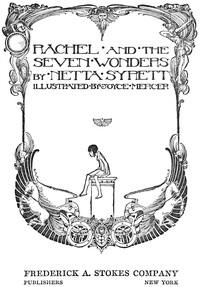
Rachel and the Seven Wonders — A Closer Reading
(0 User reviews)
1234
Project Gutenberg
2021
Not confirmed
Girls -- Juvenile fiction; Magicians -- Juvenile fiction; Seven Wonders of the World -- Juvenile fiction
Readers of public-domain and historical texts
Project Gutenberg digital edition
en
Edition facts
Words
53,039
Reading time
231 min
Text sections
11
Before opening Rachel and the Seven Wonders — A Closer Reading, the edition data offers a quick orientation: 53,039 words, 3 hr 51 min estimated reading time, and 11 detected text sections.
The text analysis averages about 17.1 words per sentence, while the detected sections provide another way to judge how the source is divided.
Project Gutenberg metadata also associates the work with “Girls -- Juvenile fiction,” connecting these edition facts with the source record’s subject description.
Source:
Project Gutenberg record #66321
In Netta Syrett's 1923 novel, a lonely girl in London escapes into visions of the Seven Wonders, guided by a mysterious magician. The story weaves ancient history with a child's emotional journey, using precise sensory details and a framing device that blurs reality and imagination.
Editorial Edition Score
4.8/5
★★★★★
★★★★★
Calculated from edition completeness, EPUB availability, text structure and catalogue metadata. Not a user rating.
How this score is calculated
- Description quality20 pts
- Title & short description10 pts
- Source metadata20 pts
- Text length15 pts
- Chapters / structure15 pts
- EPUB file integrity20 pts
Total of 100 points, scaled to a 2.5-5.0 range. Editions with an empty description or a missing EPUB file are not scored.
Edition quality
Read the Text
had a glimpse of the City " " 114
The Pharos Lighthouse (_Colour_) " " 136
The Olympic Games (_Colour_) " " 160
Rachel was a very unhappy little girl as she sat in an omnibus with Miss Moore, on her way to the British Museum. She didn’t want to go to the British Museum. She didn’t want to be in London at all. She longed desperately to be back in her country home with her father and mother—now, alas! far away in Egypt.
Everything as Rachel said had happened so suddenly. Certainly her mother had been ill some time, but it was all at once decided that the only possible place to send her little daughter in a hurry, was to Aunt Hester, in London.
Aunt Hester, who was her father’s eldest sister, and in the eyes of Rachel, at least, awfully old, was quite kind, but also, as she admitted, quite unused to children. The first thing she did therefore, was to engage a governess to look after her niece for the seven weeks she would have to remain with her.
Miss Moore, a rather uninteresting, middle-aged lady, had duly arrived the previous evening, and at breakfast time Aunt Hester had suggested the British Museum as a suitable place to which Rachel might be conducted.
“She’s never been to London before, and, though I don’t want her to sit too long over lessons, I think she should improve her mind while she is here. The British Museum is an education in itself,” declared Aunt Hester, and Miss Moore had primly agreed.
So it happened that at eleven o’clock on a bright spring morning, a secretly unwilling little girl climbed the steps leading to the great entrance of the great museum. The pigeons on the steps reminded her of the dovecote at home, and the tears came suddenly to her eyes, as almost without thinking she counted the number of birds on the top step.
“Seven,” she murmured half aloud.
“Seven what?” asked Miss Moore.
“Seven pigeons on this step. Aren’t they pretty?” Rachel lingered to look at the burnished shining necks. She would much rather have stayed outside with the pigeons, but Miss Moore hurried on to the swing doors, and Rachel was obliged to follow her into the huge building.
“What do they keep here?” she asked listlessly, when Miss Moore had given up her umbrella to a man behind a counter, just inside.
“All sorts of things,” returned her governess vaguely. “It’s a _museum_, you know.”
Rachel was not very much the wiser but, as she walked with Miss Moore from one great hall to another, she was confused and wearied by the number of things of which she had glimpses. There were rows of statues, cases full of strange objects, monuments in stone all covered with carvings; curious pictures on the walls. Indeed, there _were_ “all sorts of things” in the British Museum! But, as she knew nothing about any of them, and Miss Moore volunteered very little information, she was yawning with boredom by the time her governess remarked:
“Now, _these_ things come from Egypt.”
For the first time Rachel pricked up her ears. Mother and Dad were now in Egypt, and as she glanced at the long stone things like tombs, at drawings and models and a thousand other incomprehensible objects all round her, she wished she knew something about them. Instead of saying so, however, and almost without thinking, she murmured, “This is the seventh room we’ve come to. I’ve counted them.”
“This is the famous _Rosetta_ Stone,” observed Miss Moore, reading an inscription at the foot of a dull-looking broken block of marble in front of them.
Rachel yawned for the seventh time with such vigour that her eyes closed, and when she opened them a queer-looking little old man was bending over the big block.
“What is the date of the month?” he asked so suddenly that she started violently.
“Let me see. The seventh, I think. Yes—the seventh,” she stammered, raising her eyes to his face.
He was so muffled up, that nearly all Rachel could see of him was a pair of very large dark eyes, under a curious-looking hat. He wore a long cloak reaching to his heels, and one end of the cloak was flung over his left shoulder almost concealing his face.
Rachel scarcely knew why she thought him so old, except perhaps, that his figure seemed to be much bent.
“Quite right. It’s the seventh,” he returned. “And what’s the name of your house?”
Rachel looked round for Miss Moore, who strangely enough was still reading the inscription on the stone, and seemed to be paying no attention to the old man’s questions.
Rachel, an unhappy little girl sent to stay with an aunt in London, finds herself dragged to the British Museum against her will. The opening pages establish a sharp contrast between her longing for her country home and the sterile educational regime imposed by Aunt Hester and the governess, Miss Moore. The museum steps, with pigeons that remind her of home, become a threshold between two worlds.
From this reluctant start, the narrative pivots when Rachel meets a magician who transports her—and later a friend—into vivid reenactments of the Seven Wonders. The excerpts show that these visions are not mere fantasy; they are grounded in historical detail, such as the ceremony of cutting a boy's hair in the Temple of Diana. The story's structure hinges on this interplay between a child's emotional reality and the imagined past.
A Child's Unhappiness and the Museum as Escape
The novel opens with Rachel's acute misery: she 'didn’t want to go to the British Museum' and 'longed desperately to be back in her country home.' Her aunt's well-meaning but rigid approach—'she should improve her mind'—clashes with Rachel's grief over her mother's illness and her parents' absence in Egypt. The museum, intended as an educational tool, becomes a site of resistance. Rachel's silent counting of pigeons—'Seven,' she murmurs—introduces a motif of numbers and observation that recurs throughout. The governess, Miss Moore, is described as 'rather uninteresting,' highlighting the lack of emotional connection. This tension between adult intentions and a child's inner world sets the stage for the magical intervention that follows.
The Magician's Role and the Blurring of Time
Mr. Sheston, the magician, appears as a guide who enables Rachel and her friend Diana to witness historical events. In the excerpt from the Temple of Diana, the children see a boy named Dinocrates have his hair cut off in a dedication ceremony. The text emphasizes recognition: Dinocrates 'point eagerly to a row of pillars' and 'felt that somehow or other he was ... mixed up with that temple.' This moment illustrates the novel's treatment of time—past lives echo into the present. Mr. Sheston explains that Dinocrates became a famous architect who rebuilt the temple, linking the boy's ancient experience to the children's modern perception. The narrative does not fully explain the mechanics of these visions, leaving the boundary between imagination and history deliberately porous.
Sensory Details and the Texture of the Ancient World
Syrett builds the ancient settings through concrete sensory cues: 'the sound of chanting voices echoed through the temple,' 'sweet scents floated in the air from burning incense,' and the 'blue sky and the blue sea in the distance.' The description of the little boy—'dressed in a short white tunic, his silky hair falling on either side of his face'—is precise and visual. The cutting of his hair onto a 'silver platter' held by a priestess is rendered with ritualistic gravity. These details ground the fantastical premise in a tangible world. The children's reactions—'amazement and delight'—mirror the reader's immersion. The novel uses such moments to contrast the grayness of Rachel's London life with the vividness of the imagined past, without ever fully resolving which is more real.
Readers should attend to the way Syrett uses the framing device of the museum and the magician to question how history is accessed and felt. The excerpts do not reveal whether Rachel's adventures are literal or metaphorical, but the emotional logic is consistent: each wonder corresponds to a step in her growth. The novel rewards attention to small details—the number seven, the pigeons, the shears—that recur across the narrative. Approach it as a story less about the Wonders themselves than about a child learning to see beyond her own unhappiness.
Some evenings, reading about Rachel’s magician and her shimmering visions, I felt the same hush as when I first opened The Chevalier's daughter — Reading Notes. Both books seem to hold a child’s loneliness in their palms, turning it over gently until it catches the light of distant, improbable worlds. That quiet blur between what is real and what is remembered lingers here too, like dust in a familiar room.
There are no reviews for this eBook.
There are no comments for this eBook.
Reader reflection
What did you think of this book?
Answer a few questions and save a private reflection on this device.
Your progress
0
/
10
2
How did the book work for you overall?
3
Is this a title you would suggest to others?
4
Did the language feel accessible?
5
How strongly did the book affect you emotionally?
6
Do you expect to return to this book?
7
Was the book moving at the right speed?
8
Which element worked best for you?
9
In one sentence, what did you learn?
10