1

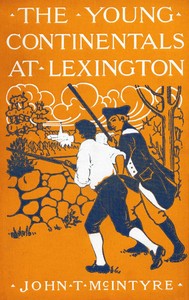
The Young Continentals at Lexington — Story, Setting & Ideas
(0 User reviews)
65
Project Gutenberg
2021
Not confirmed
Historical fiction; United States -- History -- Revolution, 1775-1783 -- Juvenile fiction; Lexington, Battle of, Lexington, Mass., 1775 -- Juvenile fiction
Readers of public-domain and historical texts
Project Gutenberg digital edition
en
Edition facts
Words
61,888
Reading time
270 min
Text sections
28
The catalog record for The Young Continentals at Lexington — Story, Setting & Ideas provides practical reading context through 61,888 words, 4 hr 30 min estimated reading time, and 28 detected text sections.
The text analysis averages about 16.1 words per sentence, while the detected sections provide another way to judge how the source is divided.
Project Gutenberg metadata also associates the work with “Historical fiction,” connecting these edition facts with the source record’s subject description.
Source:
Project Gutenberg record #67004
An editorial note on McIntyre's 1909 juvenile historical novel, focusing on its narrative voice, pacing, and use of dialogue to convey pre-Revolutionary tensions through the perspective of a young protagonist.
Editorial Edition Score
4.8/5
★★★★★
★★★★★
Calculated from edition completeness, EPUB availability, text structure and catalogue metadata. Not a user rating.
How this score is calculated
- Description quality20 pts
- Title & short description10 pts
- Source metadata20 pts
- Text length15 pts
- Chapters / structure15 pts
- EPUB file integrity20 pts
Total of 100 points, scaled to a 2.5-5.0 range. Editions with an empty description or a missing EPUB file are not scored.
Edition quality
Read the Text
more. It was easy to see that his fears were of the worst, but that he had no desire to impart them to his son.
“All this controversy is a struggle,” he said. “And as time draws on, it will grow more bitter.”
“But,” queried Ben, his face alight with anticipation, “do you think it will end in blows being struck?”
But his father was bent over the book. All he would say was:
“No one can predict the outcome of such a thing.”
Ben waited for a moment, thinking he would speak further; but as he did not, the lad shook the reins and Molly loped gaily up the path and off toward the barn.
In the shadow of the coach house a broad-shouldered youth of seventeen was engaged in cleaning a long, shining rifle. He looked up as Ben dismounted and turned the mare over to a hired man.
“Good morning for a ride,” commented he, as he rubbed industriously at the brass butt of the weapon. “Wanted to go over my traps, or I’d have joined you.”
“You missed something,” replied Ben, as he sat upon a sawbuck near the other. “The air is fine upon the road.”
“I know,” smiled the other, “full of sunshine and some other things which you can’t see, but which make you feel like a giant. It’s that way among the hills, up in the Wyoming valley.”
Ben kicked at some chips with the toe of his riding-boot and looked thoughtful.
“You _are_ right,” he said, after a short pause; “there are things in the air this morning--things that maybe you don’t mean. And the nearer I rode to the city, the stronger I felt them.”
The broad-shouldered youth laughed and his gray eyes twinkled.
“Maybe,” said he, “they were bits of Mr. Franklin’s electricity.”
“It might seem odd to you, Nat,” proceeded Ben, without noticing the other’s light words, “but I fancied that the roadside looked different. Everything seemed closer together and secretive, somehow. When the trees rustled in the wind and nodded toward each other, it seemed as though they were whispering mysteriously.”
Again Nat Brewster laughed.
“Ben,” said he, “I think you’ve passed the glen where Mother Babette lives, and that she’s put a spell upon you.”
But Ben paid no attention to the raillery; his round, good-natured face was serious and he went on soberly:
“Of course, I don’t think any of these things are so. They are merely impressions caused by something I did not notice at the time.”
Nat looked at him with more interest. The long rifle lay across his knee, and the burnishing ceased.
“That’s so,” said he. “I’ve often felt like that myself. Sometimes when I’ve tramped alone among the mountains I’ve felt worried about things that I couldn’t give a name. And always something of importance turned up afterward. It was just as though I felt it coming a long way off.”
“That’s it,” said he. “That’s it, exactly.” He paused a moment, then continued, “All along the road the people seemed quiet. Men burning brush in the fields looked strangely at me through the smoke. People in carts who’d usually have something to say just nodded their heads, and seemed to look after me, watchfully. I passed the schoolhouse there at the crossroads and the long drone that always comes from it, of the scholars chanting their lessons, was queer and hushed.”
“It was a strange sort of ride,” commented Nat. “I wish I’d gone with you.”
“I went as far as the ‘Bull and Badger.’ Some farmers were gathered in front of it and some travelers were upon the porch. It was the same with them as with the others. The very inn seemed to be trying to contain some weighty secret; and I turned and rode away without even getting down.”
Ben leaned over and his forefinger tapped his cousin upon the shoulder.
“I was at the gate of this place before I found out what caused it all,” said he.
“What was it?” asked Nat, quickly.
“We’re going to have a war with England,” replied Ben. “It means nothing else.”
TELLS WHY NAT BREWSTER WALKED TOWARD CLIVEDEN IN THE DARK
Nat Brewster settled his stalwart frame back against the coach house wall and, wrinkling his brows, regarded his cousin attentively.
McIntyre opens The Young Continentals at Lexington with a measured, almost leisurely narrative pace that mirrors the slow gathering of revolutionary forces. The early chapters, such as the one in which Nat Brewster observes a stranger in a tavern, rely heavily on extended dialogue and detailed physical description—the stranger's brass buttons, his lounging posture, his cold eyes—to build character and suspense. The voice is formal yet accessible, with a tendency toward understated humor, as when Nat finds the stranger "nothing short of a bore" before the man reveals his political sympathies. This deliberate pacing allows McIntyre to embed historical exposition within natural conversation, a technique that distinguishes the novel from more action-driven juvenile fiction of the period.
Dialogue as a Vehicle for Historical Exposition
McIntyre frequently uses extended exchanges between characters to convey political context without resorting to authorial intrusion. In the tavern scene, the stranger's remarks about "a stubborn and narrow ministry" and the colonies' determination to be "justly dealt by" serve as a compressed lesson on colonial grievances. The dialogue is carefully calibrated: the stranger speaks in measured, almost legalistic phrases ("Modern history does not show anything that can compare"), while Nat responds with cautious agreement, reflecting his gradual political awakening. This technique recurs throughout the excerpts, suggesting that McIntyre trusts his young readers to absorb historical information through character interaction rather than through summary. The conversations often carry a double function—advancing the plot while educating the reader—without sacrificing naturalness.
Shifts in Narrative Pace and Their Effect
The novel's pace varies noticeably between chapters, as indicated by the table of contents. Early chapters like "Shows How Ben Cooper Saw the War a Long Way Off" and "Tells Why Nat Brewster Walked Toward Cliveden in the Dark" promise slow, scene-setting openings, while later titles such as "Nat Brewster is Taken by Foes and Paul Revere Begins His Midnight Ride" signal a quickening tempo. In the tavern excerpt, the pacing is deliberate: the stranger's methodical button-touching and prolonged silences create a sense of watchful tension. McIntyre controls rhythm through paragraph length—short, action-driven paragraphs contrast with longer descriptive passages. This variation likely mirrors the historical transition from political debate to armed conflict, though the excerpts do not reveal how fully this arc is sustained.
The Observer's Perspective: Nat Brewster as Narrative Lens
Nat Brewster functions primarily as an observer in the early chapters, a role that shapes the narrative voice. His internal reactions—disappointment, surprise, attention—guide the reader's interpretation of events. When the stranger's eyes become "steadfastly fixed upon him," Nat's conviction that they are "cruel" colors the description, blending external detail with subjective judgment. McIntyre maintains a close third-person perspective, rarely stepping outside Nat's limited knowledge. This focalization creates a sense of immediacy and uncertainty, as readers experience the unfolding political crisis through a protagonist who is himself still learning. The technique also allows McIntyre to introduce historical figures (such as Paul Revere and Dr. Warren) gradually, as Nat encounters them, rather than through omniscient exposition.
Readers approaching The Young Continentals at Lexington will find a novel that balances historical instruction with character-driven storytelling. McIntyre's use of dialogue and pacing rewards attention to small details—a gesture, a pause, a shift in tone—that reveal the tensions beneath polite conversation. The book is best read not as a fast-paced adventure but as a deliberate, scene-by-scene reconstruction of a world on the brink of change, seen through the eyes of a boy who is just beginning to understand its significance.
That rainy afternoon, I kept returning to how McIntyre lets the boy’s questions carry the weight of history—uncertainty breathing between lines. A footnote later sent me wandering to Reuben Stone's discovery — A Reader’s Guide, and I found the same quiet patience there. One book simply handed me to the next, like tea passing hands.
There are no reviews for this eBook.
There are no comments for this eBook.
Reader reflection
How will you remember this book?
Save your reaction, strongest insight, and memorable passage.
Your progress
0
/
10
2
What was your overall reaction to the book?
3
Is this a title you would suggest to others?
4
Did the language feel accessible?
5
Did it raise ideas you would like to talk about?
6
How distinctive were its ideas or approach?
7
How strongly did the book affect you emotionally?
8
Which aspect of the book did you value most?
9
What did this book teach you most?
10