1

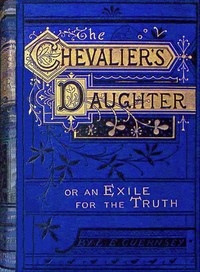
The Chevalier's daughter — Reading Notes
(0 User reviews)
68
Project Gutenberg
2024
Not confirmed
Historical fiction; Huguenots -- France -- Juvenile fiction; France -- History -- Louis XIV, 1643-1715 -- Juvenile fiction
Readers of public-domain and historical texts
Project Gutenberg digital edition
en
Edition facts
Words
124,387
Reading time
541 min
Text sections
12
The source record for The Chevalier's daughter — Reading Notes measures this digital text at 124,387 words, 9 hr 1 min estimated reading time, and 12 detected text sections.
The text analysis averages about 18.2 words per sentence, while the detected sections provide another way to judge how the source is divided.
Project Gutenberg metadata also associates the work with “Historical fiction,” connecting these edition facts with the source record’s subject description.
Source:
Project Gutenberg record #73365
Lucy Ellen Guernsey's historical novel uses a first-person memoir frame, with narrator Vevette's voice shifting between playful banter and grave reflection. The excerpt reveals a distinctive blend of domestic detail, religious tension, and regional dialect, set in 1660s France and Cornwall.
Editorial Edition Score
4.9/5
★★★★★
★★★★★
Calculated from edition completeness, EPUB availability, text structure and catalogue metadata. Not a user rating.
How this score is calculated
- Description quality20 pts
- Title & short description10 pts
- Source metadata20 pts
- Text length15 pts
- Chapters / structure15 pts
- EPUB file integrity20 pts
Total of 100 points, scaled to a 2.5-5.0 range. Editions with an empty description or a missing EPUB file are not scored.
Edition quality
Read the Text
IV. Trust and Distrust
V. Guests at the Tour
VI. The Lonely Grange
VII. A Sudden Summons
XX. "You shall have no Choice"
THE CHEVALIER'S DAUGHTER
I WAS born in the year of grace 1660, at the Tour d'Antin, a château not very far from the little village of Sartilly in Normandy.
My father was the Chevalier d'Antin, a younger son of the Provençal family of De Fayrolles.
My mother was an English lady, daughter of a very ancient Devonshire family. Her name was Margaret Corbet, and the branch of that tribe to which she belonged had settled in Cornwall. I remember her as a very beautiful woman, with crispy waved blonde hair and a clear white skin more like alabaster than marble, and no tinge of color in her cheeks. I never saw any other person so pale as she, though her lips were always red. She had beautiful gray eyes, with long black lashes, and clearly defined arched eyebrows meeting above her nose, which gave a very serious and even solemn expression to her face. This expression accorded well with her character, which was grave and thoughtful and very deeply religious. I never saw any person whose faith was so much like sight as hers. Nevertheless, she could smile very sweetly, and even laugh merrily at times, but not very often. For a shadow hung over our house from my earliest years—the same shadow which darkened so many other French families at that time.
My father was a pleasant, lively, kindhearted gentleman, who worshipped his beautiful wife, and treated her as if she were indeed some fragile statue of alabaster which might be broken by rough usage.
He was, as I have said, a younger son. His elder brother lived far-away in Provence—at least his grand château was there; but he and his wife spent most of their time at court, where they both held offices about the king and queen. By some family arrangement which I never understood, our own Tour d'Antin came to my father, thus putting him in a much more comfortable position than that of most younger brothers, as there was a large and productive domain and certain houses at Granville which brought good rents. Besides, there were dues of fowls and so forth from the tenants and small farmers. Indeed, my father, with his simple country tastes, was far richer than his elder brother, and that though my father's purse was always open to the poor, especially those of our own household of faith.
The Tour d'Antin was a large building of reddish stone, partly fortress, partly château. I suspect it had some time been a convent also, for there was a paved court surrounded by a cloister, and a small Gothic chapel which was a good deal dilapidated, and never used in my time. The fortress part of the house was very old. It consisted of a square and a round tower, connected by a kind of gallery. The walls were immensely thick, and so covered with lichens and wall plants that one could hardly tell what they were made of.
In the square tower my mother had her own private apartment, consisting of a parlor and an anteroom, and an oratory, or closet, as we should call it in England, the last being formed partly in the thickness of the wall, partly by a projecting turret. It seemed an odd choice, as the new part of the house was so light and cheerful, but there was a reason for this choice which I came to understand afterward.
The rooms communicated by a gallery with the newer part of the house, where was a saloon, my father's special study and business room, and various lodging rooms. This same gallery, as I have said, led to the oldest part of the château—the round tower, which was somewhat ruinous, and where nobody lived but the bats and owls, and, if the servants were to be credited, the ghosts of a certain chevalier and his unhappy wife, about whom there was a terribly tragical legend. There was a steep stone staircase leading to the top of the round tower, from whence one could see a very little bit of the sea and the great monastery and fortress of St. Michael.
The Chevalier's Daughter opens with a framing device that immediately establishes a layered narrative: the memoir is presented as a transcription by Rosamond Genevieve Corbet, who discovered her grandmother's papers in a carved cabinet. This structure creates distance between the reader and the events, while the grandmother's first-person voice—colloquial, observant, and occasionally playful—dominates the excerpt. The narrator, Vevette, speaks in a register that mixes domestic practicality with wry humor, as when she compares herself to a pony or teases Andrew about being a jack-of-all-trades. The prose is dense with period detail: hare's-foot charms, knitting-pins forged by a blacksmith, and the specific textures of Cornish village life.
Voice and Register in the Memoir Frame
The grandmother's narrative voice is the most distinctive feature of the excerpt. She shifts easily between registers: bantering with Andrew (“That is a likely story!”), describing her schoolchildren with affectionate precision, and reflecting on religious persecution with quiet gravity. The dialogue is brisk and naturalistic, with contractions and colloquialisms (“I am glad of it,” “as if I could not knit more than one pair of hosen in four weeks”) that give the characters a lived-in quality. The framing narrator, Rosamond, adds a second layer of voice—more formal, explanatory—but the grandmother’s idiom dominates. This dual perspective allows Guernsey to embed historical commentary within a personal, unpretentious account.
Pace and the Rhythm of Domestic Life
The excerpt moves at a measured, episodic pace, mirroring the rhythms of daily routine. A walk to school, a conversation about knitting supplies, a visit to an ailing dame—these scenes unfold without dramatic urgency, yet they accumulate texture. The narrator’s attention to small actions (cutting a hare’s-foot, spinning yarn, curtsying) slows the narrative, inviting the reader into the sensory world of the 1660s. When the pace does quicken, as in the opening escape into bushes, the contrast is striking. Guernsey uses this variation to underscore the precariousness beneath ordinary life: the threat of persecution is always present, but it surfaces only in brief, tense moments.
Setting and Regional Particularity
The Cornish setting is rendered through specific, unglamorous details: “black curly heads and white teeth,” “clean kirtle and apron,” the “old house at St. Wenna’s Well.” The narrator remarks that “Cornwall was and is a country of handsome folk,” grounding the story in a particular geography. The French Huguenot context is introduced through the subtitle and the note about the dauphin, but the excerpt itself focuses on the textures of village life—school, knitting, folk remedies. This juxtaposition of the local and the historical is central to the novel’s method: the grand drama of religious exile is refracted through the small, concrete experiences of a young woman.
Readers attentive to narrative voice will find the grandmother’s memoir a rewarding study in tonal control. The shifts between jest and earnestness, between domestic detail and historical weight, are managed with a light hand. The framing device invites reflection on how memory and transcription shape a story. For those interested in nineteenth-century historical fiction, this novel offers a less sentimental, more granular portrait of Huguenot life than many contemporaries provided.
I’ve often thought Vevette’s stubborn faith, tested in old Cornwall, finds a quieter echo across the sea. Both she and those young Continentals carry a cause not yet proven, weighing duty against fear. It’s a kinship of hesitant courage, I suppose. The Young Continentals at Lexington — Story, Setting & Ideas holds that same trembling dawn before the shot. One remembers such things.
There are no reviews for this eBook.
There are no comments for this eBook.
Reader reflection
What was your reading experience?
Capture what you thought, learned, and would like to remember.
Your progress
0
/
10
2
How did the book work for you overall?
3
Would you pass this book on to a friend?
4
What was the reading difficulty like?
5
What was its emotional impact?
6
What did you appreciate most?
7
How well did it match your expectations?
8
Would you read this book again?
9
What did this book teach you most?
10