1

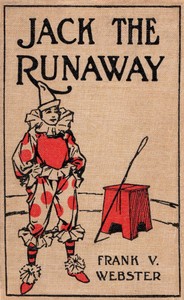
Jack the runaway; or, On the road with a circus — Background and Themes
(0 User reviews)
1387
Project Gutenberg
2022
Not confirmed
Mystery and detective stories; Circus -- Juvenile fiction; Runaway teenagers -- Juvenile fiction
Readers of public-domain and historical texts
Project Gutenberg digital edition
en
Edition facts
Words
47,457
Reading time
207 min
Text sections
31
For Jack the runaway; or, On the road with a circus — Background and Themes, the stored edition analysis reports 47,457 words, 3 hr 27 min estimated reading time, and 31 detected text sections.
The text analysis averages about 14.3 words per sentence, while the detected sections provide another way to judge how the source is divided.
Project Gutenberg metadata also associates the work with “Mystery and detective stories,” connecting these edition facts with the source record’s subject description.
Source:
Project Gutenberg record #68413
Jack Allen, a boy who runs away after a false accusation, joins a circus and must navigate rivalries, accidents, and a cruel ringmaster while trying to prove himself as a clown. The story moves between domestic tension and circus performance, with recurring motifs of falls, collisions, and public humiliation.
Editorial Edition Score
4.9/5
★★★★★
★★★★★
Calculated from edition completeness, EPUB availability, text structure and catalogue metadata. Not a user rating.
How this score is calculated
- Description quality20 pts
- Title & short description10 pts
- Source metadata20 pts
- Text length15 pts
- Chapters / structure15 pts
- EPUB file integrity20 pts
Total of 100 points, scaled to a 2.5-5.0 range. Editions with an empty description or a missing EPUB file are not scored.
Edition quality
Read the Text
ease, Professor Klopper, advance me a dollar from my allowance that dad left with you for me.”
“Not one penny for such a frivolous use as that,” replied the professor firmly. “Now let me hear no more about it.”
“Well, I’m going!” fired back Jack. “I’m bound to see that show, and have a good time once in a while.”
“That will do!” cried the professor so sharply that Jack was startled. “Go to your room at once. I will deal with you later. I never inflict any punishment when I am angry, and you have very nearly made me so. I will attend to your case later. Go to your room at once!”
There was no choice but to obey. Slowly Jack left the library, and mounted the stairs to his own apartment. His heart was bitter, and he was not a little worried concerning his father and mother, for, since Mr. and Mrs. Sylvester Allen had reached China, on their trip around the world, news had been received that there had been serious uprisings against the “foreign devils” as the Mongolians call people not of their race.
Jack Allen, who was a bright, sturdy youth, of about sixteen years, lived in the town of Westville, in one of our Eastern States. He was an only child, and his parents were well off.
Mr. Allen was very fond of travel, and so was his wife, but they had had little chance to gratify their tastes. A short time before this story opens Mr. Allen’s firm had some business to transact abroad, in several countries. Mr. Allen was offered the chance to go, and, as it was a long-awaited opportunity he decided to take his wife, and, while they were about it, make a tour of the world.
Jack begged hard to be allowed to go, but, as it would have broken up his schooling, and as his father wanted him to become an electrical engineer, he was, much against his will, left at home.
Jack attended the Westville Academy, and was one of the best students in that institution. When his parents decided to make their long trip, they discussed several plans of having their son taken care of while they were away. Finally they decided to send him to live with a former college instructor, Professor Klopper, who was an eminent authority on many subjects.
The professor was a bachelor, and, with an elderly sister, lived in a somewhat gloomy house on the outskirts of Westville.
There Jack had been for about a year, attending school in the meanwhile.
He had never liked Professor Klopper, for the aged man was crabbed and dictatorial, and very stern when it came to lessons. He made Jack study more than any other boy who went to the academy, and was continually examining him at home, on what he had learned in school. This, undoubtedly, was good for Jack’s scholarship, but the boy did not like it.
Mr. Allen had arranged that the professor should have complete charge of Jack, and a goodly sum had been left with the scientist for the keep of the boy.
“Give him a little spending money,” Mr. Allen had said to the professor, “and see that he does not waste it.”
The trouble was that the mathematical mind of the professor and the more liberal one of Jack’s father differed as to what a “little spending money” was, and what was meant by “wasting” it.
The consequence was that Jack led a very miserable life with the professor, but he was too manly a lad to complain, so his letters to his parents said nothing about the disagreeable side of his sojourn with the former college teacher.
But, of late, there had come no letters from Mr. and Mrs. Allen. Jack’s boyish epistles had not been replied to, and the professor’s long effusions, containing precise reports as to his ward’s progress, were not answered.
All trace of Mr. and Mrs. Allen was lost when they got to China, though up to now Jack had not worried about them, as he realized that mail in some foreign countries is not as certain as it is in the United States.
“Professor Klopper is the meanest old codger that ever lived!” exclaimed Jack, as he mounted the stairs to his room. “I wish dad and mother would come back. It’s been a long time since I’ve seen them, and things are getting worse here instead of better. The idea of not giving me a dollar!
The first chapter opens with Jack Allen asking his guardian, Professor Klopper, for a dollar to attend a show—a request that immediately establishes the boy’s constrained domestic life and his yearning for spectacle. The professor’s eyes, seen through thick glasses, are compared to “the orbs of a cuttlefish,” a vivid image that signals the story’s habit of blending precise physical description with a slightly comic, exaggerated tone. Within a few pages, Jack is falsely accused, runs away, and boards a freight train, setting in motion a series of scenes that alternate between cramped, threatening spaces (a boxcar, a circus tent’s backstage) and the open, chaotic arena of the ring.
From Library to Boxcar: The Structure of Flight
The narrative moves in swift, episodic jumps. Jack’s initial plea for a dollar is denied, and within a chapter he is on the road, having stolen away after a serious accusation. The story does not linger on his emotional state; instead, it propels him into physical action—a narrow escape from a train, a lost bundle, a chance encounter with a circus. This rhythm of crisis and relocation recurs throughout the excerpts. Each chapter heading signals a new predicament: “Jack Loses Something,” “A Fruitless Search,” “Jack Does a Stunt.” The structure mirrors the restless, improvised life of a runaway, where stability is always temporary and the next scene arrives abruptly.
Recurring Falls and Collisions
Jack’s first performance as a clown is built around a planned fall: he leaps from a springboard, tangles himself in paper hoops, and trots off to laughter. But the act is immediately disrupted by a real collision when another clown, Ted Chester, runs into him with a miniature automobile. The crowd applauds, mistaking the accident for part of the show. This pattern—a controlled stunt giving way to an uncontrolled mishap that is then absorbed into the performance—recurs in the excerpts. Later, Jack is struck by the ringmaster’s whip, an act of cruelty that the audience also misreads as comedy. The story repeatedly blurs the line between intentional clowning and genuine injury, using the circus ring as a space where pain is repackaged as entertainment.
The Ringmaster’s Whip and Other Threats
Otto Mitz, the ringmaster, is introduced through his whip: “the lash came curling toward Jack, but he jumped aside in time to avoid it.” The whip is not merely a prop; it is a weapon that leaves a smarting leg and a sense of humiliation. Jack’s anger at this “needlessly cruel” man fuels his determination to succeed. Yet the threat is not only physical. Ted Chester, the older clown, responds to the accidental collision with a whispered threat: “I’ll have you fired.” The circus world in these excerpts is one of constant surveillance and precarious status, where a misstep can lead to expulsion. Jack must navigate both the visible dangers (the whip, the fall) and the invisible ones (jealousy, accusations of sabotage).
Movement Between Inside and Outside
The story alternates between enclosed, private spaces and the public arena. The library where Jack asks for a dollar is a quiet, book-lined room; the boxcar where he hides is dark and cramped; the circus tent is vast and filled with noise. Each shift in setting changes the rules of behavior. In the library, Jack is a supplicant; in the boxcar, a fugitive; in the ring, a performer under scrutiny. The excerpts emphasize thresholds: Jack jumps from a train, steps into the ring, leaps from a springboard. These moments of crossing—from one space to another, from one identity to another—are the hinges of the plot. The reader is never allowed to settle, just as Jack is never allowed to rest.
Readers should pay attention to how the story uses the circus not just as a setting but as a mechanism for testing Jack’s resilience. The repeated collisions, falls, and misread signals are not random; they form a pattern that questions whether skill or luck determines success in this world. The excerpts leave Jack still vulnerable to the ringmaster’s whip and Ted’s enmity, suggesting that his place in the circus remains uncertain. Watch how the narrative balances Jack’s growing competence against the persistent threats that surround him.
Reading about Jack Allen’s tumbles in the ring, I kept thinking of those quiet, steady laps in The boys of Columbia High in track athletics — Key Ideas to Explore. There, falling isn’t public humiliation, just a rhythm of starting again. It’s a gentler kind of perseverance, the sort where nobody’s watching, and somehow that makes it feel more hopeful. A different shade of resilience.
There are no reviews for this eBook.
There are no comments for this eBook.
Reader reflection
Take a moment to reflect on this book
Create a short personal record of your experience with this book.
Your progress
0
/
10
2
Was reading this book enjoyable?
3
Would you pass this book on to a friend?
4
Did the language feel accessible?
5
How valuable was this book for your own interests?
6
How clearly were the main ideas presented?
7
What was the strongest part of the book?
8
How closely did the book connect with your experience?
9
What changed or sharpened your thinking?
10