1

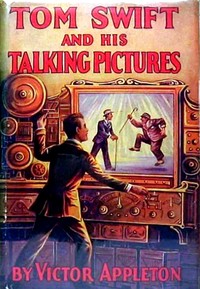
Tom Swift and his talking pictures — Context and Discussion
(0 User reviews)
648
Project Gutenberg
2024
Not confirmed
Adventure stories; Swift, Tom (Fictitious character) -- Juvenile fiction; Motion pictures -- Juvenile fiction
Readers of public-domain and historical texts
Project Gutenberg digital edition
en
Edition facts
Words
49,648
Reading time
216 min
Text sections
5
The source record for Tom Swift and his talking pictures — Context and Discussion measures this digital text at 49,648 words, 3 hr 36 min estimated reading time, and 5 detected text sections.
The text analysis averages about 13.4 words per sentence, while the detected sections provide another way to judge how the source is divided.
Project Gutenberg metadata also associates the work with “Adventure stories,” connecting these edition facts with the source record’s subject description.
Source:
Project Gutenberg record #72578
An editorial note examining Victor Appleton's authorial choices in Tom Swift and His Talking Pictures, focusing on diction, dialogue, and description in the 1928 adventure.
Editorial Edition Score
4.7/5
★★★★★
★★★★★
Calculated from edition completeness, EPUB availability, text structure and catalogue metadata. Not a user rating.
How this score is calculated
- Description quality20 pts
- Title & short description10 pts
- Source metadata20 pts
- Text length15 pts
- Chapters / structure15 pts
- EPUB file integrity20 pts
Total of 100 points, scaled to a 2.5-5.0 range. Editions with an empty description or a missing EPUB file are not scored.
Edition quality
Read the Text
raphs by wireless. Also, in a limited way, television had made it possible for a person in a dark room to be visible to lookers-on in another apartment some distance away.
“But I am going to combine the two!” declared Tom Swift. “I want to make it possible for a synchronized performance of seeing and hearing to take place. Thus when a theater is equipped with my sending apparatus and I have perfected my receiver, one need never go outside the house to enjoy a theatrical performance or a concert.”
“But even if you’re successful, you won’t make any money out of it,” declared Ned Newton, after first hearing of his chum’s ambitions. “Look at the radio people! The air is free. Anybody who wants to can tune in and listen to a million dollar concert without paying a cent. They don’t even have to buy any special kind of receiver—they can roll their own, so to speak. What’s to prevent them from stealing your stuff—your—what do you call it, anyhow?”
“I haven’t settled on a name,” Tom said, with a smile. “Call it talking pictures for the time being. Of course it’s entirely different from moving pictures with phonograph attachment.”
“Well, what’s to prevent any one from tuning in on your talking pictures?” asked Ned.
“This,” answered Tom, pointing to a small tube on one side of the receiving apparatus. “This is a new device. Without it no one can see and hear my pictures that will talk. This is protected by patents and no one can use it without my sanction. That’s the secret.”
“Well, maybe you’ve got something there,” Ned admitted.
So, during the past months, he had helped Tom Swift bring the new apparatus to such perfection as it now had.
The present night’s performance was only one of many. At first there had been only blank failure. But by using different kinds of receiving screens, finally settling on a mirror covered with electrified glass, Tom had achieved a measure of success. Still, even now, the projected image of the singing or talking performer in a distant room was too dim to be commercially successful.
“We’ll go at it again to-morrow,” Tom told his chum as he let him out of the laboratory and locked the door after him.
“It’s the biggest thing I ever attempted,” he said to himself, when Ned had gone and he was alone in the room, “the very biggest, and I’m not going to have it stolen from me. No one suspects as yet what I am working on—no one except dad and Ned. But I wish I were nearer success. I thought the image would come through clear to-night, but there was that same haze—that same haze. I wonder——”
He paused and listened intently. Outside his door he heard footsteps—cautious footsteps.
“Is that you, Ned?” he called. “Anything wrong?”
Tom did not open the door—he was taking no chances.
“That you, Ned?” he asked again, more sharply.
“No, Mr. Swift,” came back a voice with a foreign accent. “I am just leaving my own laboratory. I think I have perfected that new magnetic gear shift we have been working on.”
“That’s good,” Tom responded. He recognized the voice of Jacob Greenbaum, a clever inventor whom he had recently engaged to work on some side lines that occupied the Swift factory. Tom had an idea for a new device to make easier the shifting of gears on automobiles. It was an adaptation of the old magnetic selection that has often been tried and which, up to date, had not been successful.
“Do you want to take a look at it?” asked Greenbaum, and from the nearness of the voice Tom knew that the man was just outside the locked door.
“No, thank you, Greenbaum, not now,” the young inventor replied. “I am busy at something else. I’ll see you in the morning.”
“You are working late, Mr. Swift,” went on the man. “Could I be of any service to you? I should be glad——”
“No, thank you,” Tom said. “As for lateness, you are doing a bit of overtime yourself.”
“Oh, yes; but I do not mind. I think I am on the right track. If you would take a look——”
“No, not now,” and Tom’s voice was a bit sharp. “I am busy. Good night!”
There was no response for a moment, and then came a short:
Greenbaum, however, did not immediately move away from the door and a look of annoyance passed over Tom’s face as he bent over his secret apparatus.
Victor Appleton opens Tom Swift and His Talking Pictures with a laboratory scene that immediately establishes the series' signature blend of technical jargon and colloquial banter. Ned Newton's breathless entrance and his question—"Do you seem to be getting anywhere with it, Tom?"—sets a tone of collaborative inquiry. The description of the apparatus as "a complicated apparatus of wires, switches, and radio bulbs that glowed dimly" grounds the invention in tangible, period-specific detail. Appleton's diction favors concrete nouns and active verbs, avoiding abstract exposition. Dialogue carries much of the narrative weight, revealing character through idiom: Tom's "Well, so much for that" and Ned's banking concerns show a practical, problem-solving mindset. The author also uses physical description sparingly but effectively, as when Koku's speech is rendered in dialect—"Nobody come right away"—to mark his foreignness and strength. These choices create a brisk, action-oriented style that prioritizes plot momentum over introspection.
Dialogue as a Driver of Plot and Character
Appleton relies heavily on dialogue to advance the story and define relationships. Conversations between Tom and Ned are laced with technical shorthand—"I have my machine set up again after the explosion"—and financial pragmatism, as when Ned questions borrowing money. The exchanges are brisk, rarely exceeding a few lines, and often end with a decision or action. Tom's speech is direct and authoritative; Ned's is more cautious, providing a foil. Minor characters like Koku are distinguished by dialect: "Me guard!" and "Nobody git past without me punch him." This linguistic marking is a deliberate authorial choice to signal otherness and simplicity. The dialogue also serves as a vehicle for exposition: Tom explains his invention's progress through conversation rather than narration. This technique keeps the reader engaged while conveying necessary information, a hallmark of the series' formula.
Descriptive Economy in Setting and Action
Appleton's descriptions are functional and focused on objects that matter to the plot. The laboratory is sketched with a few details—"wires, switches, and radio bulbs"—enough to suggest a workshop without slowing the pace. Settings like the plant's fence with "electrically charged wires" are described only to explain their defensive role. Action sequences are similarly lean: "Tom hurried out to intercept Greenbaum" conveys movement without embellishment. The author avoids lengthy scene-setting, preferring to let dialogue and events create atmosphere. This economy extends to character descriptions; Koku's size is implied through his speech and Tom's reference to "the weight of that mighty fist." Appleton trusts readers to infer from context, a choice that keeps the narrative swift and accessible.
Recurring Motifs of Secrecy and Security
A persistent theme in the excerpts is the protection of Tom's invention. The laboratory is guarded by Koku, who is instructed to admit only Tom, Ned, and Tom's father. The plant is surrounded by a "high and strong fence" with electrified wires. Tom reflects on keeping "the secret among as few as possible." These details recur across chapters, reinforcing the value of the talking-picture machine and the threat of industrial espionage. Appleton uses security measures as both plot devices and character cues: Tom's caution shows his maturity, while the giant's loyalty is demonstrated through his guarding role. The motif also creates tension, as readers know that despite precautions, danger is imminent. This pattern of secrecy and breach is a structural staple of the Tom Swift series, and here it is woven into the fabric of the narrative through repeated, specific references.
Voice and Narrative Rhythm in the Series Formula
Appleton's narrative voice is consistent with earlier Tom Swift books: third-person, past-tense, with a focus on external action. Internal thoughts are rare; when Tom "ruminated" or "thought the matter over," the narration quickly returns to observable events. The rhythm alternates between dialogue-heavy scenes and brief descriptive passages, maintaining a pace suited to young readers. Sentences are generally short and declarative, as in "That was quick work" or "It was not long before the destroyed parts had been remade." The author avoids complex syntax or literary flourishes, prioritizing clarity. This voice is a deliberate authorial choice to support the series' brand of adventure fiction, where invention and peril drive the story. The excerpts show no deviation from this formula, suggesting that Appleton adhered closely to the established template for the Tom Swift franchise.
Readers approaching Tom Swift and His Talking Pictures will find a narrative driven by brisk dialogue and functional description, where every word serves the plot. Appleton's authorial choices—from the use of dialect to mark characters to the recurring emphasis on secrecy—create a consistent, fast-paced adventure. The excerpts offer a clear window into the series' enduring formula: invention, threat, and resolution, delivered with economy and energy.
That afternoon, rain blurred the windows while I traced Appleton’s crisp diction in Tom Swift and His Talking Pictures, noticing how every sound effect felt staged. The careful artifice made me wonder about quieter adventures. Later, I found Roy Blakeley's roundabout hike — Key Ideas to Explore waiting nearby—a gentler, wandering pace that felt like stepping outside after the reel ended.
There are no reviews for this eBook.
There are no comments for this eBook.
Reader reflection
Take a moment to reflect on this book
Create a short personal record of your experience with this book.
Your progress
0
/
10
2
Was reading this book enjoyable?
3
Is this a title you would suggest to others?
4
How easy was the book to follow?
5
Would you read this book again?
6
Could you apply anything you learned?
7
How understandable was the text?
8
Did you relate to its people, ideas, or situations?
9
What changed or sharpened your thinking?
10