1

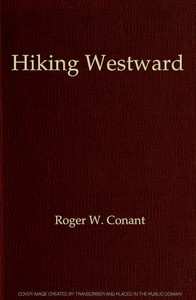
Hiking Westward Being the Story of Two Boys Whose Ambition Led Them to Face Privations and Hardships in Their Quest of a Home in the Great West — Key Ideas to Explore
(0 User reviews)
1029
Project Gutenberg
2019
Not confirmed
Frontier and pioneer life -- Juvenile fiction; Mothers and sons -- Juvenile fiction; West (U.S.) -- Juvenile fiction; Families -- Juvenile fiction; Self-reliance -- Juvenile fiction; Pioneer children -- United States -- Juvenile fiction
Readers of public-domain and historical texts
Project Gutenberg digital edition
en
Edition facts
Words
80,823
Reading time
352 min
Text sections
39
Before opening Hiking Westward Being the Story of Two Boys Whose Ambition Led Them to Face Privations and Hardships in Their Quest of a Home in the Great West — Key Ideas to Explore, the edition data offers a quick orientation: 80,823 words, 5 hr 52 min estimated reading time, and 39 detected text sections.
The text analysis averages about 15.0 words per sentence, while the detected sections provide another way to judge how the source is divided.
Project Gutenberg metadata also associates the work with “Frontier and pioneer life -- Juvenile fiction,” connecting these edition facts with the source record’s subject description.
Source:
Project Gutenberg record #58601
An editorial note examining the authorial choices in Roger W. Conant's 1920 frontier novel, focusing on the boys' dialect, the guide's instructional tone, and the use of concrete details like the improvised stone stove to convey self-reliance.
Editorial Edition Score
4.9/5
★★★★★
★★★★★
Calculated from edition completeness, EPUB availability, text structure and catalogue metadata. Not a user rating.
How this score is calculated
- Description quality20 pts
- Title & short description10 pts
- Source metadata20 pts
- Text length15 pts
- Chapters / structure15 pts
- EPUB file integrity20 pts
Total of 100 points, scaled to a 2.5-5.0 range. Editions with an empty description or a missing EPUB file are not scored.
Edition quality
Read the Text
“Hurry and finish your suppers; we want you to go canoeing,” exclaimed one of the girls. Then, as she noticed that Mrs. Porter seemed about to refuse, she added: “Now you mustn’t say ‘no,’ Momsy Porter. It’s concert night, and we can’t go unless you let Sallie and Margie and the boys go, mother said so.”
“We’re going to sow wheat instead,” asserted Margie.
“That will do, daughter,” rebuked her mother. “I—”
“You will let them, won’t you?” begged another girl.
“Yes. Dr. Blair is coming to talk with me, so I shall not be left alone.”
With a swish of skirts the girls swooped upon the frail little woman, almost smothering her with their hugs and kisses, then rushed away, her “be careful!” ringing in their ears as they trooped off, the boys trailing behind, their arms loaded with cushions.
Sallie’s remark about her brother’s absorption in his nine might have been applied with equal truth to every boy in the Parker School. When any of them met, the playing of the team was the one topic of conversation, especially since, under Phil’s leadership, there was the possibility of the interscholastic championship coming to Parker School, an honour which had not been attained for almost ten years.
It was but natural, therefore, that, with the captain of the team as their companion, the boys should deluge him with questions, and they did.
“Honestly now, Phil, do you think Parker can beat Mercer Academy?” asked one of them. “If our pitchers work well, we ought to.”
“If our pitchers work well,” repeated another, in amazement. “What’s the matter with you, Phil? Aren’t you the best pitcher in the school league, according to the coaches? Why, you did the most of the work last season and you’ve done all of it, practically, this year. And then you say if our pitchers go well we may win.”
“What’s up, anyhow?” demanded several of the others, astounded at the words of their captain.
“There’s going to be a change in the team,” replied Phil, quietly.
This statement elicited a veritable avalanche of comment and questions, but to them all the captain of the team would make no reply except to tell them to wait and see.
This answer was so unsatisfactory, serving as it did only to whet their curiosity the more, that finally Phil broke away from his companions and hurried ahead to join the girls. Yet no sooner had he caught up with them than he wished he had remained behind.
“Hello, Farmer Phil!” cried several of them, as they caught sight of the popular pitcher. “How’s crops? What’s the latest quotation on wheat?”
For the moment he thought to rebuke his sisters for disclosing the plan which he had intended to keep secret, at least until he should announce it on the morrow to his team-mates.
But Sallie and Margie wisely kept on the side of their companions farthest from him, and so riotous did the badinage become that Phil soon realized that anything he might say would only make the matter worse. Yet the glance he threw at his sisters was eloquent.
“Oh, you needn’t blame Marg or Sallie,” exclaimed one of the others. “I heard part of what you said before I entered the dining-room. So I bullied Marg into supplying the missing links.”
By this time the rest of the fellows had caught up, and the group quickly divided into couples, all of them talking excitedly over the surprising bits of news.
As they proceeded toward the boathouse, Phil was seemingly unconscious that he was walking beside the girl who had sought to appease his wrath against his sisters, and so absorbed was he in his own thoughts that it was not until she spoke that he was aware of her presence.
“I think it is perfectly splendid,” she exclaimed, tenderly.
“What?” demanded Phil, almost savagely.
“Why, your giving up the captaincy of the school team when you are certain to win the championship, just to help your mother.”
“Splendid nonsense! I should be worse than a cad if I didn’t.”
“But you could wait about going out West until after school closes, you know, and then you wouldn’t sacrifice the honour of bringing the championship to Parker.”
“You mustn’t say such a thing,” returned the boy, in a tense voice, as he heard with revulsion the very idea expressed in cold words which had been persistently surging through his mind.
“Why not, pray? I am as keen to have Parker land the championship under your captaincy as you are yourself, and what difference would a few weeks—it’s only seven—make to your mother? Besides—”
From the opening dialogue of Hiking Westward, Roger W. Conant establishes a clear contrast between the boys' fanciful ambitions and the practical demands of frontier life. When Mrs. Porter asks how her sons would support the family, Phil answers "Play ball" and Ted "Be an aviator"—responses that the sisters immediately dismiss as impractical. This exchange, with its snappy back-and-forth and the girls' exasperated interjections, sets up the central tension: the Porter boys must learn to replace boyish dreams with the hard skills of homesteading. Conant's authorial choices in diction and dialogue consistently reinforce this theme, as the narrative moves from the family's urban home to the raw landscape of a quarter section in the West.
Dialogue as a Marker of Growth
Conant uses dialogue not merely to advance plot but to chart the boys' evolving competence. Early in the excerpt, Phil and Ted speak in short, impulsive bursts—"Play ball," "Be an aviator"—that reveal their immaturity. By the time they reach their claim, their speech has shifted to include practical concerns: "There is a brook, to the right, from which we can get water for irrigation." The contrast is sharpened by the guide Andy's terse, instructional replies. When Phil complains about trees, Andy retorts, "You didn't expect plowed ground, did you?" His bluntness mirrors the unforgiving environment. The author avoids long, explanatory passages; instead, he lets the characters' words carry the weight of their learning curve. The boys' final toast—"And here's success, and the best of it to you!"—is spoken "silently and solemnly," a marked departure from their earlier flippancy.
Instruction Through Action: The Guide's Voice
Andy, the land agent, functions as a conduit for frontier know-how, and Conant renders his lessons through vivid, step-by-step description rather than abstract advice. When the boys realize they have no stove, Andy does not scold; he demonstrates: "selecting a thin flat stone, built others up on three sides and placed the first one upon them." The author's choice to include the precise dimensions of the bough hut—"ten feet long, five wide and six high"—and the instruction to "always hang your provisions up" grounds the narrative in tangible details. Andy's warning about fire—"Always put out your fire—and see that it is out"—is delivered with a dash that mimics a pause for emphasis. These passages read almost like a manual, but Conant keeps them organic by embedding them in the characters' immediate needs. The result is a story that teaches without lecturing, a deliberate authorial strategy for a juvenile audience.
Concrete Details Over Emotional Description
Conant rarely tells readers how the boys feel; instead, he shows their emotional state through physical actions and sparse commentary. When the boys first see their claim, they are "too deeply affected to speak for many minutes." The author does not elaborate on their awe or fear—he lets the silence speak. Phil's protest, "But the trees," and Ted's quick defense, "I think it is perfectly bully!" reveal their differing temperaments without internal monologue. The description of building the hut is methodical: "cutting poles, placing them and thatching a hut of boughs." Even the meal scene—"crackers, jam, and pickles"—is presented as a simple list, emphasizing the meager resources. This restraint is a deliberate authorial choice: by focusing on what the boys do rather than what they feel, Conant underscores the theme of self-reliance. The reader infers the emotional weight from the characters' actions, not from authorial commentary.
The Foreword as a Contract with the Reader
Conant's foreword is an unusual authorial intrusion that shapes how the story should be read. He states that the book is "really a chapter taken out of the lives of two wide-awake American boys" and that it presents "a true picture of early pioneer days." By revealing that the story originally appeared under a pen name and was revised, he signals a commitment to authenticity. The language of the foreword—"face their difficulties with a smile," "work like Trojans"—echoes the boys' own determined dialogue, creating a consistent voice between author and characters. Conant also explicitly states the moral: "the love which they bear their mother" drives their every act. This directness is typical of early 20th-century juvenile fiction, but Conant's choice to frame the story as a "true picture" rather than a mere adventure tale sets expectations for a realistic, instructional narrative. Readers are thus primed to view the boys' struggles as instructive examples.
Readers approaching Hiking Westward will find a narrative that values doing over telling. Conant's prose is lean, his dialogue functional, and his descriptions precise. The book rewards attention to small details—the way a stone stove is built, the exact dimensions of a bough hut, the specific provisions packed. These are not decorative flourishes but the building blocks of the story's central lesson: that self-reliance is learned through concrete actions, not abstract ideals. The author's choices consistently reinforce this theme, making the novel a useful artifact for understanding how early 20th-century juvenile fiction taught resilience through example.
I keep thinking about those boys and their stone stove, how they built something lasting from whatever the trail offered. It reminded me of another kind of first foothold, a young man learning that the bottom rung still holds weight. That quiet patience, that same stubborn craft of making do—Frank Merriwell's First Job; Or, At the Foot of the Ladder — Key Ideas to Explore carries a similar warmth, like two voices humming the same old tune.
There are no reviews for this eBook.
There are no comments for this eBook.
Reader reflection
What was your reading experience?
Capture what you thought, learned, and would like to remember.
Your progress
0
/
10
2
How much did you enjoy the reading experience?
3
Would you encourage someone else to read it?
4
How easy was the book to follow?
5
How closely did the book connect with your experience?
6
Did anything about the book feel genuinely new?
7
Was the book easy to understand?
8
How much did the book move you?
9
What changed or sharpened your thinking?
10