1

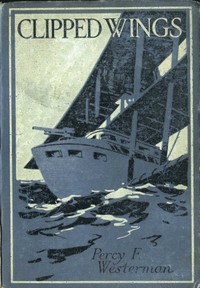
Clipped Wings — Story, Setting & Ideas
(0 User reviews)
70
Project Gutenberg
2019
Not confirmed
Sea stories; Sailors -- Juvenile fiction; Warships -- Juvenile fiction
Readers of public-domain and historical texts
Project Gutenberg digital edition
en
Edition facts
Words
74,132
Reading time
323 min
Text sections
10
Clipped Wings — Story, Setting & Ideas can be approached with a clearer sense of reading commitment from its source measurements: 74,132 words, 5 hr 23 min estimated reading time, and 10 detected text sections.
The text analysis averages about 15.9 words per sentence, while the detected sections provide another way to judge how the source is divided.
Project Gutenberg metadata also associates the work with “Sea stories,” connecting these edition facts with the source record’s subject description.
Source:
Project Gutenberg record #60311
Percy F. Westerman's 1920s naval adventure follows Royal Navy officers posing as tramp steamer crew on a decoy ship, with scenes shifting from Portsmouth harbour to South American rivers and aerial combat.
Editorial Edition Score
4.8/5
★★★★★
★★★★★
Calculated from edition completeness, EPUB availability, text structure and catalogue metadata. Not a user rating.
How this score is calculated
- Description quality20 pts
- Title & short description10 pts
- Source metadata20 pts
- Text length15 pts
- Chapters / structure15 pts
- EPUB file integrity20 pts
Total of 100 points, scaled to a 2.5-5.0 range. Editions with an empty description or a missing EPUB file are not scored.
Edition quality
Read the Text
Cavendish was nearly twelve months senior to Peter Corbold. In height he was a full two inches shorter, and lacked the breadth of shoulder and massive limbs of his chum. Peter's features were dark, and might be described as ruffled; Cavendish's were fair and rounded. Peter was essentially a thinker; the other was a man of action, with an impulsive temperament. In short, they had little or nothing in common, as far as build, appearance, and characteristics went, but they were close chums.
"Nothing to apologize for, old son," rejoined Peter. "There's no such luck for me--even to the extent of becoming the master of a barge. There's nothin' doin' afloat for a has-been naval bloke nowadays. There are far too many Mercantile Marine fellows on the beach looking for jobs as it is."
"That's a fact," admitted his chum soberly.
Cavendish was one of the lucky ones, although, with his characteristic honesty, he could form no idea why his name should have been "ear-marked" for retention in the Service. He had not shone in his exams. More than once he had got into scrapes, harmless enough, during his career at Dartmouth. Perhaps it was the fearless, almost foolhardy feat he had performed in mid-Atlantic, when he took the _Baffin's_ second cutter alongside a burning tanker--a German--and rescued seven survivors from a raging inferno, that had been a deciding factor in his retention.
Probably he alone of all the officers knew the precarious state of Peter Corbold's finances and the gloomy outlook that confronted him. So much he gathered by "putting two and two together". Peter was not a fellow to moan and whine, but was inclined to reticence on the matter.
"What are you going to do, old thing?" he demanded abruptly.
"Haven't any plans," replied Peter. "At least, nothing definite to work upon. Probably I'll go abroad."
"Canada or Australia?"
Corbold shook his head.
"No; I've been thinking of going to Rioguay," he replied. "I've an uncle out there. Mining engineer--nitrates, I believe, but I'm not sure."
"Rioguay? Where's that?" inquired Cavendish. "Somewhere in South America, isn't it?"
"Quite a flourishing little republic," declared Peter. "It has been going steadily ahead ever since that little scrap with Brazil. People are mostly of Spanish and Indian descent, of course, but there's a fair sprinkling of pure Europeans, I've been told."
The shrill notes of a bugle interrupted Corbold's words. Instantly, every officer and man upon the _Baffin's_ deck stiffened to attention, the white-helmeted marine detachment drawn up aft presenting arms with the regularity and precision of a well-oiled machine.
The light cruiser had entered Portsmouth Harbour and was now abreast the blackened ruins of what was once the semaphore tower. Ahead and on the starboard bow appeared three tapering masts above a block of yellow-bricked offices. At the mizzen-truck fluttered a white flag with a St. George's Cross. Quickly the rest of the vessel came into view--a comparatively small black-hulled ship with triple bands of white--lying, not riding to the tide, but in a dry dock, in which she is fated to remain as long as her planks and timbers hold together.
A few seconds later and again the bugle blares out--this time to "carry on". The _Baffin_, as does every vessel belonging to His Majesty's navy that passes that way, has paid her homage to the renowned _Victory_. Past the huge building slip--from which, until the Washington Conference left it untenanted and derelict, a ceaseless procession of noble battleships sped to make their first acquaintance with the ocean--the _Baffin_ glided. Then, under port helm, she turned her lean bows towards the gigantic lock through which she must pass to gain her allotted berth. Ahead were warships of every size and condition; battle-scarred capital ships that had borne the brunt of Jutland, gigantic seaplane-carriers, battle cruisers, light cruisers, P-boats, destroyers, and submarines--forlorn, neglected, and condemned to the scrap-heap. No longer did the once-busy dockyard resound to the ceaseless rattle of pneumatic hammers as the "maties" toiled to contribute their not inconsiderable share to the supremacy of the Empire.
"You mark my words, old son," exclaimed Cavendish, "some day we'll be sorry we've scrapped these ships. We'll want them pretty badly. People talk of air power being the predominant factor, and that the battleship is a back number! It's sea power that counts, has counted from the beginning of history, and will do so till the end."
Three months later, Peter Corbold saw Rioguayan territory for the first time. Acting upon a laconic cablegram from his uncle, Brian Strong, he had taken a passage in a Royal Mail steamer as far as Barbadoes, transferring at that point to one of the fleet of small vessels plying between the West Indies and the numerous ports on the Rio Guaya.
The story opens not with a recruiting poster but with a light cruiser named Baffin approaching Portsmouth, its technical specifications—displacement, speed, armament—given as precisely as a Jane's entry. Within pages, the setting shifts to a tramp steamer, the Complex, whose crew are naval officers in disguise, struggling to look less smart. The contrast between the crisp cruiser and the deliberately shabby merchantman sets up a central tension: the performance of ordinariness under extraordinary orders.
Disguise and the Divided Deck
The opening chapter establishes a peculiar double consciousness. Aboard the Complex, Captain Meredith tells the newly arrived Cavendish that his rig is “too smart and too new” and suggests “toning it down with a little tar.” The sailors, meanwhile, must unlearn naval habits: one man is reprimanded for giving a proper salute. The ship itself has been hurriedly renamed, its armament concealed in “elaborately concealed mountings.” Westerman dwells on the material details of disguise—the cost of a second-hand outfit, the gunner’s mate who knows where to buy cheap clothes—making the reader aware that every surface is a lie. The deck becomes a stage where rank must be hidden, and the effort of pretending to be a merchant seaman is as absorbing as any battle.
Movement Between Elements
The table of contents promises a restless journey: from the Complex to the Rio Guaya, over the Sierras, into the air in a flying-boat, and back to home waters. The chapter titles themselves form a kind of itinerary—“Up the Rio Guaya,” “Over the Sierras,” “The Passage Perilous”—and the action moves between sea, river, mountain, and sky. Westerman does not settle in one element. The flying-boat appears early as “The Super Flying-boat,” and later chapters pair seaplanes with destroyers. The illustrations listed—making up the river, Peter tackles the sentry, a blaze of dazzling beams—suggest a narrative that cuts rapidly from cockpit to deck to jungle. This constant shift in setting keeps the reader oriented not by place but by the next mode of transport.
Recurring Details of Naval Craft
Westerman’s prose is thick with the specificities of ships. The Baffin is given as “9900 tons displacement, 30 knots speed, and armed with seven 7.5-inch and twelve 3-inch guns.” Later, the Complex carries “one 4.7, four 12-pounders, and a couple of 3-pounder high-angle guns.” These details are not mere decoration; they anchor the fiction in a world of exact tonnages and gun calibers. The reader is expected to know what a 4.7-inch gun is, or to recognize that a “tripod mast with a decidedly ugly raking top” signals a particular class of warship. This technical vocabulary creates a texture of authenticity, even as the plot veers into improbable adventure. The ships are characters in their own right, each with a history of refits and disguises.
The Rhythm of Concealment and Revelation
Throughout the excerpt, information is doled out in layers. The Complex is not what it seems; its crew are not who they appear; even the ship’s name has been painted over. Cavendish learns that the hardest part of the job “was not to be smart, and to forget that he was an officer of the Royal Navy.” This theme of hidden identity extends to the narrative structure: the reader is given enough to understand that a deception is underway, but the full plan—the “secret” of Uncle Brian, the purpose of the decoy ship—is withheld. Westerman uses this rhythm of partial revelation to maintain suspense. Each new scene peels back another layer of disguise, whether it is a sailor’s forgotten salute or a ship’s false name, keeping the reader alert to the gap between appearance and reality.
Voice and the Vernacular of the Lower Deck
The dialogue in the opening pages is brisk and idiomatic. Captain Meredith calls Cavendish “Weeds” and tells him to “try toning it down with a little tar.” Seton greets him with “Cheerio, George!” and boasts of getting his kit “in the Ditches for something like half a dozen Bradburys.” The sailors speak in a compressed, knowing slang—“pukka naval salute,” “the Old Man,” “sculling around”—that signals insider knowledge. Westerman uses this vernacular to create a sense of a closed world, where rank is both rigid and playfully subverted. The contrast between the formal naval report of the Baffin and the casual banter of the Complex’s crew is deliberate: the story moves between official and unofficial registers, between the public face of the service and the private jokes of men in disguise.
Readers coming to Clipped Wings should expect a narrative that values technical accuracy over psychological depth, and that moves quickly between settings without lingering. The pleasure lies in watching the machinery of deception operate—the false names, the hidden guns, the rehearsed carelessness. Pay attention to the ships themselves: their tonnages, their armaments, their disguises. Westerman trusts his audience to keep up with the jargon and the jumps, and the story rewards that trust with a steady current of action.
Rain found the tin roof while I turned pages of Westerman’s Clipped Wings, imagining that Portsmouth drizzle. Later, the same grey light made me think of hidden compartments and old secrets, so I pulled down Tom Swift and his chest of secrets — Context and Discussion. Both felt like rainy-day discoveries, quiet and durable, the way certain stories stay.
There are no reviews for this eBook.
There are no comments for this eBook.
Reader reflection
Before you leave, reflect on the book
Use these questions to collect your thoughts before moving on.
Your progress
0
/
10
2
Was reading this book enjoyable?
3
Would you encourage someone else to read it?
4
Did the language feel accessible?
5
Was the book what you thought it would be?
6
Is this a title worth rereading?
7
Did this book create an emotional response?
8
Which part made the strongest impression?
9
What did this book teach you most?
10