1

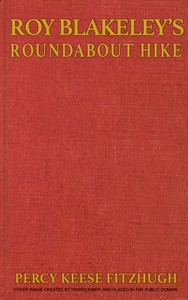
Roy Blakeley's roundabout hike — Key Ideas to Explore
(0 User reviews)
266
Project Gutenberg
2025
Not confirmed
Adventure stories; Hiking -- Juvenile fiction; Boy Scouts of America -- Juvenile fiction
Readers of public-domain and historical texts
Project Gutenberg digital edition
en
Edition facts
Words
49,626
Reading time
216 min
Text sections
5
The source record for Roy Blakeley's roundabout hike — Key Ideas to Explore measures this digital text at 49,626 words, 3 hr 36 min estimated reading time, and 5 detected text sections.
The text analysis averages about 13.8 words per sentence, while the detected sections provide another way to judge how the source is divided.
Project Gutenberg metadata also associates the work with “Adventure stories,” connecting these edition facts with the source record’s subject description.
Source:
Project Gutenberg record #75164
Percy Keese Fitzhugh's 1927 Boy Scout adventure, narrated by Roy Blakeley in a rambling, self-deprecating first-person voice, follows a chaotic hike that tangles with a movie crew, spaghetti experiments, and Pee-wee Harris's relentless chatter. The prose relies on digressive humor, mock arithmetic, and running gags about heroism.
Editorial Edition Score
4.7/5
★★★★★
★★★★★
Calculated from edition completeness, EPUB availability, text structure and catalogue metadata. Not a user rating.
How this score is calculated
- Description quality20 pts
- Title & short description10 pts
- Source metadata20 pts
- Text length15 pts
- Chapters / structure15 pts
- EPUB file integrity20 pts
Total of 100 points, scaled to a 2.5-5.0 range. Editions with an empty description or a missing EPUB file are not scored.
Edition quality
Read the Text
pulled it around and before I could let go of Pee-wee’s leg down he came kerflop into the water. I grabbed hold of his hat and pulled it down over the head of the fellow who was hanging on to the boat so he couldn’t see and he let go and then the next minute he and Pee-wee were trying to climb up over the same side of the boat and it was getting swamped and Dud and I were laughing and the kid was sputtering and----
_Oh boy_, there goes the dinner gong. I should worry about this chapter.
Now I’m going to write another chapter till I have to go to scout meeting. I have to get there at eight o’clock, but if I don’t get there till seven it won’t make any difference. Even if I didn’t get there at all, Pee-wee would be satisfied, but most always he’s never satisfied, especially about eats; say it with eats, that’s his motto. Anyway, this story isn’t about Bridgeboro where I am now; it’s about Temple Camp. Bridgeboro is where I live, it’s a good place to start out from, I’ll say that much for it. Anyway, I’ve had some pretty good fun there. I live in a dandy big house, it’s a two part house, it’s got an inside and an outside and I like the outside best, because it’s bigger--anyway, this story isn’t about Bridgeboro.
So then the four of us decided that as long as we were in a grand mixup together we’d stick together and have a hike the next morning. And that’s what this story is about--that hike. Some hike! The other fellow, the one that had on a bathing suit, was named Egg Sandwich and I guess that’s why Pee-wee wanted him to go. That wasn’t really his name; his name was Egbert Sanderson, but everybody called him Egg Sandwich for short. He comes from Rye, New York, so I guess he’s made of rye bread, but anyway, I like frankfurters better.
I said, “Now we have to hang together separately, because fate has thrown us together.”
“You think you’re smart talking like a book,” Pee-wee said. He was all wet and shivering, jiminies he looked awful funny.
“You’d better go up to your patrol cabin,” I told him, “and get some dry clothes on and we’ll row around and wait for you. You’re _shaking all over from head to foot_, you remind me of a milk shake and you needn’t ask me if I got shaking all over from head to foot out of a book, because I got it out of an ash barrel.” That kid thinks whenever I use dandy language I got it out of a book. He doesn’t know I’m such a famous author, I’m the only one that knows it, that proves I’m smarter than anybody else, because I know something that nobody else knows. “Go on up, we’ll wait for you,” I said.
I bet you like this story already, hey? But only you just wait, it’s going to be even worse.
So, now, kind of, while we’re waiting for Pee-wee to come back, I’ll tell you about us, because we’re the ones you’re going to be with for a whole lot of chapters--you should worry about Temple Camp. But it’s one dandy place, I’ll say that. They have as many as four hundred Scouts there to say nothing of trustees and scoutmasters--why should I say anything about them? I mind my business and they mind mine. Chocolate Drop, he’s cook, and I mind his business, believe me. Two helpings of dessert--_yum, yum_!
Roy Blakeley narrates his own story in a voice that announces its unreliability from the first page: “Every time I start telling you about one of our hikes, I say it’s the craziest hike I ever took. I guess it’s true, because they’re all crazier than each other.” The prose is built on digressions, mock-logic (long division versus short division), and a running joke that the hike has “no brakes at all.” Fitzhugh lets Roy’s narration wander into asides about spaghetti experiments, the proper way to eat licorice, and the impossibility of reading a book “too hard.” The result is a comic, self-aware adventure that treats its own plot as secondary to the narrator’s personality.
A Narrator Who Won’t Stay on Trail
Roy’s first-person voice is the book’s central device. He interrupts himself constantly, offers mock arithmetic to prove a point (“If there are a lot of things and each one of them is crazier than the other, that shows they’re all the craziest”), and treats the hike as an excuse for wordplay. The proclamation he tacks up on the bulletin board is typical: “calling for volunteers absolutely positively for not more than one day’s service—maybe two days.” The humor depends on the reader accepting that Roy is both the organizer and the comic foil. He admits he cannot get rid of Pee-wee Harris, and the narrative becomes a duet of interruptions. Fitzhugh does not use a third-person omniscient voice; everything is filtered through Roy’s self-deprecating, hyperactive mind. This choice means the reader never gets a straight description of events—only Roy’s version, complete with tangents about spaghetti and the proper way to hold a fork.
The Spaghetti Scene as a Microcosm
A lunch scene in the chasm reveals Fitzhugh’s method of building comedy through physical detail and dialogue. Roy describes making spaghetti with canned tomatoes, then admits to flavoring it with chocolate (“it wasn’t any good”) and substituting licorice shoestrings for pasta. The dialogue is a rapid-fire exchange: Sandy jokes that spaghetti grows in Italy as “wop-weed,” Dub deadpans “we know where it goes to,” and Pee-wee struggles to keep the noodles from “wriggling away from his mouth.” Roy’s advice to “hold your mouth up in the air and eat it by the attraction of gravitation” is typical of his pseudo-scientific humor. The scene does not advance the plot—it is a set piece that establishes the group’s dynamic and Roy’s narrative style. Fitzhugh uses the meal to delay the hike’s next event, letting the characters banter while the reader waits for the promised visit to the movie crew.
Movie Heroes and Real Heroism
The hike’s destination is a movie set where a stunt actor named Bunko Bravado is filming. Roy proposes a scheme: “We’ll dare him to do something dangerous. And if he does, Pee-wee will save his life.” This plan sets up a contrast between staged heroism (movie stunts with rag dummies) and Scout-style bravery. Pee-wee objects that movie actors are “not regular heroes,” and Sandy suggests faking a rescue for a medal. The dialogue reveals the book’s interest in the gap between performance and genuine action. Fitzhugh does not resolve this tension in the excerpts; the reader only sees the setup. The movie crew’s presence allows Roy to comment on the artificiality of adventure stories—even as he tells one. The narrative voice remains aware that it is constructing a tale, and the movie subplot becomes a mirror for the book’s own status as a manufactured adventure.
Diction and the Sound of Chatter
Fitzhugh’s dialogue is distinguished by its rhythm and repetition. Characters interrupt each other, finish sentences with non sequiturs, and use exaggerated politeness (“Explain all that,” Roy says when Pee-wee insists spaghetti does not grow). The word choices are deliberately juvenile: “gee whiz,” “dandy,” “crazy,” “nut.” Roy’s narration includes meta-commentary on writing: “Even I wrote a proclamation,” and later, “he’ll write it up in a book and expect fellers to read it.” The prose mimics spoken language, with dashes and sentence fragments. Fitzhugh avoids formal description; the setting emerges through action and dialogue. The chasm, the camp, the movie location are sketched lightly. What matters is the sound of the boys talking. This choice gives the book a conversational immediacy but also means the reader must infer the physical world from offhand remarks.
Readers should pay attention to what Roy does not say. The narrative skips over practical details—how far they hike, what they carry, the landscape—in favor of banter and digression. Fitzhugh trusts the reader to enjoy the voice more than the plot. The book rewards those who listen to the rhythm of the chatter and the running jokes about arithmetic, spaghetti, and heroism. It is a comedy of narration, not a survival manual.
Reading Roy’s rambling detours, I remembered the summer I wandered off-trail myself, not for glory but just to see. Tonight, that feeling lingers in Hiking Westward Being the Story of Two Boys Whose Ambition Led Them to Face Privations and Hardships in Their Quest of a Home in the Great West — Key Ideas to Explore—both stories drift, unsure, yet somehow land exactly where they ought to be.
There are no reviews for this eBook.
There are no comments for this eBook.
Reader reflection
Record your reading impressions
A brief reflection can help important ideas stay with you longer.
Your progress
0
/
10
2
What was your overall reaction to the book?
3
Would you pass this book on to a friend?
4
How much effort did this book require?
5
What did you appreciate most?
6
Did it raise ideas you would like to talk about?
7
How distinctive were its ideas or approach?
8
How understandable was the text?
9
In one sentence, what did you learn?
10