1

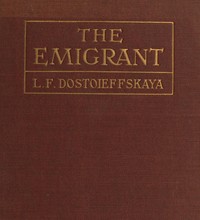
The Emigrant — Edition Insights
(0 User reviews)
84
Project Gutenberg
2018
Not confirmed
Women -- Fiction; Man-woman relationships -- Fiction; Religion -- Fiction; Russians -- Italy -- Fiction
Readers of public-domain and historical texts
Project Gutenberg digital edition
en
Edition facts
Words
59,317
Reading time
258 min
Text sections
6
The catalog record for The Emigrant — Edition Insights provides practical reading context through 59,317 words, 4 hr 18 min estimated reading time, and 6 detected text sections.
The text analysis averages about 19.9 words per sentence, while the detected sections provide another way to judge how the source is divided.
Project Gutenberg metadata also associates the work with “Women -- Fiction,” connecting these edition facts with the source record’s subject description.
Source:
Project Gutenberg record #57986
An editorial note on how the opening, middle, and later excerpts of L. F. Dostoevskaia's 'The Emigrant' guide a first reading, focusing on the heroine Irene's spiritual crisis, the conflict between Père Etienne and Prince Gzhatsky, and the novel's psychological and religious themes.
Editorial Edition Score
4.7/5
★★★★★
★★★★★
Calculated from edition completeness, EPUB availability, text structure and catalogue metadata. Not a user rating.
How this score is calculated
- Description quality20 pts
- Title & short description10 pts
- Source metadata20 pts
- Text length15 pts
- Chapters / structure15 pts
- EPUB file integrity20 pts
Total of 100 points, scaled to a 2.5-5.0 range. Editions with an empty description or a missing EPUB file are not scored.
Edition quality
Read the Text
d so deep an impression on her. She tried in vain to define this power that Rome wielded over her, and, finding no explanation, she invented one of her own: “Who knows,” thought Irene dreamily, “perhaps people never really quite die, but remain for ever hovering in spirit round those places where they have most forcibly lived and suffered. It may be that Rome is full of the ghosts of ancient Romans, of early Christians, of Renaissance painters, of nineteenth-century Italians, who died nobly in the struggle for Italy’s freedom and unity. All these phantoms are unable to tear themselves away from their beloved Eternal City. They are the rulers of Rome to-day, as much as in their own time, and we, foreigners, fall under their influence and cannot dissociate our thoughts from them.”
On the whole, the influence of Rome was not only overwhelming—it was also soothing. Wandering in museums, among ruins, through churches and catacombs, Irene felt, day by day, stealing into her soul a profound, indescribable sense of peace, such as that which unconsciously comes over one as one enters a convent. And it was just for this holy stillness and peace that her tired soul was thirsting.
Let not the reader think, however, that my heroine had passed through the storm of some great misfortune, or the suffering of some severe illness. On the contrary, her life and circumstances were such, that many a short-sighted and superficial observer envied her exceedingly.
At the death of her parents, Irene had remained entirely free, with plenty of money, a good name, and a good position in society. She enjoyed excellent health, in spite of the fact that she had been born and had passed all her life in Petrograd; she was clever and well educated. What more, one asks oneself, could anyone desire of the Fates?
But, somehow, it is an unfortunate fact in dear Russia, that even the most precious gifts of the gods seem never to be of any benefit to our people. How is one to explain this curious circumstance? Does it arise from some peculiarity in the Russian temperament, or from the general disorder and purposelessness of our way of living? The French, in the similar case of “La Belle au Bois Dormant,” have laid all the blame at the door of the wicked fairy who was offended at not being invited to the christening. I think I shall not go far wrong if I say that in Russia the part of the wicked fairy is played by the parents of the infant themselves. Oh, of course not intentionally, but simply as a consequence of our Russian laziness and the absence of organized and formulated ideas in the bringing up of our children.
Irene Mstinskaia lost her mother early and was brought up by her father, a scientist who spent all his life in his laboratory, disliked society, and received nobody but an occasional friend, as jealously devoted to science as himself. He adored his little Irene, petted and spoiled her; but, like most Russian parents, took very little interest in her spiritual development. The child grew up, lonely, silent, pensive. Books took, in her young life, the place of companions and childish games. She read a great deal without guidance or discrimination, and gained all her ideas on life, all her faith, all her ideals and aims and aspirations from books. Books stood between her and reality, and hid from her those deep truths that can never be learnt from even the greatest literary production, but can only be understood after long years of untiring observation and experience. It was in books also that Irene found her ideal of the man she could love. Her hero was an exceedingly complicated character. He united in himself the stoicism of an ancient Roman, the romanticism of a mediæval knight, the gallantry of a powdered marquis, and the dignified chivalry of the hero of an English novel.
The preface to The Emigrant immediately establishes Irene, a forty-year-old Russian woman in Italy, as a passionate idealist whose pride in Russia shatters after the Japanese War. The preface describes her as “selfish and extremely condemnatory” yet “vivacious, spontaneous, engaging,” a combination that primes readers for a psychological study rather than a plot-driven narrative. The excerpts show Irene’s inner turmoil through a long monologue on “morbid types” who quarrel with God when happiness eludes them—a speech that could be Irene’s own self-indictment. This editorial note examines how the opening, middle, and later excerpts shape a first reading, focusing on the heroine’s voice, the religious conflict, and the novel’s rhetorical structure.
The Heroine’s Voice and Self-Diagnosis
The excerpt containing the monologue on “morbid types” is striking for its clinical, almost diagnostic tone. The speaker—likely a character addressing Irene—argues that “rancour, greed, envy, voluptuousness, cruelty” are spiritual ailments requiring treatment, not sins. Irene’s stammered objection, “these are sins, and not diseases,” reveals her resistance to a deterministic worldview. The monologue cites Shakespeare, Pushkin, and Molière to argue that literature has long prepared for this “new theory.” For a first reader, this passage signals that the novel will interrogate moral categories through intellectual debate. The speaker’s proposal to “forbid novels and operas” and train people in hospitals suggests a radical materialism that clashes with Irene’s romantic idealism. The excerpt does not reveal who delivers this speech, but its placement early in the text establishes a central tension: is Irene’s suffering a moral failing or a curable illness?
Religious Conflict and the Convent of Sœurs Mauves
The preface mentions Irene’s willingness to “throw over the Orthodox Church” and enter a convent of sœurs mauves, a detail that hints at a religious subplot. The excerpts do not describe this convent, but the preface frames it as a response to her contempt for Russia. The monologue’s attack on religion—calling it part of “worn-out social machinery”—suggests that Irene’s faith is under intellectual siege. The preface also introduces Père Etienne, a Catholic priest whose influence competes with that of Prince Gzhatsky, a compatriot of “handsome looks and robust mind.” A first reader should note that the religious conflict is not merely doctrinal but personal: Irene’s search for an ideal hero (a “man after my own heart”) may be displaced onto spiritual authority. The excerpts do not resolve this conflict, but they establish that Irene’s crisis is both emotional and ideological.
The Structure of Debate and Interiority
The excerpts are dominated by extended speech and internal reflection rather than action. The monologue on moral disease runs for several paragraphs, and Irene’s response is a single stammered line. This asymmetry suggests that the novel’s drama unfolds through argument and self-analysis. The preface notes that Irene is “always asking pertinent questions,” and the excerpts bear this out: she is a listener and reactor, not a driver of events. The setting—a pension “teeming with old maids”—reinforces a claustrophobic, conversational atmosphere. A first reader should expect a novel of ideas where psychological change is charted through dialogue and interior monologue. The excerpts do not reveal the outcome of the debate, but they establish a pattern: Irene’s ideals are challenged by a rationalist interlocutor, and her responses reveal her vulnerability.
The Role of Italy and Expatriate Life
The preface states that Irene finds consolation in Italy after her disillusionment with Russia. The excerpts, however, contain no description of Italian scenery or local life; the focus remains on internal states and abstract arguments. This suggests that Italy functions primarily as a backdrop for psychological exile rather than a vividly rendered setting. The preface’s mention of a pension “teeming with old maids” implies a community of displaced women, but the excerpts do not develop this milieu. A first reader should note that the novel’s title, The Emigrant, points to a condition of rootlessness that is more spiritual than geographical. The excerpts do not show Irene interacting with Italians or adapting to a new culture; instead, they dwell on her Russian pride and its aftermath. The expatriate setting may serve to isolate Irene, intensifying her confrontation with Père Etienne and Prince Gzhatsky.
These excerpts reveal a novel that proceeds through intellectual confrontation and psychological dissection rather than external action. The heroine’s voice—passionate, questioning, and prone to self-dramatization—is the central instrument. A first reader should attend to the arguments themselves, noting how each character’s worldview is articulated and challenged. The religious and romantic conflicts are intertwined, and the excerpts leave unresolved whether Irene will find peace through faith, love, or self-understanding. The novel rewards attention to its rhetorical structure and the gradual unfolding of Irene’s character through debate.
Last night I kept thinking about Irene’s quiet unraveling, how a person can drift so far from themselves without noticing. It reminded me of that old adventure story, Frank Merriwell's Chase; Or, Exciting Times Afloat — Background and Themes, where the chase is all motion but the real undertow is something unspoken. Some books just sit with you like that, holding a question you didn't know you were carrying.
There are no reviews for this eBook.
There are no comments for this eBook.
Reader reflection
Take a moment to reflect on this book
Create a short personal record of your experience with this book.
Your progress
0
/
10
2
How much did you enjoy the reading experience?
3
How likely are you to recommend this book?
4
How much effort did this book require?
5
How closely did the book connect with your experience?
6
How clearly were the main ideas presented?
7
Could you apply anything you learned?
8
How did the pace of the book feel?
9
Which lesson or insight stayed with you?
10