1

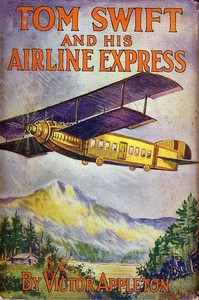
Tom Swift and his airline express — Background and Themes
(0 User reviews)
496
Project Gutenberg
2024
Not confirmed
Adventure stories; Swift, Tom (Fictitious character) -- Juvenile fiction; Aeronautics -- Juvenile fiction
Readers of public-domain and historical texts
Project Gutenberg digital edition
en
Edition facts
Words
49,382
Reading time
215 min
Text sections
6
The source record for Tom Swift and his airline express — Background and Themes measures this digital text at 49,382 words, 3 hr 35 min estimated reading time, and 6 detected text sections.
The text analysis averages about 14.6 words per sentence, while the detected sections provide another way to judge how the source is divided.
Project Gutenberg metadata also associates the work with “Adventure stories,” connecting these edition facts with the source record’s subject description.
Source:
Project Gutenberg record #72701
Tom Swift's plan for a transcontinental airline express with detachable passenger cars is shadowed by suspicious eavesdroppers and industrial spies. The opening chapters establish a mood of quiet surveillance, with Tom's private reflections interrupted by a lurking figure, while later scenes show Mr. Damon tiptoeing to check for listeners. The narrative voice shifts between Tom's proud musings and tense, cautious dialogue.
Editorial Edition Score
4.7/5
★★★★★
★★★★★
Calculated from edition completeness, EPUB availability, text structure and catalogue metadata. Not a user rating.
How this score is calculated
- Description quality20 pts
- Title & short description10 pts
- Source metadata20 pts
- Text length15 pts
- Chapters / structure15 pts
- EPUB file integrity20 pts
Total of 100 points, scaled to a 2.5-5.0 range. Editions with an empty description or a missing EPUB file are not scored.
Edition quality
Read the Text
y gathering over the landscape, shrouding in velvety black the trees which were faintly stirring in the summer breeze. Tom, following an old-time cowpath across the green meadow on his way home from town, topped a little rise and caught a glimpse of the high board fence surrounding the Swift Construction Company’s plant which he and his father had built up after many years of hard work.
Tom paused for a moment to trace, in the fast-gathering shadows of the night, the outlines of the various buildings—the foundry, the wood-working mill, the electrical shop, the hangars where many types of aircraft were housed.
From some of the tall chimneys faint clouds of smoke arose, for certain of the industries carried on by the Swift Construction Company required that furnaces be kept going day and night.
“A great plant—a wonderful plant!” mused Tom. It gave him a certain sense of pleasure to dwell thus in introspection on the accomplishments of his father and himself. And it buoyed him up for the work in prospect—for Tom Swift had a great plan in mind, a plan so great and daring that, as yet, he had said but little of it even to his father or to Ned Newton, his old chum who was now an officer of the concern.
“But it can be done! I know it can be done!” declared Tom. “And I’m going to do it! I’m going to——”
In his mental energy he had unconsciously spoken the last words in a low voice, but the sight of something just ahead of him in the gathering darkness caused him to break off abruptly and halt suddenly. Concentrating his gaze, Tom Swift looked eagerly at a clump of bushes.
“It’s a man,” murmured Tom Swift. “A man, sure enough, and it isn’t one of our workers, either. None of them would sneak around as he is doing.”
For that described exactly the movements of the stranger of whom Tom had caught sight in the darkness as he approached the big fence which surrounded his plant.
“What’s he up to?” mused Tom. “No good, that’s sure. He wouldn’t sneak along like that if he were on the level.”
Through Tom’s mind flashed remembrances of times when attempts had been made by enemies of himself and his father to fire the plant. To prevent this, and to keep strangers away, a high fence had been erected around the buildings. This fence was protected by wires on the plan of a burglar alarm, so that, no matter at what point the barrier was climbed, a bell would ring in the main office and on an indicator would appear a number to show at what part of the fence an attempt was being made to scale it.
An effort to break down the barrier, or burrow beneath it, would also sound the alarm in like manner. So Tom had no fear that the sneaking stranger, crouching along in the darkness, could get into the midst of the buildings without notice being given.
“But what’s his game?” thought Tom.
Almost at the instant he asked himself this question he saw the man crawl behind a clump of bushes. In the natural course of events the man should have appeared on the other side of the clump. But he did nothing of the sort.
“He may be hiding there,” mused Tom. “Perhaps waiting for a confederate. I’ll just have a closer look at this!”
He advanced boldly toward the bushes. There was nothing between him and the shrubbery, and it was still light enough to see fairly well. Besides, Tom had extraordinarily good eyes. His astonishment can be imagined when, on reaching the bush off which he had not taken his gaze and behind which he had seen the crawling man disappear he found—no one!
“That’s the queerest thing I’ve seen yet!” exclaimed Tom, rubbing his organs of vision.
Standing beside the bush which came about to his shoulders, Tom looked on all sides of it. There was no hollow in the ground, as far as he could make out, no depression and no other clumps of shrubbery and no boulders behind which a man might be hidden. Some distance away there were all of these things in profusion, for the land was wild and uncultivated outside the plant fence. But there was not a hole, boulder, or bush near enough to the one beside which Tom stood to have enabled a man to gain their protection while the young inventor was watching.
The novel opens not with action but with Tom Swift alone on a cowpath, murmuring to himself about the greatness of his plant. The prose slows to match his introspection: darkness gathers, trees stir faintly, and Tom traces building outlines in the twilight. This quiet, almost lyrical passage is abruptly broken when he spots a man sneaking near a clump of bushes—a man who is not one of his workers. The shift from private pride to alert suspicion sets the tone for a story where plans are hatched in whispers and every closed door may hide an ear.
From Soliloquy to Surveillance
The narrative voice in the first chapter is notably interior. Tom’s murmured thoughts—“A great plant—a wonderful plant!”—read like a stage aside, giving readers direct access to his pride and ambition. This soliloquy is interrupted by external observation: the sight of a man in the bushes. The prose tightens, shifting from expansive description to focused, cautious sentences. Later, Mr. Damon’s tiptoeing to the door and his whispered warning—“You can’t be too careful”—echo this pattern. The book repeatedly stages moments where private speech is threatened by unseen listeners, creating a rhythm of confidence and caution.
The Mechanics of the Express
Tom’s explanation of the airline express is delivered in precise, technical detail: three laps of approximately one thousand miles each, a flying rate of two hundred miles an hour, a fare of one thousand dollars. The prose here becomes brisk and factual, contrasting with the earlier atmospheric passages. The detachable passenger car—able to move under its own power—is described as a Pullman sleeper that can be transferred between planes without waking passengers. This blend of mechanical specificity and visionary salesmanship defines Tom’s voice: he is both inventor and promoter, and the narrative mirrors his dual role.
Pace and Suspense in Dialogue
The trial flight chapter accelerates the pace through rapid, anxious dialogue. Mr. Damon’s tiptoeing, Ned’s curiosity, and Tom’s hopefulness create a scene of layered tension. The exchange about a suspicious valet—who stood listening at the door—tightens the atmosphere. The prose shortens into quick exchanges: “Can it be done?” “I think so.” The rhythm mimics the characters’ alertness. Even Tom’s later admission that the undertaking will take “a mint of money” lands as a sobering pause. The book alternates between expansive planning and cramped, watchful conversations, using pace to signal when danger is near.
Readers should attend to how the novel uses silence and interruption. Tom’s private thoughts are repeatedly broken by threats—a man in the bushes, a listener at the door. The narrative rewards attention to who is speaking and who might be overhearing. The technical passages, though dense, are never static; they are always framed by the possibility of espionage. This tension between openness and secrecy gives the story its particular rhythm.
I remember huddling under blankets with my father’s old football annuals, sensing that same watchful quiet—players sizing each other up between plays. Reading about Tom’s nervous glance out the hangar window, I thought of Rivals for the Team, where suspicion hides in locker-room whispers. That book stirred a similar feeling: that competition isn’t always loud, but sometimes tiptoes, waiting. Rivals for the Team: A Story of School Life and Football — Text and Context keeps that hush alive, somehow.
There are no reviews for this eBook.
There are no comments for this eBook.
Reader reflection
Record your reading impressions
A brief reflection can help important ideas stay with you longer.
Your progress
0
/
10
2
How much did you enjoy the reading experience?
3
Would you encourage someone else to read it?
4
How much effort did this book require?
5
Would you start a conversation about this book?
6
How did the reading compare with what you expected?
7
How would you describe its reading pace?
8
Which part made the strongest impression?
9
In one sentence, what did you learn?
10