1

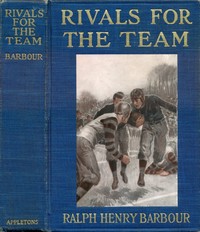
Rivals for the Team: A Story of School Life and Football — Text and Context
(0 User reviews)
43
Project Gutenberg
2022
Not confirmed
Adventure stories; Boarding schools -- Juvenile fiction; Football stories
Readers of public-domain and historical texts
Project Gutenberg digital edition
en
Edition facts
Words
76,474
Reading time
333 min
Text sections
30
The catalog record for Rivals for the Team: A Story of School Life and Football — Text and Context provides practical reading context through 76,474 words, 5 hr 33 min estimated reading time, and 30 detected text sections.
The text analysis averages about 14.0 words per sentence, while the detected sections provide another way to judge how the source is divided.
Project Gutenberg metadata also associates the work with “Adventure stories,” connecting these edition facts with the source record’s subject description.
Source:
Project Gutenberg record #67805
An editorial note on Ralph Henry Barbour's 1916 school football novel, focusing on the narrative's shifts between athletic action and quieter interpersonal moments, the use of dialogue to reveal character, and the pacing of the opening chapters.
Editorial Edition Score
4.9/5
★★★★★
★★★★★
Calculated from edition completeness, EPUB availability, text structure and catalogue metadata. Not a user rating.
How this score is calculated
- Description quality20 pts
- Title & short description10 pts
- Source metadata20 pts
- Text length15 pts
- Chapters / structure15 pts
- EPUB file integrity20 pts
Total of 100 points, scaled to a 2.5-5.0 range. Editions with an empty description or a missing EPUB file are not scored.
Edition quality
Read the Text
it, Bert. It was my pretty little thought.”
“He wouldn’t have seen me on the field tomorrow, anyway,” remarked Nick. “I’m going down to the junction to meet Guy at three-something. Come on with me.”
“I wouldn’t make that trip in this weather for the King of England, much less Guy Murtha,” responded Bert impressively.
“I’ll buy you ice cream,” tempted Nick. Bert shook his head.
“Will you come, Ted?” asked Nick.
“I will――not! I love Guy like a brother, _but_――――”
“Oh, you fellows make me weary!” sighed Nick. “No sporting blood at all! No――――”
“Is that your idea of sporting?” jeered Ted. “Get on a hot, stuffy little one-horse train and dawdle down to Needham Junction, four miles away, in something like half an hour? I’ve made that trip once this fall and, Fortune aiding me, I shan’t make it again!”
“Come on to supper,” said Bert. “It’s almost a quarter of. It will be cooler over there on the steps than it is here, too.”
“Just when I was beginning to get comfortable,” mourned Nick. “Say, Ted, did you do this last year?”
“Come up for early practice.”
“I did. And we had ten days of it last fall instead of only a week. You fellows needn’t kick!”
“I do kick, though, Teddy, old scout! Look here, you! I gave up a whole week of the best sort of fun at Deal Beach to come up here and frizzle and fry in my juices and chase a contemptible football over a sun-smitten cow-pasture! Needn’t kick, eh? Why, man, back there there’s a nice cool breeze off the ocean and a band playing moosics and piles of eats and――and nothing to do but play around! And just because I’m――I’m patriotic enough and unselfish enough to leave all that you lie there like a ton of bricks and tell me I needn’t kick! I do kick! I’m kicking!”
“I hear you,” murmured Ted. “Go on kicking. Nobody’s going to miss you if you go back to Deal Beach tomorrow. We could have got on well enough without you, anyhow. You were simply asked because we thought you’d feel hurt if you weren’t.”
“I like your nerve!” gasped Nick. “My word! Who’s been doing the work for five days out there? Trying to get drive into you chaps is like pulling teeth! Why, you miserable sandy-haired――――”
“Oh, come on,” begged Bert. “I’m getting hungry. Anyone want to wash up? Come along if you do. You’ll have to wipe your hands on your handkerchiefs, though. They haven’t given us any towels yet.”
“What’s the good of washing if we’re going in swimming later?” asked Nick, sprawling off the window-seat.
“Because for once, old son, you’re dining with gentlemen,” Ted answered, gripping the smaller youth by the shoulders and propelling him towards the door in the wake of Bert.
“Honest?” wailed Nick. “I’d much rather dine with you, Ted!”
A few minutes later the three boys were crossing the campus unhurriedly and with an impressive disregard of “Keep Off the Grass” signs. And three good-looking, healthy, well-set-up youths they were. Their bare heads――there wasn’t a hat among them――showed three distinctly different colors. Ted Trafford’s hair was sandy, Bert Winslow’s black, Nick Blake’s reddish-brown. Between sandy hair and brown lay a matter of four inches in height, with black hair halving the difference. In build the trio were again at variance. Ted was a big, broad-bodied chap, Bert was slenderer, without being thin, and Nick was at once short and slight. Although Nick was only five months Bert’s junior――and Bert was seventeen――his smallness made him appear much younger. He had a thin face, deeply tanned, and gray eyes. Nick’s usual expression was one of intense, even somber, thoughtfulness. He had, in fact, the appearance of a boy with a deep and secret sorrow. But in his case appearances were deceptive, or, if he had a sorrow, it was merely that there are only a certain number of ways to create mischief and that he had pretty well exhausted them all.
Ralph Henry Barbour's Rivals for the Team opens not on the football field but in a stuffy study, where Ted Trafford, Nick Blake, and Bert Winslow complain about the heat and the slate stairs of their dormitory. The first chapter, “After Practice,” establishes a conversational, almost leisurely tone before any athletic action begins. The boys' banter about room temperatures and the merits of open fireplaces sets a domestic, school-life atmosphere that contrasts with the more urgent, game-focused chapters later in the book.
Dialogue as Character Revelation
The early chapters rely heavily on dialogue to define the main characters. Ted's complaints about the heat and his pride in Trow Hall's cold rooms reveal a touch of competitiveness, while Nick's teasing counters that. Bert Winslow, stretched on the leather cushions, speaks less and listens more, hinting at a reserved nature. When Hugh enters later, his speech is marked by British slang—"old chap," "rot," "tin"—and a willingness to help, as when he offers to wire his mother for money to bail Bert out of debt. The dialogue is naturalistic, with interruptions and unfinished sentences that mimic real conversation, such as Hugh's "I say, though, maybe I'd better ask mother to telegraph it, eh?" This technique allows Barbour to advance plot and character without lengthy exposition.
Pacing: From Dormitory Chatter to Gridiron Tension
The narrative pace shifts markedly between the opening chapters and the later football sequences. The first chapter moves slowly, with the boys' idle talk and descriptions of the study—the slate stairs, the lack of a fireplace—creating a sense of everyday school routine. In contrast, Chapter XV, “Grafton Scores,” accelerates into terse, action-driven prose: "Rotan had already scored once and the board announced 'Grafton 0—Visitors 7.'" The sentence fragments and quick cuts mirror the urgency of the game. This alternation between relaxed social scenes and tense athletic contests structures the novel's rhythm, giving readers breathing room before the next play.
Voice and the Use of Slang
Barbour distinguishes his characters through their vocabulary. Hugh's British-inflected speech—"I fancy I'll send a couple of these"—sets him apart from the American-born boys, who use phrases like "dandy steam heat" and "scared to death." The slang of the era, such as "strapped" (broke) and "grouchy as a bear," grounds the dialogue in its 1916 setting. Even the narrator's voice adopts a colloquial tone in action scenes: "the second team were not exempted from work on Saturday, rather to their annoyance." This consistent use of period-appropriate language reinforces the authenticity of the school setting without becoming a parody.
Setting as a Character
The physical environment of Grafton Academy is rendered with specific, sensory details. The study in Lothrop Hall has "slate stairs" that are "harder" than others, and the rooms are described in terms of their heating systems—open fireplaces versus steam heat. These details do more than decorate; they create a lived-in world. The boys' complaints about the heat and the climb up three flights of stairs establish a baseline of comfort and discomfort that contrasts with the open-air football field. Later, the gridiron is described with minimal detail, focusing instead on the scoreboard and the action. This shift from interior to exterior spaces mirrors the novel's thematic move from personal concerns to team competition.
Inference from Incomplete Excerpts
The excerpts provided cover only the opening chapter and a later game scene, leaving much of the plot—including the central rivalry hinted at in the title—unseen. Hugh's offer to send money suggests a subplot involving debt and potential disgrace, but the resolution is not shown. Similarly, the relationship between Hugh and Bert, which includes a quarrel over rooming together, is only partially revealed. Readers should note that the novel's full arc may develop these tensions further, but the excerpts do not confirm whether the rivalry is athletic, personal, or both.
Readers approaching Rivals for the Team should attend to the way Barbour balances dialogue and description, and how he uses the school setting to frame the football action. The early chapters reward patience, as they establish the social dynamics that later conflicts will test. The novel's voice—colloquial, period-specific, and character-driven—offers a window into early twentieth-century boarding school life, where friendships and debts matter as much as touchdowns.
Reading the editorial notes on Barbour’s football novel, I kept thinking about how those quiet locker-room talks mattered as much as the game itself. Something in that unhurried rhythm reminded me of an old friend’s copy of Frank Merriwell’s First Job; Or, At the Foot of the Ladder — Key Ideas to Explore, where the ladder’s first rung felt just as tender as the final score.
There are no reviews for this eBook.
There are no comments for this eBook.
Reader reflection
Record your reading impressions
A brief reflection can help important ideas stay with you longer.
Your progress
0
/
10
2
Was reading this book enjoyable?
3
Would you pass this book on to a friend?
4
How easy was the book to follow?
5
Did it raise ideas you would like to talk about?
6
How would you describe its reading pace?
7
Is this a title worth rereading?
8
Did the book offer a fresh perspective?
9
In one sentence, what did you learn?
10