1

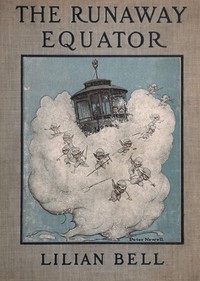
The Runaway Equator, and the Strange Adventures of a Little Boy in Pursuit of It — Story, Setting & Ideas
(0 User reviews)
842
Project Gutenberg
2020
Not confirmed
Fantasy fiction; Astronomy -- Juvenile fiction; Geography -- Juvenile fiction
Readers of public-domain and historical texts
Project Gutenberg digital edition
en
Edition facts
Words
23,022
Reading time
101 min
Text sections
15
For The Runaway Equator, and the Strange Adventures of a Little Boy in Pursuit of It — Story, Setting & Ideas, the stored edition analysis reports 23,022 words, 1 hr 41 min estimated reading time, and 15 detected text sections.
The text analysis averages about 14.9 words per sentence, while the detected sections provide another way to judge how the source is divided.
Project Gutenberg metadata also associates the work with “Fantasy fiction,” connecting these edition facts with the source record’s subject description.
Source:
Project Gutenberg record #61854
A boy named Billy chases a personified Equator across fantastical landscapes, meeting Nimbus, Jack Frost, and the Equine Ox in a story structured around pursuit and recurring images of celestial bodies.
Editorial Edition Score
4.7/5
★★★★★
★★★★★
Calculated from edition completeness, EPUB availability, text structure and catalogue metadata. Not a user rating.
How this score is calculated
- Description quality20 pts
- Title & short description10 pts
- Source metadata20 pts
- Text length15 pts
- Chapters / structure15 pts
- EPUB file integrity20 pts
Total of 100 points, scaled to a 2.5-5.0 range. Editions with an empty description or a missing EPUB file are not scored.
Edition quality
Read the Text
rly in spring, and showing Billy how the earth revolves on its axis. To illustrate this difficult matter and to make it interesting, she had taken a big yellow orange to represent the Earth and had used a stick of lemon candy for the Pole. She made the Equator out of a black rubber band such as you put around fat envelopes.
Then, when Billy said that he understood, Mother dug a hole in the orange and stuck the lemon stick in it and, handing it to Billy, said with a droll twinkle in her blue eyes, which always seemed to be laughing:
“Would you like to eat up the Earth through the North Pole?”
Now Billy had never before tasted the joys of an orange eaten through a stick of lemon candy; so when Mother, who had a trick of remembering nice things from her own childhood, showed Billy how it was done, he settled down to a blissful half hour in which he meant to devour the whole earth.
It tasted so good that he rolled over on the short grass, under a lilac-bush in full bloom, and only took his lips from the North Pole long enough to tell his mother that it tasted “bully.”
“Well,” said his mother, standing up and shaking out her blue dress, “I must go now. Here is your geography. Don’t forget to bring it in when you come, and don’t lose the Equator off the Earth, even if you are eating it. I don’t know what would become of us if the Equator really should get away!”
Billy laughed aloud. It really was no trouble at all to understand things when Mother made them appear so funny.
He lay on his back looking up into the sky, which was just the color of his mother’s blue dress. White clouds, like mountains of white feathers which must be very soft to sleep on, were over his head.
A bee was buzzing lazily over the lavender blossoms of the lilacs. A soft wind was blowing. It was indeed very pleasant.
What if the bee should turn into a fairy!
“Why don’t you?” said Billy aloud.
The bee, being puzzled, scratched his head with his left hindfoot and answered:
“Why don’t you be one?”
“I am one bee!” answered the bee, striking a match on Billy’s orange and lighting a grapevine cigarette.
“Could you be a fairy?” asked Billy.
“I am always beeing things--flowers and honey--so of course I could bee a fairy. How do you know that I am not one? Look at me!”
Billy sat up and looked.
“Well, I never!” exclaimed Billy. “A minute ago I thought you were a bee!”
“I can bee anything I choose,” said the Fairy. “That’s why you thought I was a bee. Because I can bee!”
“Who are you now?” asked Billy.
“I am the Geography Fairy,” answered the stranger.
He held out his hand and then looked at it.
“It’s not raining yet,” he observed; “still----”
Without finishing his sentence he unfolded a pink parasol and tossed it into the air. It sailed away, slowly at first, then more rapidly as the light wind caught it and carried it out of sight beyond the lilac-bush.
“I won’t need it till it begins to rain,” he explained, “so they might as well have it.”
“The sunbeams. If a sunbeam gets wet he’s done for. Haven’t you ever noticed that?”
Billy thought he had noticed something of the kind. Anyway the sunbeams all disappeared directly it began to rain. But being just an ordinary little boy, he was much more interested in the conversation of the wonderful stranger than he was in sunbeams, and that is why he asked:
“What is your name, if you please?”
“My name is Nimbus and I live in the clouds with the other fairies. I was named after one of the clouds.”
“But,” objected Billy, “I don’t believe in fairies.”
“Very well,” said Nimbus briskly, “keep right on don’t believing. It doesn’t disturb me in the least.”
“And besides,” said Billy, “there couldn’t be such a thing as a Geography Fairy.”
“How do you know?” demanded Nimbus.
“Because,” said Billy, “I have never seen one.”
“Nonsense!” returned Nimbus. “Did you ever see a noise?”
“No,” Billy admitted, “I don’t think I ever did. At least I don’t remember ever having seen one.”
“Well, do you believe that there _aren’t_ any noises?”
Billy had no reply that seemed suitable, and so he said nothing.
The story opens with a geography lesson made tangible: Billy's mother uses an orange for Earth, a lemon-candy stick for the Pole, and a black rubber band for the Equator. That rubber band soon comes to life, and Billy must chase it across a world where trolley cars fly through craters and Jack Frost sings about his seasonal duties. The narrative moves swiftly from one surreal encounter to the next, each scene anchored by a specific natural phenomenon turned into a character or obstacle.
A Geography Lesson Becomes a Quest
The opening chapter establishes a pattern: abstract scientific concepts are translated into physical objects. The Equator is a rubber band; the Pole is candy. When the Equator escapes, Billy's pursuit becomes a literal journey through the concepts he just learned. The author uses this device to blend education with adventure, but the tone remains playful rather than didactic. Billy's mother disappears after the first scene, leaving him to navigate a world where Nimbus (a cloud-like being) and Jack Frost are real. The quest structure—chase the runaway Equator—gives the story a clear forward momentum, with each chapter introducing a new obstacle or ally.
Recurring Images: Ice, Fire, and Celestial Bodies
Jack Frost's song, reproduced in full in the excerpts, is a catalog of winter imagery: bonfires, robins, leaves, silver films on water, snowflakes, and lacy windowpanes. This song is one of several set pieces that pause the action for a lyrical interlude. The Equine Ox also sings, and the Evening Star is pursued as a potential comet. These recurring celestial and seasonal images create a consistent visual vocabulary. The story moves between extremes: a passive volcano, a cliff edge, a six-month night. Each setting is defined by its relationship to light, temperature, or time, reinforcing the astronomical and geographical themes.
Movement Between Scenes: Trolley Cars and Meteors
The mode of travel shifts as rapidly as the settings. Billy rides an enchanted trolley car, follows a crater through a volcano, and is accompanied by a train of meteors. The trolley car, introduced in Chapter II, is a recurring vehicle; its rope is later tied to the Equine Ox's horn. This mix of mundane (a trolley) and fantastic (meteors) keeps the journey unpredictable. The illustrations by Peter Newell, listed in the contents, emphasize key moments of transition: the car plunging into snow, characters shooting into the void, a meteor dropping among them. The narrative's rhythm is built on these abrupt shifts, each chapter ending with a new direction or discovery.
Dialogue as Exposition and Characterization
Conversations carry much of the story's explanatory weight. Jack Frost explains his actions—freezing pipes, nipping fingers—as benevolent corrections. Billy's responses are polite and often apologetic, reinforcing his role as a well-meaning but fallible child. The dialogue is naturalistic, with interruptions and clarifications that mimic real speech. When Jack Frost scolds Billy for forgetting to watch the Equator, the exchange is gentle but pointed. This pattern of instruction through conversation mirrors the opening geography lesson, but now the teachers are fantastical beings. The result is a story that teaches without lecturing, embedding information in character interactions.
Readers should pay attention to how each chapter reinterprets a geographical or astronomical concept as a character or event. The Equator is not just a line but a mischievous entity; the Evening Star is a potential comet. The story's pleasure lies in these transformations. The illustrations by Peter Newell, though not reproduced here, are integral to the narrative's visual imagination. Approach this as a journey through a child's conceptual world, where learning and adventure are inseparable.
Reading about Billy chasing that personified Equator, I remembered summer evenings when the horizon seemed endlessly retreating. There’s a similar ache in A Girl of High Adventure, where the pursuit isn’t a line but a self, a quieter reckoning. Both books hold that odd loneliness of a quest, and the strange comfort in never quite arriving. A Girl of High Adventure — Background and Themes lingered with me the same way, like a lantern barely visible across a field.
There are no reviews for this eBook.
There are no comments for this eBook.
Reader reflection
Before you leave, reflect on the book
Use these questions to collect your thoughts before moving on.
Your progress
0
/
10
2
Was reading this book enjoyable?
3
How likely are you to recommend this book?
4
How easy was the book to follow?
5
How much did the book move you?
6
How clear did the writing feel?
7
Did anything about the book feel genuinely new?
8
Was the book moving at the right speed?
9
What is the main idea you are taking away?
10