1

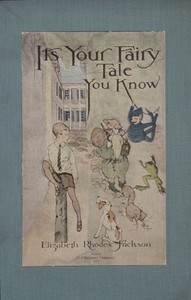
It's Your Fairy Tale, You Know — Text and Context
(0 User reviews)
751
Project Gutenberg
2018
Not confirmed
Fairy tales; Boys -- Juvenile fiction; Boston (Mass.) -- Juvenile fiction
Readers of public-domain and historical texts
Project Gutenberg digital edition
en
Edition facts
Words
29,999
Reading time
131 min
Text sections
4
The catalog record for It's Your Fairy Tale, You Know — Text and Context provides practical reading context through 29,999 words, 2 hr 11 min estimated reading time, and 4 detected text sections.
The text analysis averages about 14.1 words per sentence, while the detected sections provide another way to judge how the source is divided.
Project Gutenberg metadata also associates the work with “Fairy tales,” connecting these edition facts with the source record’s subject description.
Source:
Project Gutenberg record #57662
Wendell, a boy who reads only fairy tales, finds himself inside one when a pixie tasks him with rescuing an enchanted maiden. The story blends Boston landmarks with magical logic, using modern touches like movie contracts and gas ranges to subvert traditional fantasy expectations.
Editorial Edition Score
4.6/5
★★★★★
★★★★★
Calculated from edition completeness, EPUB availability, text structure and catalogue metadata. Not a user rating.
How this score is calculated
- Description quality20 pts
- Title & short description10 pts
- Source metadata20 pts
- Text length15 pts
- Chapters / structure15 pts
- EPUB file integrity20 pts
Total of 100 points, scaled to a 2.5-5.0 range. Editions with an empty description or a missing EPUB file are not scored.
Edition quality
Read the Text
eek at the fairy stories before doing his home work, and that he never thought of those fractions till he heard his mother’s step on the stairs, when he shoved the fairy book into his desk drawer and opened his arithmetic at random.
“Bedtime, my son. Have you finished your lessons?” asked his mother.
“No! Bothersome lot! Can’t make anything of this example--have to give me another half-hour,” muttered Wendell, not really wishing to deceive his dear mother, but a little bit ashamed to tell her how he had neglected his duty.
“I’m sorry, dear, but you’ll have to do it in the morning. You mustn’t lose sleep. And your brain will be clearer then. I’ll tell Jane to call you half an hour early.”
“Many are called, but few get up,” as the proverb hath it. Wendell, next morning, was not one of the few. Jane’s call fell on sleepy ears. He turned over for one more snooze, woke an hour later to find himself ‘way behind time, hustled through his dressing and his breakfast, and was off to school with lessons unprepared,--a sad thing that happened only too often in his easy-going life.
He managed to slide through most of his recitations, badly but not disgracefully, until he came to the arithmetic class. I might tell you in detail of his tragic floundering through problems that he was supposed to have prepared, of his guilty acknowledgment that he had not made up the delinquencies of yesterday and the day before, and of the stern wrath that was visited upon him by the arithmetic teacher, a strict and disciplinary spinster, whose patience he had often tried in the past. But this is not a school story. I have to record only such a part of his troublous career as led directly to the wonderful adventure of the Wishing Stone. So, briefly, he was “kept in,” with three days’ problems to finish before he could go home.
His teacher, who bore the singularly happy name of Miss Ounce, left him alone in the deserted school-room. She had a lesson to give in another part of the building. Wendell pulled his book in front of him, flipped the pages open to the proper place, ran his fingers through his hair, and remained in that attitude, which may have denoted either deep concentration or utter dejection. He read the first problem through twice, and it had no more meaning for him than Dante’s Inferno in the original tongue.
“Jee-rusalem!” he said aloud after a long pause.
“Can I be of any assistance?” asked a friendly voice. It came from a little being perched on the desk in front of him, who certainly had not been there a moment before. He was about the size of a two-year-old child, but he had the face of an old man, a genial old man with twinkling eyes. His body was very round and quite filled his suit of blue knitted jersey, and his arms and legs were long and spindling.
“For goodness’ sake, who are you?” gasped Wendell.
“I’m a Pixie,” said the being.
“You are?” said Wendell. “I didn’t know there were any--out of fairy stories.”
“But I’m _in_ a fairy story,” explained the Pixie politely. “I’m in the same fairy story you’re in.”
“Am I in one?” said the startled Wendell.
“Since last night,” declared the Pixie. “You wished to be, you know, on the Wishing Stone, after you had run around it nine times. It’s a sure charm.”
“The Wishing Stone! Is that the old Wishing Stone--the alley post?”
“Somewhat fallen into disuse,” assented the Pixie, “but never-the-less the Wishing Stone.”
“Well, I never!” said Wendell.
It was so stupendous, such an unbelievable piece of good fortune, that at first he did not grasp its possibilities. Then his eye fell on the open book lying on his desk.
“Say!” he exclaimed. “If that’s all true, if I’m really living in a fairy story, there ought to be some way of settling junk like this in short order.” He gave a vindictive thump to the arithmetic.
“That’s what I came for,” said the Pixie. “I thought I saw a business opening here.”
“You mean--” faltered Wendell.
“Why, I’ll do your problems for you. That’s easy. And you do three tasks for me.”
“Yes, it’s always three,” said the Pixie.
“Say, I think I ought to get more than just these problems for three. I think you ought to do my home work till the end of the term.”
“Just as soon,” said the Pixie. “No trouble to me. Is it a bargain?”
“But what will you want me to do?” said Wendell.
Wendell, the ten-year-old protagonist of It's Your Fairy Tale, You Know, is introduced not as a dreamy bookworm but as a robust boy with "excellent arm and leg muscles" who reads fairy tales obsessively—hiding them behind his geography book and taking them to Sunday school. The narrator immediately undercuts the reader's assumption of a pale, bespectacled child, establishing a playful voice that will consistently nudge the conventions of the genre.
The story opens in a children's library, a setting grounded in realistic detail: the murmur at the delivery desk, squeaky shoes, and a helpful child whispering about a "dandy book." Yet this ordinary space becomes the threshold to a magical adventure when a pixie appears, launching Wendell into a quest that treats fairy-tale logic as a practical problem to be solved.
A Boy Who Reads Only Fairy Tales
The opening chapter establishes Wendell's character through his reading habits: he "never read anything but fairy tales, unless it happened to be 'required reading.'" The narrator describes his immersion with comic exaggeration—he reads in bed, before breakfast, in the street—but also notes his physical vitality, contrasting the stereotype of the pale bookworm. This detail matters because Wendell's practical, athletic side will later help him navigate magical challenges.
The library scene also introduces the story's narrative voice, which is wry and slightly conspiratorial. When the librarian snaps on lights, Wendell doesn't notice; the narrator remarks that he "gave an excellent imitation of a bookworm." This self-aware tone, which occasionally addresses the reader directly, signals that the book will play with fairy-tale conventions rather than simply replicate them.
Modernity Intrudes on Magic
One of the most striking features of the excerpts is the deliberate collision between traditional fairy-tale elements and 1920s modernity. The Beauteous Maiden, upon being freed from a frog form, announces that her first priority is to "hunt up that moving picture man and sign the contract." She plans to become a movie actress, a goal that treats magical rescue as a career opportunity rather than a romantic destiny.
Similarly, when the Pixie offers to help Wendell infiltrate a witch's house, he worries about the practicality of hiding in an oven: "I'll have to make you pretty small to get into one of these gas ranges they use now-a-days." The witch's magic cloak, cap, and book are traditional, but the obstacles are updated. Even the Kobold, a creature from German folklore, declares himself "a conservative" and rejects a riddle as "too ultra-modern." These anachronisms create humor and suggest that fairy-tale rules must adapt to contemporary life.
Dialogue as a Tool for Character and Comedy
The dialogue in the excerpts reveals character through tone and timing. Wendell's exchanges with the Beauteous Maiden are particularly telling: when she thanks him as "My deliverer!" and the Kobold suggests he must marry her, Wendell stammers, "Why—why—we didn't plan that." His practical, unromantic response undercuts the expected fairy-tale script. The Maiden, for her part, is equally pragmatic, quickly adding, "Not yet. There are my cruel stepmother and the giant to consider."
The Pixie's dialogue is marked by a fussy, problem-solving quality. When Wendell scoffs at the idea of being turned into a monkey, the Pixie replies, "Well, of course, it was only a suggestion." These exchanges establish a dynamic where magical beings are fallible and Wendell must think on his feet. The Kobold's parting line—"I shall not use it again under any circumstances. It is too ultra-modern"—encapsulates the book's playful tension between old and new.
Boston as a Fairy-Tale Landscape
The story is explicitly set in Boston, and the excerpts use specific local landmarks to ground the fantasy. The Kobold is said to live "under Flag Staff Hill on Boston Common" and may still be there "to this very moment." The Beauteous Maiden gives Wendell an address in Brookline and instructs him to "take the car from Park Street." These details root the magical quest in a recognizable geography, making the intrusion of the fantastic feel more immediate.
This choice also affects the narrative's logic: when the Pixie worries about gas ranges, he is responding to a modern Boston home, not a medieval castle. The blend of the mundane and the magical extends to the witch's house, which is presumably a suburban dwelling rather than a gingerbread cottage. By placing fairy-tale tasks in a contemporary urban setting, the author invites readers to imagine how traditional enchantments might operate in their own world.
It's Your Fairy Tale, You Know rewards attention to its narrative voice, which oscillates between dry commentary and genuine wonder. Readers may notice how the author uses Wendell's practical nature to question fairy-tale logic—why must things go by threes?—and how the Boston setting keeps the story grounded. The excerpts suggest a book that respects the genre's traditions while gently mocking their rigidity, offering a quest that is as much about problem-solving as about magic.
I remember curling up with It's Your Fairy Tale and feeling oddly seen—how Wendell’s Boston streets turned magical the same way my own childhood sidewalk did after rain. That blend of familiar and impossible reminded me of the quiet awe I felt reading The Young Ice Whalers — Inside the Classic, where the cold ocean felt both real and dreamed. Both left me staring out a window, wondering which parts of my day might be enchanted without my noticing.
There are no reviews for this eBook.
There are no comments for this eBook.
Reader reflection
Record your reading impressions
A brief reflection can help important ideas stay with you longer.
Your progress
0
/
10
2
Did this book hold your interest?
3
How likely are you to recommend this book?
4
What was the reading difficulty like?
5
Would you like to discuss this book with someone?
6
Could you follow the author’s main argument?
7
How would you describe its reading pace?
8
Could you see yourself revisiting this book?
9
What is the main idea you are taking away?
10