1

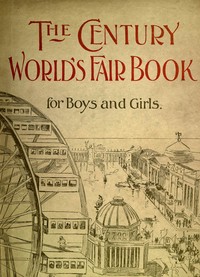
The Century World's Fair Book for Boys and Girls Being the Adventures of Harry and Philip with Their Tutor, Mr. Douglass, at the World's Columbian Exposition — Text and Context
(0 User reviews)
59
Project Gutenberg
2019
Not confirmed
Conduct of life -- Juvenile fiction; Cousins -- Juvenile fiction; Artists -- Juvenile fiction; Chicago (Ill.) -- Juvenile fiction; National characteristics -- Juvenile fiction; Youth -- Conduct of life -- Juvenile fiction; Tutors and tutoring -- Juvenile fiction; World's Columbian Exposition (1893 : Chicago, Ill.) -- Juvenile fiction; World's Columbian Exposition (1893 : Chicago, Ill.); Exhibitions -- Juvenile fiction; Photographers -- Juvenile fiction
Readers of public-domain and historical texts
Project Gutenberg digital edition
en
Edition facts
Words
65,178
Reading time
284 min
Text sections
22
This digital edition of The Century World's Fair Book for Boys and Girls Being the Adventures of Harry and Philip with Their Tutor, Mr. Douglass, at the World's Columbian Exposition — Text and Context is described by source-level measurements including 65,178 words, 4 hr 44 min estimated reading time, and 22 detected text sections.
The text analysis averages about 19.1 words per sentence, while the detected sections provide another way to judge how the source is divided.
Project Gutenberg metadata also associates the work with “Conduct of life -- Juvenile fiction,” connecting these edition facts with the source record’s subject description.
Source:
Project Gutenberg record #59681
Tudor Jenks' 1893 novel follows cousins Harry and Philip and their tutor Mr. Douglass through the World's Columbian Exposition, blending educational sightseeing with fictional adventures. The narrative contrasts systematic learning with spontaneous discovery, as seen in Philip's art-gallery visit and the boys' independent explorations.
Editorial Edition Score
4.9/5
★★★★★
★★★★★
Calculated from edition completeness, EPUB availability, text structure and catalogue metadata. Not a user rating.
How this score is calculated
- Description quality20 pts
- Title & short description10 pts
- Source metadata20 pts
- Text length15 pts
- Chapters / structure15 pts
- EPUB file integrity20 pts
Total of 100 points, scaled to a 2.5-5.0 range. Editions with an empty description or a missing EPUB file are not scored.
Edition quality
Read the Text
ell about money and tickets.
“Rather sudden, isn’t it?” said Mr. Douglass, smiling.
“Yes,” said Harry, “but—immense! Don’t you think so?”
“I’m glad to go,” the tutor said. “It seems to me that a visit to the Fair is worth more than all the studying here you boys could do in twice the time you’ll spend there; and it’s a lucky opportunity for me.”
“Then you’ll go?” said Harry, to whom the news seemed a bit of fairy story come true, with the Atlantic cable for a magic wand.
“Of course,” answered the tutor. “The only thing that surprises me is the quickness of your father’s decision.”
“That’s just like him,” said Harry. “He’s a railroad man, you know, and they always go at high pressure. Why, he’d rather talk by telephone, even when he can’t get anything but a buzz and a squeak on the wire, than send a messenger who’d get there in half the time.”
“But has he said anything about sending you before?”
“No. The fact is, people abroad are slow to know what a whacker this Fair is! They think it’s a mere foreign exposition. Father’s just found out that Uncle Sam has covered himself with glory, and now he wants Phil and me to see the bird from beak to claws—the whole American Eagle.”
“But sha’n’t we have trouble about tickets?” asked Mr. Douglass.
“No,” said Harry. “Father’s a railroad man. That’s what ‘See Farwell’ means. You let me go to see him. He’s the general manager, or some high-cockalorum. He’ll see us through by daylight.”
“Very well,” said Mr. Douglass, “I’m just as glad to go as you are. Philip and I will attend to the packing, and you shall go to New York this afternoon and see Mr. Farwell. Now you can tell Philip about it.”
Harry ran out of the room, slamming the door behind him, but Mr. Douglass only laughed. Perhaps he would have slammed it, too, if he’d been in the boy’s place.
“Well?” said Philip, looking up from the Xenophon he was translating.
“Thanks be to Christopher Columbus!” said Harry, with a jig-step.
“Has he done anything new?” Philip asked, looking over his spectacles.
“I guess not,” said Harry, “but we’re going to the Fair.”
“How can we?” Philip asked.
Harry threw the cable despatch down upon the table, and turned to get his hat. Philip read the telegram, carefully wiped his glasses, rose, put the Xenophon into its place upon his book-shelves, and said:
“Xenophon will have to attend to his own parasangs for a while.”
“You pack up for me, and I’ll see to the railroad-tickets,” said Harry. “I have just about time to catch the train for New York.”
That was a hard and busy day for all three of the party. Perhaps Harry’s share was the easiest, for, by showing his father’s despatch to Mr. Farwell, he had everything made easy for him. Still, even influence might not have secured them places except for the aid of chance. It happened that a prominent man had, at the last moment, to give up a section in the Wagner sleeper, and this was turned over to Harry. So, late in the afternoon the boy came back with what he called “three gilt-edged accordion-pleated tickets.”
Meanwhile Mr. Douglass and Philip had put into three traveling-bags as much as six would hold, and the party went to bed early to get a good rest before the long journey.
Next day at nearly half-past four the three travelers walked through the passageway at the Grand Central Depot, had their tickets punched,—and Philip noticed that the man at the gate kept tally on a printed list of the numbers of different tickets presented,—and entered the mahogany and blue-plush Wagner cars.
In a few minutes some one said quietly: “All right,” and the train gently moved out.
“I can remember,” said Mr. Douglass, “when a train started with a shock like a Japanese earthquake. Now this seemed to glide out as if saying, ‘Oh, by the way, I think I’ll go to Chicago!’”
Harry laughed. “Yes,” he said, “and how little fuss there is about it. Why, abroad, I remember that they had first a bell, then a yell, then a scream, then the steam!”
As the train passed through the long tunnel just after leaving the station, Mr. Douglass remarked:
“How monotonous those dark arches of brickwork are!”
“Yes,” said Philip, “they should have a set of frescos put in them.”
“But no one could see the pictures,” said Mr. Douglass, “we pass them so fast.”
Tudor Jenks' The Century World's Fair Book for Boys and Girls (1893) is structured as a travelogue-adventure hybrid, following cousins Harry and Philip and their tutor Mr. Douglass through the World's Columbian Exposition in Chicago. The book's table of contents reads like an itinerary—each chapter a new building, exhibit, or event—but the excerpts reveal a deliberate tension between the boys' desire for unstructured fun and the tutor's educational agenda. Philip's visit to the Fine Arts Building, for instance, shows him abandoning a systematic plan as he becomes 'fascinated' by individual paintings, while Harry's earlier day at the battleship and Government Building suggests a preference for hands-on, mechanical exhibits. This push-pull between order and spontaneity shapes the narrative's pacing and the boys' character development.
The Tutor's Map vs. the Boys' Curiosity
The opening chapters establish Mr. Douglass as a guide who relies on maps and schedules. When Philip encounters two lost ladies, he 'drew forth the map and showed them that they could go as well one way as the other'—a gesture that mirrors the tutor's methodical approach. Yet the boys repeatedly deviate. Philip, heading to the Art Galleries, first pauses at a staff-built sphinx with 'no legend or inscription,' leaving visitors to 'make their own interpretation.' This moment of ambiguity contrasts with the Fair's didactic intent. Later, in the gallery, Philip's plan to begin with the French section dissolves as he is drawn to a battle-scene or a lovely face. The text notes that 'like all the world when in a picture-gallery, he did not see how he could examine the collection systematically.' Jenks thus frames the Fair as a place where official routes and personal fascinations constantly collide.
Stories Within the Exhibits
Jenks repeatedly emphasizes the narrative pull of the Fair's displays. Philip cannot ignore 'the stories the artists had chosen as foundations for their compositions'—whether it is the parable of the Prodigal Son in Tissot's series, the dragon-fight in 'St. George and the Dragon,' or the diver in 'The Birth of the Pearl,' which he calls 'a story nearly as good as the Sleeping Beauty.' The book itself mirrors this layering: the boys' adventures are framed as a story, but within that story, each exhibit contains its own tale. Even the sphinx without a label invites storytelling. This meta-narrative quality suggests that the Fair was designed not just to educate but to provoke imagination, and Jenks' protagonists respond accordingly, turning every building into a potential plot.
Photography and the Gaze
The book's subtitle promises 'snap-shots by Philip,' and the excerpts show Philip as an active observer who carries a camera. His photographic eye is evident in the detailed descriptions: the 'great rock' of staff, the 'lioness with the head and shoulders of a woman,' the 'swift bubbling plunge of the diver.' Yet the act of photographing also implies selection—what to frame, what to ignore. Philip's day at the Fair includes a visit to a photographic dark-room (Chapter XIII), suggesting an interest in the technical process behind the images. Meanwhile, Harry 'strikes' during a rainy day (Chapter IX), refusing to follow the schedule. The contrast between Philip's patient artistry and Harry's impatience highlights different modes of engaging with the spectacle: one through the lens, the other through action. Jenks thus uses the camera as a symbol of mediated experience, a way to both capture and distance oneself from the overwhelming Fair.
Readers approaching this book should expect a hybrid work: part guidebook, part novel, part period piece. The Fair itself is the true protagonist, and the boys' adventures serve as a vehicle for exploring its architecture, exhibits, and social dynamics. Pay attention to the moments when the narrative slows down for a painting or a sculpture—these are where Jenks' own interests as a writer and observer come through most clearly. The book rewards those who read it as a time capsule of 1893 Chicago, with all its boosterism, wonder, and occasional self-awareness.
I remember wandering a museum as a boy, not following the map but drifting toward light and noise—much like Philip in The Century World's Fair Book, where straying felt truer than the tutor’s plan. That same guiltless detour surfaced in Under Honour's Flag — Context and Discussion, where loyalty bends around personal discovery, the old honour softening into something quieter, almost accidental.
There are no reviews for this eBook.
There are no comments for this eBook.
Reader reflection
Before you leave, reflect on the book
Use these questions to collect your thoughts before moving on.
Your progress
0
/
10
2
How did the book work for you overall?
3
Would you pass this book on to a friend?
4
How much effort did this book require?
5
Would you like to discuss this book with someone?
6
How well did it match your expectations?
7
How would you describe its reading pace?
8
Do you expect to return to this book?
9
In one sentence, what did you learn?
10