1

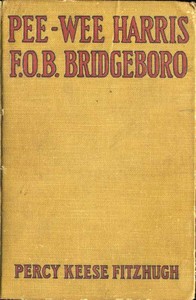
Pee-wee Harris, F.O.B. Bridgeboro — Story, Setting & Ideas
(0 User reviews)
525
Project Gutenberg
2019
Not confirmed
Camps -- Juvenile fiction; Boy Scouts of America -- Juvenile fiction; Relay racing -- Juvenile fiction
Readers of public-domain and historical texts
Project Gutenberg digital edition
en
Edition facts
Words
39,899
Reading time
174 min
Text sections
34
This digital edition of Pee-wee Harris, F.O.B. Bridgeboro — Story, Setting & Ideas is described by source-level measurements including 39,899 words, 2 hr 54 min estimated reading time, and 34 detected text sections.
The text analysis averages about 15.6 words per sentence, while the detected sections provide another way to judge how the source is divided.
Project Gutenberg metadata also associates the work with “Camps -- Juvenile fiction,” connecting these edition facts with the source record’s subject description.
Source:
Project Gutenberg record #59405
Percy Keese Fitzhugh's 1923 novel follows Pee-wee Harris on a relay race from Bridgeboro to Temple Camp, mixing Scout adventure with comic mishaps. The narrative voice shifts between hyperbole and deadpan, while the pacing accelerates from leisurely camping preparations to frantic, chain-linked episodes.
Editorial Edition Score
4.8/5
★★★★★
★★★★★
Calculated from edition completeness, EPUB availability, text structure and catalogue metadata. Not a user rating.
How this score is calculated
- Description quality20 pts
- Title & short description10 pts
- Source metadata20 pts
- Text length15 pts
- Chapters / structure15 pts
- EPUB file integrity20 pts
Total of 100 points, scaled to a 2.5-5.0 range. Editions with an empty description or a missing EPUB file are not scored.
Edition quality
Read the Text
nothing about Pee-wee which he opened as often as his mouth, unless it was his scout handbook. And on one occasion when he opened his scout handbook, he put his foot in it with a vengeance. And thereby hangs a tale. There can be no doubt that Pee-wee knew all about scouting—oh _everything_. But the trouble was that he did not know all about scouts. And this was his undoing.
It is a harrowing story with a frightful ending. Scouts right and left died—laughing. As one of the girls connected with it said, “it was just killing.”
The story, as I shall relate it, begins with Pee-wee sitting on the railing of his porch, reading his scout handbook. He was glancing over the hints on camping, for he and Townsend Ripley were going to Temple Camp in Townsend’s flivver and although they would probably be not more than two or three days making the trip, Pee-wee intended to carry a commissary which would hold out for several weeks. He was not going to run any risk of being stranded in the desert wastes of Ulster County without supplies.
Pee-wee was now the “feature” of the new Alligator Patrol, of which Townsend Ripley was patrol leader. But in a certain sense it might be said that the new Alligator Patrol was a part of Pee-wee. It was just as much a part of him as his voice and his appetite, and these were certainly parts of him.
In a broad sense, it cannot be said that Pee-wee was _in_ anything (unless it was the apple barrel in the cellar). Things were in Pee-wee, all sorts of things, patrols, troops, ideas, everything. He consumed everything that he touched. Even the Boy Scouts of America was a part of Pee-wee.
Pee-wee had deserted the Ravens of the First Bridgeboro Troop for the purpose of organizing a new patrol. That was at Temple Camp and he had organized the Pollywogs, consisting of two members who for a while submitted to his autocratic sway. But the Pollywogs became frogs and hopped away. There was too much coming and going at Temple Camp for permanent organization.
Returning to the more stable population of his own town, Pee-wee had formed the Alligators and, like the true dictator that he was, had made Townsend Ripley patrol leader. But the power behind the throne was Scout Harris.
Shortly after the formation of the Alligator Patrol (which was intended to form the nucleus of a new Boy Scouts of America) it was annexed (in defiance of international law) to the First Bridgeboro Troop and thus came under the wise and kindly supervision of Mr. Ellsworth, scoutmaster of that familiar and lively troop.
With four patrols, Ravens, Silver Foxes, Elks and Alligators, Mr. Ellsworth, that never-tiring friend of scouting, had his hands full. In the new patrol was little Joe McKinny, alias Keekie Joe of Barrel Alley, so really Mr. Ellsworth’s hands were more than full, they were overflowing.
When school closed the entire troop excepting Pee-wee and Townsend Ripley went to Temple Camp in the Catskills. The reason why Townsend deferred his going was because his parents intended shortly to go to Orange Lake, near Newburgh, to spend the summer and wished Townsend to drive them there in the flivver.
He intended then to motor on to Temple Camp, which, as all friends of the Bridgeboro boys know, is situated among the mountains five or six miles in from Catskill Landing. Pee-wee, who loved everything, above all things loved motoring, and he had lingered behind to accompany Townsend and, as he said, “show him the right way.”
“You have our sympathy,” Roy Blakeley of the Silver Foxes had said to the leader of the new patrol.
“That’s all right,” Townsend had said; “the flivver makes lots of noise and will drown his voice. Don’t worry about me, I’m all right. We’ll come rattling up to camp in a few days.”
“Maybe we’ll be there in two days,” Pee-wee had shouted.
“Don’t hurry,” Roy had answered.
“Maybe we’ll be there by Saturday,” Pee-wee had announced in a voice of thunder.
“Any time you’re passing we’d be glad to see you—pass,” Roy had said.
“Drop in some time when you’re at the lake,” Connie Bennett had remarked.
And so they had gone and Pee-wee had spent three rather lonesome days waiting for Townsend’s parents to get ready to go to Orange Lake. It was during that time that he had his great inspiration.
From its first sentence, Pee-wee Harris, F.O.B. Bridgeboro establishes a narrator who delights in exaggeration: Roy Blakeley observes that whenever Pee-wee opened his mouth he put his foot in it, and the narrator adds that his mouth was open “probably a hundred and twenty per cent of the time.” This playful inflation of statistics sets the tone for a story where the humor depends on the gap between Pee-wee’s self-assurance and his actual competence. The opening chapter also introduces a structural pattern: Pee-wee’s scout handbook is treated almost as a character, a source of knowledge that he applies with disastrous literalness. The narrative voice is consistently ironic, undercutting Pee-wee’s grand plans with dry asides about his appetite and his tendency to treat the Alligator Patrol as an extension of himself.
Voice and Hyperbole
The narrator’s voice is the book’s most distinctive feature. It oscillates between mock-heroic and matter-of-fact, often within the same paragraph. For instance, the opening declares the story “harrowing with a frightful ending” and notes that scouts died laughing—a claim that is both absurd and literally impossible within the story’s frame. This hyperbolic register is not consistent, however. When Pee-wee is stranded in the railroad tower house, the prose becomes more restrained, describing the gathering darkness and the “solemn, silent night” with a quiet precision that contrasts sharply with the earlier bombast. The shift suggests that the narrator’s exaggeration is a deliberate comic device rather than a default style. The use of italics for emphasis (e.g., “oh everything”) further underscores the oral, performative quality of the narration, as if the story is being told aloud to a knowing audience.
Pacing and the Chain of Events
The novel’s structure is built around a relay race, and the pacing mirrors that format: short, linked episodes that accelerate as the story progresses. Early chapters, such as “The Only Original” and “The Fateful Gum-Drop,” move at a leisurely pace, filled with dialogue and character setup. But by the time Pee-wee is marooned in the tower house, the narrative tightens. The description of the abandoned factory, the branch track, and the switch lever is detailed and unhurried, yet it builds tension through accumulation of sensory detail—the “silver” rails, the “dull and rusty” siding, the “deep, melodious whistle” of an approaching locomotive. This moment of suspense is typical of the book’s rhythm: long, patient setups followed by sudden, often comic, payoffs. The chapter titles themselves, like “Chaos and Confusion” and “Up in the Air,” signal a preference for escalating disorder over linear progression.
Setting and the Flivver
The setting is not merely background but an active agent in the plot. The flivver (a Model T Ford) is introduced as a means of transport, but it quickly becomes a source of mechanical trouble and comic delay. The journey from Bridgeboro to Temple Camp is punctuated by breakdowns, wrong turns, and encounters with local characters. The tower house episode, in particular, transforms a mundane railroad crossing into a stage for Pee-wee’s resourcefulness—and his impulsiveness. The narrator’s attention to the physical environment—the “deserted houses,” the “large wooden structure” that might be a factory, the “branch track” curving behind it—gives the setting a documentary quality that grounds the fantasy. Yet the description remains tethered to Pee-wee’s limited perspective: he sees the rails as “two lines” and infers the factory’s history from its size. The setting is thus filtered through his curiosity, making the landscape a reflection of his character.
Readers should pay attention to the way Fitzhugh uses chapter titles as punchlines and the narrator’s asides as a running commentary on Pee-wee’s logic. The book rewards those who notice the gap between what Pee-wee thinks he knows and what the reader can infer. The flivver, the handbook, and the relay race are not just props but mechanisms that generate both plot and comedy. Approach the story as a series of escalating misunderstandings rather than a straightforward adventure, and the humor becomes sharper.
We’ve kept Pee-wee Harris on the shelf for decades, his relay race a breathless muddle. Yet beside him sits a quieter companion, An Everyday Girl: A Story — Reading Notes, where the hurrying stops. Both share that odd loneliness of being always slightly out of step, and I’ve grown fond of how they whisper to each other across the years.
There are no reviews for this eBook.
There are no comments for this eBook.
Reader reflection
What was your reading experience?
Capture what you thought, learned, and would like to remember.
Your progress
0
/
10
2
Did this book hold your interest?
3
Would you encourage someone else to read it?
4
How easy was the book to follow?
5
How clearly were the main ideas presented?
6
Did the book give you something worth debating?
7
Was the book moving at the right speed?
8
What was its emotional impact?
9
In one sentence, what did you learn?
10