1

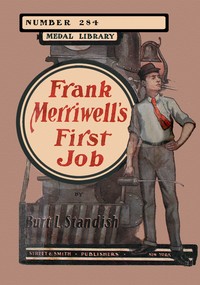
Frank Merriwell's First Job; Or, At the Foot of the Ladder — Key Ideas to Explore
(0 User reviews)
1152
Project Gutenberg
2021
Not confirmed
Adventure stories; Dime novels; Railroads -- Employees -- Juvenile fiction; Merriwell, Frank (Fictitious character) -- Juvenile fiction
Readers of public-domain and historical texts
Project Gutenberg digital edition
en
Edition facts
Words
58,688
Reading time
256 min
Text sections
49
For Frank Merriwell's First Job; Or, At the Foot of the Ladder — Key Ideas to Explore, the stored edition analysis reports 58,688 words, 4 hr 16 min estimated reading time, and 49 detected text sections.
The text analysis averages about 11.8 words per sentence, while the detected sections provide another way to judge how the source is divided.
Project Gutenberg metadata also associates the work with “Adventure stories,” connecting these edition facts with the source record’s subject description.
Source:
Project Gutenberg record #64635
In this 1898 dime novel, Frank Merriwell leaves Yale for a railroad job, facing jealous coworkers and physical danger. The text contrasts polished manners with rough labor, showing how courtesy and self-reliance play out in a roundhouse setting.
Editorial Edition Score
4.8/5
★★★★★
★★★★★
Calculated from edition completeness, EPUB availability, text structure and catalogue metadata. Not a user rating.
How this score is calculated
- Description quality20 pts
- Title & short description10 pts
- Source metadata20 pts
- Text length15 pts
- Chapters / structure15 pts
- EPUB file integrity20 pts
Total of 100 points, scaled to a 2.5-5.0 range. Editions with an empty description or a missing EPUB file are not scored.
Edition quality
Read the Text
II. FAREWELL TO YALE 11
III. ON THE WAY HOME 16
IV. THE REWARD OF WRONGDOING 23
V. THE MAN WHO WORKED THE WIRES 28
VI. THE SETTING OF THE SUN 34
VII. PHANTOM FINGERS 40
VIII. UNWELCOME VISITORS 46
IX. CAPTURED BY WHITECAPS 52
XI. FRANK’S STRANGE FRIEND 63
XII. FOR HIS ENEMY 69
XIII. THE BULLY OF THE ROUNDHOUSE 75
XIV. THE BULLY MEETS HIS MATCH 80
XV. STRIKING A JOB 86
XVI. THE FIRST FORENOON 91
XVII. THE STREET MUSICIANS 97
XVIII. UPLIFTED HEARTS 103
XIX. AN ANGRY ENGINEER 109
XX. SOME POINTS ABOUT HICKS 115
XXI. FRANK DISCOVERS A BREAK 120
XXII. THE INTERRUPTED SUPPER 126
XXIII. AN UNWELCOME RELATION 132
XXIV. FRANK EXACTS A PROMISE 137
XXV. ON A SWITCH ENGINE 143
XXVI. CAPTURING A WILD ENGINE 148
XXVII. FRANK’S FRIENDS 154
XXVIII. FIRING A FREIGHT ENGINE 160
XXIX. THE FIGHT ON THE ENGINE 165
XXX. MERRIWELL’S GENEROSITY 171
XXXI. AN UNGRATEFUL MAN 177
XXXII. ON THE STAIRS 182
XXXIII. UNDER THE CRUST OF A HUMAN HEART 188
XXXIV. THE REVELATION OF A SECRET 193
XXXV. THE LITTLE PILOT 200
XXXVI. “ON TIME, AT LAST!” 206
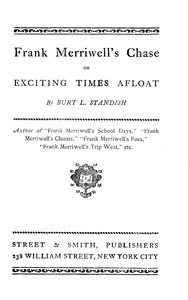
Frank Merriwell’s First Job OR AT THE FOOT OF THE LADDER
_By BURT L. STANDISH_
_Author of_ “Frank Merriwell’s School Days,” “Frank Merriwell’s Chums,” “Frank Merriwell’s Foes,” “Frank Merriwell’s Trip West,” etc.
STREET & SMITH, PUBLISHERS 238 WILLIAM STREET, NEW YORK CITY
Copyright, 1898 By STREET & SMITH
Frank Merriwell’s First Job
FRANK MERRIWELL’S FIRST JOB.
“Go at him, Rattleton!”
“Don’t let him knock you up against the door like that.”
“There you go again!”
“Oh, jose your claw--I mean close your jaw!” panted Harry Rattleton, as he ducked and escaped a left-hand swing from Frank Merriwell, with whom he was boxing in the room of the latter at Yale. “You fellows are not in this!”
“You’re not in it, either,” lazily laughed Bruce Browning, who was half sitting, half reclining on the couch, watching the boxing bout and smoking a pipe at the same time.
“Well, you weren’t such a much when you got up against Merriwell that time you tried to do him,” snapped Rattleton, backing out as Frank slowly followed him up.
“That’s ancient history,” declared the big fellow. “But Merriwell found me a pretty warm baby!”
“Get up and try him now!” cried Harry. “I’ll bet he’ll bang you all over the room before you touch him.”
“Thanks!” grinned Bruce. “I’ve quit the ring. I’m not looking for pugilistic glory any more.”
“Stand up to him, Rattleton,” advised Diamond. “You do too much running away.”
“Oh, you know!” flung back Rattleton. “You’ve had your turn, too, and you wasn’t so good.”
“You can’t do anything with him if you don’t try to hit him,” said Bart Hodge, who was sitting astride a chair in the corner.
“More thanks! If you’ll put the gloves on, I’ll guarantee you will not hit him any oftener than I have. I believe he gave you a dose of medicine once on a time. I’m the only fellow in the room who hasn’t been punched in earnest by him. You chaps are good talkers, but---- No you don’t.”
Then he went under Frank’s arm like a cat, giving Merry a sharp jab in the ribs.
“Well, that wasn’t so worse!” yawned Browning.
But Frank whirled swiftly and followed Harry, sparring for an opening, which he quickly got.
“Oh, my!” gurgled Harry. “That last one was on the nose! She’s beginning to bleed! I’m knocked out!”
He flung off the boxing gloves and got out his handkerchief in a hurry, for the blow on his nose had started the blood.
“Didn’t mean to hit you hard enough for that, Rattles,” said Frank, apologetically.
“Don’t mention it,” grinned Rattleton. “It’s nothing much. I don’t mind a little thing like that.”
Frank took off his gloves and hung the set up, after which he quickly set the room in order.
Rattleton’s nose bled very little, and he soon recovered.
“It seems to me you are worse than ever since your trip into Maine, Merriwell,” said Harry. “You’ll be a swift one on the football team this fall.”
“I shall not give much time to football,” Frank declared.
“No?” shouted Rattleton, Diamond and Hodge.
“Is that so?” grunted Browning. “You talked like that last fall, and you know what came of it. You had to get into gear in order to save Old Eli from being thrown down.”
“I know all about that; but it seems to me that I have done my part in the way of upholding the honor of Old Eli, and there should be somebody to fill my place by this time.”
“Why do you want anybody to fill your place?” asked Hodge.
The story opens with a boxing match in Frank Merriwell's Yale room, where the dialogue is peppered with slang like "jose your claw" and "soaker." Within a few chapters, Frank is forced to leave college and seek work on the railroad, shifting the setting from academic halls to the gritty roundhouse. The excerpts show a clear contrast between Frank's polite, well-bred demeanor and the coarse environment of the wipers and firemen. The narrative repeatedly emphasizes the value of courtesy, citing Washington and Napoleon, while Frank's actions—volunteering for tasks, listening rather than boasting—earn him both favor and jealousy.
From Yale to the Roundhouse
The transition from college to manual labor is abrupt. Chapter titles like "Farewell to Yale" and "On the Way Home" mark a swift departure from the familiar campus banter. Once at the railroad, Frank is assigned to clean engines, a job far removed from his previous life. The text notes that "the very air about him was different from that of the other wipers," yet he never acts superior. This tension between his background and his present circumstances is a recurring pattern. The foreman watches him "with astonishment" but says little, suggesting that Frank's conduct is being tested. Meanwhile, the bully Joe Hicks resents Frank's quick assignment to engine No. 33, setting up a conflict rooted in class and perceived favoritism.
Courtesy as a Weapon
The narrative explicitly argues that politeness is a practical tool. A passage states that "but for Washington's courteous bearing... the War of the Revolution might not have been brought to a successful close," and that Napoleon "often... put himself on a footing of perfect equality with the common soldiers." Frank embodies this philosophy: he remains polite to Hicks, even when Hicks glares and growls. The text claims that "Frank Merriwell lost no opportunity to please those with whom he was dealing." This is not mere niceness; it is strategic. The wipers initially see him as a "dude," but his willingness to do any work and his refusal to grumble gradually win over some, while fueling jealousy in others. The contrast between Frank's polished manners and the rough, direct speech of characters like Old Slugs—who warns Frank in plain terms—highlights the social friction.
Warnings and Undercurrents
Old Slugs, the man Frank thumped earlier, approaches him with a warning: "You've got a bad man down on you." He identifies Hicks as the threat, noting that Hicks "don't have to have a reason" to hate someone. This moment is striking because it comes from a former adversary, showing that Frank's fair play has earned him an ally. The warning is delivered in a hushed, conspiratorial tone—"I don't want it known I made any talk"—suggesting a code among the workers. Frank, however, seems naive, asking for a reason and expressing disbelief. The pattern of hidden hostility and open jealousy recurs throughout the excerpts, with Hicks's muttered threats and Frank's oblivious politeness creating a tense undercurrent. The reader senses that a confrontation is inevitable, though the excerpts do not reveal its outcome.
Readers should pay attention to how the narrative uses historical examples of courtesy to frame Frank's behavior. The contrast between the boxing match's rough energy and the roundhouse's gritty labor is deliberate. Notice how minor characters like Old Slugs and the foreman serve as barometers of Frank's progress. The story rewards close observation of small gestures—a volunteered task, a polite reply—that accumulate into a portrait of character under pressure.
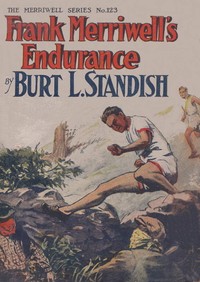
Reading Frank Merriwell's First Job, I found myself oddly touched by how his dignity held steady among the engine grime. It reminded me of another quiet thread—the same inner compass in a different sort of storm. I thought of Frank Merriwell's Endurance; or, A Square Shooter — Story, Setting & Ideas, and how endurance there felt less like bravado, more like a long, patient breath.
There are no reviews for this eBook.
There are no comments for this eBook.
Reader reflection
Your personal reading reflection
Build a private reading journal entry for this title.
Your progress
0
/
10
2
Did this book hold your interest?
3
Would you recommend this book to another reader?
4
How demanding did the text feel?
5
Would you like to discuss this book with someone?
6
How much did the book move you?
7
Did anything about the book feel genuinely new?
8
How would you describe its reading pace?
9
What changed or sharpened your thinking?
10