1

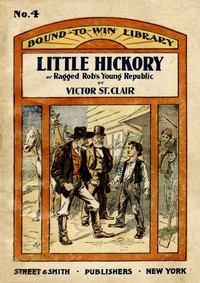
Little Hickory; or, Ragged Rob's young republic — Edition Insights
(0 User reviews)
613
Project Gutenberg
2022
Not confirmed
Adventure stories; Teenage boys -- Fiction; Poor -- Fiction
Readers of public-domain and historical texts
Project Gutenberg digital edition
en
Edition facts
Words
50,575
Reading time
220 min
Text sections
41
The catalog record for Little Hickory; or, Ragged Rob's young republic — Edition Insights provides practical reading context through 50,575 words, 3 hr 40 min estimated reading time, and 41 detected text sections.
The text analysis averages about 17.0 words per sentence, while the detected sections provide another way to judge how the source is divided.
Project Gutenberg metadata also associates the work with “Adventure stories,” connecting these edition facts with the source record’s subject description.
Source:
Project Gutenberg record #68532
This editorial note examines how George Waldo Browne's 1901 adventure novel uses its catalog subjects—poverty, teenage boyhood, and survival—through the specific lens of the excerpts, noting the bootblack's dialect, the sod camp setting, and the tension between self-reliance and community aid.
Editorial Edition Score
4.8/5
★★★★★
★★★★★
Calculated from edition completeness, EPUB availability, text structure and catalogue metadata. Not a user rating.
How this score is calculated
- Description quality20 pts
- Title & short description10 pts
- Source metadata20 pts
- Text length15 pts
- Chapters / structure15 pts
- EPUB file integrity20 pts
Total of 100 points, scaled to a 2.5-5.0 range. Editions with an empty description or a missing EPUB file are not scored.
Edition quality
Read the Text
ER I. THE BOOTBLACK AND THE DEACON.
“I vum! I eenamost feel as if I was lost, though there do seem to be plenty o’ folks round.”
“Black yer boots and make ’em shine; only cost ye half a dime!” cried a cheery voice at the speaker’s elbow, and, looking down, the tall man was surprised to see a specimen of boyhood quite unknown to him. The features were regular enough, and would have been quite handsome had it not been for big patches of shoe blacking smeared over cheek and brow. Blue eyes peered out from the dark stains around them with a roguish twinkle, and there was a certain fearless independence in his looks and attitude which could not fail to show the most casual observer the fearlessness and self-reliance of his nature. It was his clothes, his general deportment, the air of cool contempt for everything and everybody around him which caused the stranger fresh from the country to stare upon the bootblack of the great city with speechless wonder.
“When yer eyes git done working and blinking, mister, p’raps ye will give yer tongue a chance,” said the young knight of the blacking brush, beginning to remove from his shoulder the ever-handy kit of his trade. “Better hev yer brogans shined up, mister; they need it bad.”
The reply of the man showed that something of greater moment to him at that time than his personal appearance was uppermost in his mind.
“Say, bub, can you tell me where there is a good tavern that a chap could stop at till to-morrer?”
“Sold ag’in, Ragged Rob!” cried one of half a dozen companions of his ilk, who had appeared upon the scene from all quarters. “When ye git through wi’ th’ ol’ hayseed, ye mought as well git out o’ bizness, for ye won’t hev blackin’ ’nough ter tip a gent’s boot. So long!” and the crowd beat a hasty retreat, to look for work in a more favorable direction.
“Get a move on you, old mossback, or the cops will haul you in for obstructing the sidewalks!” muttered a beetle-browed passer-by, who followed his words with a push which nearly threw the countryman off his feet.
“Geewhillikins, how the folks do crowd! Beats all natur’. What’s that you say, bub?”
“I say ye might find sich a stable as ye want by lookin’ in the right-hand corner. Luck to ye, ennyway,” and the bootblack was speedily lost in the crowd.
“Drat the leetle feller’s pictur! If I had my thumb and finger on him I’d pinch his throat for answering a civil question in that oncivil way.”
“What was that you said, friend?” asked a man, who had come hurrying toward him. “Why, can this be possible?” continued the newcomer, slapping him on the shoulder. “By Jove, but this is the pleasantest surprise of my life. Have you just come to New York, Mr. Reyburnbrook?”
By this time the man from the country was able to get a good view of the speaker, who was a tall, genteel, well-dressed person of middle life, and he said:
“Guess ye air mistook in your man this time, mister. I ain’t no sich name as Bumbrook at all. I’m just plain Elihu Cornhill, deacon o’ the church at Basinburg, where I wish I was this blessed minute. Things and folks air so tarnal thick round here one can’t draw a long breath, and----”
“Excuse me,” interrupted the other, “I can see my mistake now, Deacon Cornhill, and I offer a thousand apologies for troubling you. Do you know you look as like a friend of mine as a pea in the same pod? Good-day.”
“It’s funny queer!” exclaimed the bewildered Deacon Cornhill, “folks air in sich a pesky hurry they can’t stop to put one on his right track. I s’pose I must keep jogging, as if I was over in our lot looking for the cows.”
Meanwhile, the man who had left so abruptly after accosting him, sought another a short distance away, and who had evidently been waiting for him. Together the couple hastily examined a condensed New England directory, which the former produced from his pocket. After a short consultation they separated, one going at right angles to the street, followed by the unsuspecting countryman, while the other gave him pursuit.
Finding that the crowd of passers-by jostled him as he hastened on his way, Deacon Cornhill gathered his huge gripsack close under his right arm, pulled his hat down upon his large head, and kept stubbornly on his way, regardless of the elbowing and pushing of others, saying under his breath:
The opening chapter of Little Hickory; or, Ragged Rob's young republic introduces its protagonist not through a description of his poverty but through his voice: a bootblack who addresses a stranger with the rhyming cry, “Black yer boots and make ’em shine; only cost ye half a dime!” The catalog subjects list “Teenage boys -- Fiction” and “Poor -- Fiction,” but the excerpts show that the boy’s poverty is less a condition to be pitied than a platform for his “fearless independence.” His clothes are ragged, yet his attitude is one of “cool contempt” for passersby. The narrative voice, too, is distinctive: the man from the country is said to stare “with speechless wonder,” a phrase that aligns the reader with the provincial outsider rather than the streetwise boy.
Dialect and Deference
The bootblack’s speech is rendered in a thick dialect—“I vum! I eenamost feel as if I was lost”—that marks him as both uneducated and shrewd. The man he addresses is called “mister,” but the boy’s tone is not deferential; he commands attention. Later, when Rob (the same character, now called “Little Hickory”) speaks to Dr. Menter, his language shifts to a more standard register: “Good-morning, sir. I hope you are well.” This code-switching suggests that the boy can modulate his speech depending on his audience, a skill that the catalog subject “Poor -- Fiction” might imply is absent. The excerpts do not reveal whether this linguistic flexibility is a survival tactic or a sign of hidden education, but it is a notable pattern in the available text.
The Sod Camp as a Stage
The setting of the “coal camps” and “sod camps” is described in stark terms: Dr. Menter declares them “not fit for a pig to live in.” Yet the characters treat this space as a temporary base for action. Rob’s mother is present, and the camp houses a sick man, Mr. Little, but the narrative focus is on the notice posted by selectmen and the plan to move to the “old red house” across the town line. The catalog subject “Adventure stories” is fulfilled not by exotic locales but by the mundane geography of town boundaries. The excerpts show that the adventure here is legal and spatial: the characters must outmaneuver local authorities by relocating a few feet over an invisible line. This is a survival tale rooted in property law, not wilderness.
Self-Reliance and Its Limits
Rob’s declaration “I am going to look for better times” echoes the self-reliance often associated with adventure protagonists. Yet the excerpts also show that help comes from outside: Dr. Menter offers free medical care and the crucial information about the red house. The catalog subject “Teenage boys -- Fiction” might suggest a lone hero, but the text presents a network of assistance. The boy’s mother, friend Joe, and even the doctor all contribute. The phrase “Ragged Rob's young republic” in the title hints at a collective enterprise, and the excerpts bear this out: the group acts together, with Rob as a leader but not a solitary figure. The tension between individual pluck and communal aid is a recurring thread in the available passages.
Readers approaching Little Hickory should attend to the way Browne uses dialect, setting, and group dynamics to construct a story that is both an adventure and a social commentary. The excerpts offer a glimpse of a protagonist who is resourceful but not invincible, and a world where survival depends on knowing when to speak differently and where to move. The full novel likely expands on these tensions, but the evidence here suggests a work more interested in practical problem-solving than in pure derring-do.
That rainy afternoon, Little Hickory left me lingering on its sod-camp quiet—how the bootblack’s pride softened when neighbors appeared. Later, drifting off toward sleep, I found myself wondering about another kind of roaming: a girl’s voice, lighter, more elusive. The warm dust of that old prairie seemed to settle, almost miraculously, beside a caravan’s fire—A little gipsy lass — Reading Companion felt less like a new book than a distant echo.
There are no reviews for this eBook.
There are no comments for this eBook.
Reader reflection
Before you leave, reflect on the book
Use these questions to collect your thoughts before moving on.
Your progress
0
/
10
2
How much did you enjoy the reading experience?
3
Would you pass this book on to a friend?
4
How easy was the book to follow?
5
Would you read this book again?
6
Did anything about the book feel genuinely new?
7
Would you start a conversation about this book?
8
Could you apply anything you learned?
9
What changed or sharpened your thinking?
10