1

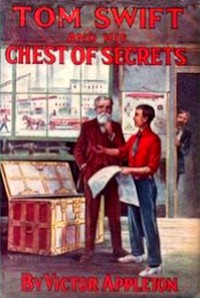
Tom Swift and his chest of secrets — Context and Discussion
(0 User reviews)
1062
Project Gutenberg
2024
Not confirmed
Detective and mystery stories; Adventure stories; Swift, Tom (Fictitious character) -- Juvenile fiction
Readers of public-domain and historical texts
Project Gutenberg digital edition
en
Edition facts
Words
49,419
Reading time
215 min
Text sections
7
Before opening Tom Swift and his chest of secrets — Context and Discussion, the edition data offers a quick orientation: 49,419 words, 3 hr 35 min estimated reading time, and 7 detected text sections.
The text analysis averages about 13.8 words per sentence, while the detected sections provide another way to judge how the source is divided.
Project Gutenberg metadata also associates the work with “Detective and mystery stories,” connecting these edition facts with the source record’s subject description.
Source:
Project Gutenberg record #72659
Tom Swift investigates the theft of his inventions, aided by his giant servant Koku and friend Ned Newton, in a 1925 adventure that blends mystery, firefighting, and a romantic subplot with Mary Nestor.
Editorial Edition Score
4.7/5
★★★★★
★★★★★
Calculated from edition completeness, EPUB availability, text structure and catalogue metadata. Not a user rating.
How this score is calculated
- Description quality20 pts
- Title & short description10 pts
- Source metadata20 pts
- Text length15 pts
- Chapters / structure15 pts
- EPUB file integrity20 pts
Total of 100 points, scaled to a 2.5-5.0 range. Editions with an empty description or a missing EPUB file are not scored.
Edition quality
Read the Text
in the rapidly growing business, though Tom always consulted his father on matters of importance.
It was at the suggestion of Mary Nestor, for whom Tom had a very great admiration, that the young inventor engaged his friend and boyhood chum, Ned Newton, to look after the business matters of the Swift Construction Company. Tom never had reason to regret that decision. For with Ned to look after money matters, see to contracts, and the like, Tom and his father were left free to exercise their inventive ability.
The Swift Company had gone into many lines of activity, from building airships and aeroplanes to constructing submarines and giant cannon for the government. These brought Tom and his associates money and fame, and also hard work.
Just prior to the opening of this story Tom had developed a new drill and a system of sinking shafts for oil wells, and when, as related in “Tom Swift and His Great Oil Gusher,” he successfully demonstrated how quickly he could get down to the oil-containing sand, he made another big amount of money, not only for the Swift Company, but for the Goby family as well.
It was after this that he began to think of getting together in one central place all his drawings, patent rights, secret formulae and the like. To this end he had had constructed the strong chest, and he and Ned had barely finished putting into it most of the valuable documents when the crash on the roof came.
“He doesn’t seem to be hurt, Tom,” remarked Garret Jackson, Tom’s shop manager, as he laid Mr. Damon on a pile of coats and jackets which some workmen hastily spread on the roof.
“Hurt! Bless my doctor’s bill, I’m not hurt at all!” exclaimed the odd man. “I’m shaken up, but I’m more worried about the plane than about myself. Is it all right, Tom? I tried to avoid the chimney, but I’m afraid one wheel grazed it.”
“Yes, that’s what happened,” replied the young inventor, as soon as he had made sure his friend was not hurt and had had time to inspect the craft. “You damaged it a little. But I can easily put on another wheel. I have some spare ones for that model.”
“Have you, Tom? That’s fine! Put one on and I’ll fly off your roof. You may charge me storage if I stay here too long,” and Mr. Damon laughed in a way which showed, better than anything else, that he had suffered no ill effects from the sudden ending of his flight.
“Are you going to trust yourself again to that plane?” asked Mr. Jackson.
“Of course I’m going to fly again!” cried the odd man. “A little bump like this doesn’t disturb me. I’ve been in worse smash-ups; haven’t I, Tom?”
“Off hand, I should say you had,” was the smiling answer.
“Besides, I want to learn how to run this jigger!” cried Mr. Damon, sitting up on the pile of workmen’s garments while the men gathered smilingly about him, for they all knew him. “What did I do wrong, Tom? Or is the steering gear out of order?”
“It seems to be all right,” answered the young inventor, who had been looking at the mechanism. “Tell me just what happened.”
“Well, as I say, I was coming over to see you. Or, if I didn’t say that before, I tell you now. I have a big offer for you, Tom Swift, a most important offer. I’ll get to that in a moment. But I was coming over in this plane, which I bought only yesterday, and I decided to fly across your shop and land in the meadow.
“But, just as I got here, I felt the machine dip suddenly. First I thought I had struck an air pocket, but I didn’t have time really to decide what it was before I came down with a crash. Luckily I was able to straighten her out a little before I struck, so I made a slanting landing. Otherwise I might have gone through the roof.”
“And right down on our heads!” exclaimed Ned. “Mighty glad you didn’t!”
“So am I,” said Mr. Damon. “But what’s wrong, Tom? I want to know so that the same thing won’t happen again.”
“I guess you forgot that you were in a monoplane instead of a biplane, Mr. Damon,” he answered. “You banked too much on the turn.”
“That’s it, Tom! I remember now! I was making the curve to head straight for the meadow, and it was then a sort of side slip came.”
The story opens with a crash on the roof, immediately introducing the oversized servant Koku, whose broken English and physical strength set a comic tone. Tom Swift is poring over blueprints when Koku’s antics interrupt, leading to banter with business manager Ned Newton. The early chapters establish a pattern of sudden disruptions—offers, fires, and attacks—that propel the plot forward.
Catalog subjects classify this as detective and adventure fiction, and the excerpts confirm a mystery centered on stolen inventions. However, the text also devotes significant space to a forest fire sequence and a romantic interlude with Mary Nestor, elements not captured by the subject headings alone.
Voice and Character Dynamics
The narrative voice alternates between brisk action and lighthearted dialogue. Koku’s speech—“Where you have ’um, Master?”—marks him as a comic figure, while Ned’s teasing remark about Koku catching Eradicate reveals a familiar, joking relationship among the characters. Tom’s annoyance is mild, and the tone remains buoyant even during crises.
Mary Nestor’s appearance shifts the register: her self-deprecating comment about her hair and Tom’s compliment “You look fine!” show a romantic subplot that contrasts with the mystery. The catalog’s subject “Swift, Tom (Fictitious character) – Juvenile fiction” fits, but the excerpts show that supporting characters like Koku and Mary carry much of the emotional weight.
The Forest Fire as a Set Piece
Chapters I–XXV include a lengthy forest fire episode that occupies several pages. Tom and Mary take shelter in a cave, watching rain extinguish the blaze. The description is sensory: “the drops pelt down,” “the blaze flickering out,” and “the loud murmuring of the brook.” This sequence is not directly tied to the stolen inventions, suggesting the book uses natural disaster as both a suspenseful interlude and a way to develop Tom’s resourcefulness.
After the fire, Tom telephones for a taxicab—a mundane detail that grounds the adventure in 1920s technology. The catalog’s “Adventure stories” label applies, but the fire episode is more survival tale than detective work, hinting at a broader scope than the subject headings imply.
Mystery and Violence in the Home
The mystery element emerges late in the excerpts when Tom learns of an attack on his father and housekeeper Mrs. Baggert. The assault is described as “mysteriously attacked and momentarily knocked senseless,” with Eradicate also “savagely set upon.” This violence occurs in the family home, contrasting with the earlier lighthearted tone.
The catalog lists “Detective and mystery stories,” and the excerpts confirm a theft plot, but the attack is personal, not a mere puzzle. Tom’s immediate response—sending for Ned and the runabout—shows his reliance on friends and technology. The mystery is thus embedded in domestic life, not exotic locales.
Readers should note that the excerpts cover only the first half of the book; the resolution of the stolen inventions and the identity of the attacker remain unknown from this sample. The text balances multiple genres—detective, adventure, romance, and disaster—within a single narrative, so those expecting a pure mystery may be surprised by the forest fire interlude. Pay attention to how Tom’s inventions are described when they appear; the excerpts show blueprints and a runabout, but the titular chest of secrets is not yet explained.
There are no reviews for this eBook.
There are no comments for this eBook.
Reader reflection
Before you leave, reflect on the book
Use these questions to collect your thoughts before moving on.
Your progress
0
/
10
2
Was reading this book enjoyable?
3
How likely are you to recommend this book?
4
What was the reading difficulty like?
5
How much did the book move you?
6
What did you think about the pace?
7
How clear did the writing feel?
8
Did the book deliver what you hoped for?
9
What is the main idea you are taking away?
10