1

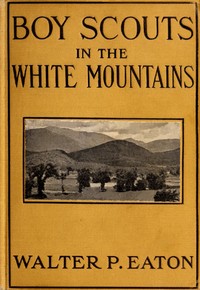
Boy Scouts in the White Mountains: The Story of a Long Hike — A Closer Reading
(0 User reviews)
29
Project Gutenberg
2021
Not confirmed
Hiking -- Juvenile fiction; Boy Scouts -- Juvenile fiction; White Mountains (N.H. and Me.) -- Juvenile fiction
Readers of public-domain and historical texts
Project Gutenberg digital edition
en
Edition facts
Words
69,846
Reading time
304 min
Text sections
29
The catalog record for Boy Scouts in the White Mountains: The Story of a Long Hike — A Closer Reading provides practical reading context through 69,846 words, 5 hr 4 min estimated reading time, and 29 detected text sections.
The text analysis averages about 14.1 words per sentence, while the detected sections provide another way to judge how the source is divided.
Project Gutenberg metadata also associates the work with “Hiking -- Juvenile fiction,” connecting these edition facts with the source record’s subject description.
Source:
Project Gutenberg record #65539
An editorial note on Walter P. Eaton's 1914 Boy Scouts novel, focusing on the tension between scenic description and practical hiking logistics, the use of local landmarks as narrative anchors, and the contrast between modern motor travel and the Scouts' stated mission of walking.
Editorial Edition Score
4.9/5
★★★★★
★★★★★
Calculated from edition completeness, EPUB availability, text structure and catalogue metadata. Not a user rating.
How this score is calculated
- Description quality20 pts
- Title & short description10 pts
- Source metadata20 pts
- Text length15 pts
- Chapters / structure15 pts
- EPUB file integrity20 pts
Total of 100 points, scaled to a 2.5-5.0 range. Editions with an empty description or a missing EPUB file are not scored.
Edition quality
Read the Text
urned red. “Shut up,” he said. “You wait till _you’re_ all dolled up, and see what _you_ look like!”
“Yes, and you’d better be getting dressed right away,” said one of the teachers to Peanut, who scampered off laughing.
Art stood about, very uncomfortable, watching the other boys and girls come from the dressing rooms, in their costumes. It was the dress rehearsal for a Colonial pageant the Southmead High School was going to present. They were going to sing a lot of old-time songs, and dance old-time dances (the girls doing most of the dancing). The stage was supposed to represent a Colonial parlor. Several people had loaned the school old mahogany furniture, the light was to come largely from candles, and finally, while the party was supposed to be in full blast, a messenger was going to dash in, breathless, announce the Battle of Lexington, and call the men-folks of Southmead to arms. Then the men would run for their guns, say good-bye to the women, and march off. Art couldn’t see why they should march off in all their best clothes, and had said so to the teacher who got up the play, but she had pointed out that they couldn’t afford to hire two costumes for all the boys, so they’d just have to pretend they went home for their other clothes. Art was not yet satisfied, however.
The girls were in funny old costumes with wide skirts and powdered hair. They were all having a much better time than Art was.
“Gee, they _like_ to dress up,” thought Art, as he watched Lucy Parker practicing a courtesy before her own reflection in a glass door, and patting her hair.
Peanut didn’t have to dress up in these elaborate clothes. He was the messenger who rushed in to announce the call to arms. He was also his own horse. Putting a board across two chairs just behind the door leading to the stage, he took a couple of drumsticks and imitated a galloping horse, beginning softly, as if the horse was far away, and drumming louder and louder till the horse was supposed to reach the door. Then he cried “Whoa!”, dropped the drumsticks, and dashed out upon the stage. Peanut had been rehearsing his part at home, and the imitation of the galloping horse was really very good.
As soon as everybody was dressed, the rehearsal began, with the music teacher at the piano, and the other teachers running about getting the actors into place. Lucy Parker was supposed to be giving the party in her house, and the other characters came on one by one, or in couples, while Lucy courtesied to each of them. The girls courtesied back, while the men were supposed to make low bows. There weren’t many lines to speak, but Dennie O’Brien was supposed to be a visiting French count, with very gallant manners, and he had to say “Bon soir, Mademoiselle Parker” (Lucy’s ancestors had lived in Southmead during the Revolution, so she kept her own name in the play), and then he had to lift her hand and kiss it. Dennie had never been able to do this at any of the rehearsals yet without giggling, and setting everybody else to giggling. But this time the teacher in charge spoke severely.
“Now, Dennis,” she said, “this is a dress rehearsal. You go through your part right!”
“Yes’m,” Dennie answered, feeling of the little black goatee stuck on his chin to see if it was on firm, and trying to keep his face straight.
When his turn came to enter, he got off his “Bon soir, Mademoiselle Parker” all right, and bowed over her hand without a snicker. But, just as he kissed her fingers, his goatee came off and fell to the floor. Everybody laughed, except Lucy. She was mad at him, because she wanted the play to be a great success, and before he could lift his face, she brought her hand up quickly and slapped his cheek a good, sounding whack.
Dennie jumped back, surprised. Then he picked up his goatee, while Lucy stamped her foot. “You great clumsy--_boy_!” she exclaimed.
“Serves you right, Dennis,” said the teacher.
“Well, I can’t help it if it won’t stick,” Dennie answered. “Gee, I’ll _bite_ your old hand next time!” he muttered to Lucy.
She ignored him, and the rehearsal proceeded. Art entered next, with Mary Pearson on his arm. Mary dropped a courtesy, and Art bowed.
The teacher clapped her hands for the rehearsal to stop. “Oh, Arthur,” she said, “don’t bow as if you had a ramrod down your back!”
“Well, I feel’s if I had,” said Art.
Walter P. Eaton's Boy Scouts in the White Mountains: The Story of a Long Hike opens not with a trail but with a costume change: Art Bruce in black silk knee-breeches and pasteboard buckles, a theatrical disguise that signals the book's blend of earnest scouting and playful adventure. The narrative quickly shifts to the road, where a motorcar—not boots—carries the troop toward the mountains. This tension between the ideal of a long hike and the convenience of automobile travel runs through the excerpts, as does Eaton's habit of piling up place names and scenic vistas with the enthusiasm of a guidebook writer.
Motorcars and Mountain Vistas
The opening chapter, 'Peanut Calls to Arms,' establishes a pattern: the Scouts are driven to their adventures. In Chapter IX, the motorcar becomes a moving viewpoint, allowing Eaton to deliver a panoramic tour of the White Mountains. The narrator ticks off Cannon, Lafayette, Garfield, the Twins, and the Presidentials as the car climbs a hill near Bethlehem. The prose shifts from road directions—'the road kept on going down'—to a sudden, almost cinematic reveal: 'they looked out across the valley to the whole panorama.' The boys react with exclamations ('Some sight!'), but the description remains the driver's, not the hiker's. Even Peanut's demand for sodas at a drug store undercuts the wilderness ethos. The car's speed is celebrated ('Pretty fast walking we're doing to-day!'), a joke that highlights the gap between the book's title and its actual locomotion.
Landmarks as Narrative Anchors
Eaton uses specific White Mountain landmarks to structure the journey. The excerpts mention Kinsman, Moosilauke, the Lafayette Ridge, the Old Man of the Mountain, Crawford Notch, Tuckerman's Ravine, Huntington Head Wall, the Great Gulf, and King's Ravine. These are not generic peaks; they are named with the precision of a trail map. The Crawford Notch chapter, for instance, describes the approach through Franconia, past the Gale River, and into Bethlehem, with the Fabyan House and Mount Pleasant House serving as waypoints. The narrative pauses at the 'gateway to the Crawford Notch,' a narrow defile between hills. This reliance on real geography gives the fiction a documentary quality, but it also means the story can feel like a guided tour, with the boys as passive observers rather than active explorers.
The Practicalities of Provisions
Amid the scenic set-pieces, Eaton repeatedly returns to the mundane details of hiking logistics. In Chapter IX, the Scouts realize they lack food for supper and that it is Sunday. The solution comes from Mr. Goodwin's chauffeur, who drives to the storekeeper's house; the storekeeper opens his store, remarking, 'I shouldn't want to see you fellers go hungry!' The episode is a small, concrete illustration of how the Scouts rely on adult assistance and local goodwill. Similarly, the earlier chapters (not fully excerpted) likely cover preparations, as suggested by the table of contents: 'Getting Ready for the Hike.' These practical concerns—food, transport, shelter—anchor the adventure in everyday problem-solving, even as the narrative reaches for the sublime. The contrast between the lofty peaks and the need for grub is a recurring, understated tension.
Readers approaching Boy Scouts in the White Mountains should expect a hybrid: part travelogue, part boys' adventure, with a strong undercurrent of early automobile tourism. The Scouts' long hike is more often a long drive, and the book's value lies in its period details—the motorcars, the summer hotels, the storekeeper who opens on Sunday—rather than in survival drama. Eaton's affection for the White Mountains is genuine, but his characters remain tourists, not trailblazers.
Years among these shelves taught me how a long hike measures itself in landmarks, not miles—Eaton’s Scouts knew that. There’s a similar quiet arithmetic in Odd made even — Inside the Classic, where what seems irregular finds its pattern. I’ve often thought both books share that patient gaze, turning rough terrain into something almost like familiarity.
There are no reviews for this eBook.
There are no comments for this eBook.
Reader reflection
How did this book work for you?
Your answers remain private and are stored only in this browser.
Your progress
0
/
10
2
What was your overall reaction to the book?
3
Is this a title you would suggest to others?
4
How easy was the book to follow?
5
Did you relate to its people, ideas, or situations?
6
Did you gain anything practical from the text?
7
How did the reading compare with what you expected?
8
How original did the book feel?
9
What did this book teach you most?
10