1

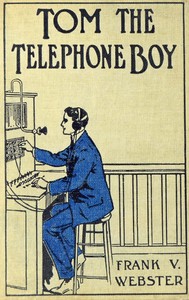
Tom the telephone boy; or, The mystery of a message — Key Ideas to Explore
(0 User reviews)
625
Project Gutenberg
2022
Not confirmed
Mystery and detective stories; Robbery -- Juvenile fiction; Telephone operators -- Juvenile fiction
Readers of public-domain and historical texts
Project Gutenberg digital edition
en
Edition facts
Words
47,427
Reading time
207 min
Text sections
31
The catalog record for Tom the telephone boy; or, The mystery of a message — Key Ideas to Explore provides practical reading context through 47,427 words, 3 hr 27 min estimated reading time, and 31 detected text sections.
The text analysis averages about 12.1 words per sentence, while the detected sections provide another way to judge how the source is divided.
Project Gutenberg metadata also associates the work with “Mystery and detective stories,” connecting these edition facts with the source record’s subject description.
Source:
Project Gutenberg record #68471
Tom Baldwin, a telephone operator in a law office, stumbles onto a mystery involving a suspicious customer and a cryptic message. The opening chapters establish his home life, job, and growing curiosity, while later excerpts show him studying law in his spare time and awaiting a follow-up from a mysterious caller.
Editorial Edition Score
4.9/5
★★★★★
★★★★★
Calculated from edition completeness, EPUB availability, text structure and catalogue metadata. Not a user rating.
How this score is calculated
- Description quality20 pts
- Title & short description10 pts
- Source metadata20 pts
- Text length15 pts
- Chapters / structure15 pts
- EPUB file integrity20 pts
Total of 100 points, scaled to a 2.5-5.0 range. Editions with an empty description or a missing EPUB file are not scored.
Edition quality
Read the Text
ownsend’s Book Emporium early the next morning. There were several other clerks employed, and Tom was told by the proprietor, Elmer Townsend, that his duties would be to run on all sorts of errands, to sweep out the store, dust the books, and, in a rush, wait on customers.
“I want you to make yourself as familiar as possible with the books,” said Mr. Townsend. “Here is a catalogue, and I have marked on it just what part of the store each book is in. The price of each book is written on the upper right-hand corner of the first fly-leaf, but as it is in letters, instead of figures, you will have to learn what the letters mean.”
Tom thought it was a queer plan to mark the selling-price in letters instead of figures, but he was soon enlightened.
“That is done so customers will not know the prices of books,” said his employer. “I take a word of ten letters, and each letter represents a figure from 1 to 0. Then, by combining the letters I can make any figure I want. Do you understand?”
Tom said that he did, and he had soon mastered the little problem so that he could, after a little study, tell the selling-price of any book, by looking at the small letters on the first page.
The book store was quite a large one. Tom had never seen so many volumes in one room before, except in a library, and he began to think he had come to just the right place, for he was fond of reading and study, and he made up his mind he would have a good time perusing his favorite volumes.
But if our hero had an idea that clerks in book stores spend their time pleasantly in looking at pictures and reading stories, he was soon disappointed.
He found himself ordered here and there by the other clerks. He had to bring books from the front of the store to the back, and from the back to the front. He had to get out bundles of wrapping-paper, and balls of twine. He had to dust off long rows of volumes, and when a clerk was trying to wait on two customers at once, Tom had to tie up books to be sent to various addresses given by the purchasers. The lad hoped he would be sent out to do some delivering, but he learned that the volumes went by a local express company, with which Mr. Townsend had a yearly contract.
Tom was in the back part of the store, arranging some pamphlets that had been scattered about, when he saw an elderly gentleman walk slowly along the aisle formed by the book tables, and pausing before some historic volumes, take one from the row on the shelves.
“Ha! Um! Here it is!” exclaimed the old gentleman, as he peered through his spectacles at the printed page. “I knew I was right. It isn’t there! Here, boy!” he called suddenly, glancing over the tops of his glasses at Tom. “Just you hold this book open a minute, right there, and keep your finger on this line,” and he held the volume out to the lad. Wonderingly, Tom complied.
The queer customer ran his finger along the row of books, took out another, leafed it over rapidly, and uttered an exclamation. Then, placing this book down on a table, and holding it open with one hand, he reached for a third volume, which he extended to Tom.
“Open that at page twenty-one,” he said.
“I can’t,” replied the boy, “unless I let go of this other book.”
“That’s so, I forgot. Well, give me the first book. I can keep two places at once.”
Tom passed it over, and the old gentleman now had two books open before him.
“Have you got page twenty-one?” he asked Tom, as he bent close over the opened books.
“Is there anything on it about the ancient Hickhites having used belladonna in fevers?”
“No,” answered Tom slowly, as he read down the page. “This seems to be an account of how to make a fruit cake.”
“A fruit cake! What do you mean?”
“This is a cook book, sir,” replied Tom.
“A cook book! Goodness me! I must have picked up the wrong memoranda when I hurried from the house.”
He rapidly searched through his pockets, and produced a crumpled piece of paper.
Tom Baldwin bursts into his house shouting “Hurrah! Good news, mother!”—a characteristic entrance that sets the tone for a boy eager to prove himself. He has landed a job as a telephone operator at a law office, and the early pages quickly establish his domestic circle: his mother and Aunt Sallie, who frets about snow tracked on a freshly cleaned carpet. The dialogue is brisk and natural, with Aunt Sallie’s complaint (“What terrible creatures boys are!”) balanced by Mrs. Baldwin’s gentler reply. The story wastes no time in introducing the central mystery: a “queer customer” appears in Chapter I, and Tom’s suspicions are aroused almost immediately.
A Boy’s World of Work and Home
The opening chapter reveals a household where money is tight and a job is cause for celebration. Tom’s mother is sewing upstairs, and the family’s modest circumstances are implied through small details: the carpet that has “only just cleaned,” the aunt’s presence, and Tom’s eagerness to share his news. The author, Frank V. Webster, uses dialogue to convey character—Tom’s energetic speech, his mother’s mild scolding, Aunt Sallie’s fussiness. This domestic scene grounds the adventure that follows, making Tom’s later exploits feel rooted in a recognizable world. The telephone switchboard, introduced as Tom’s workplace, becomes both a tool and a source of intrigue.
The Switchboard as a Stage for Suspense
Tom’s job at the law office places him at the center of communications. The excerpts show him handling calls, adjusting the switchboard, and overhearing fragments of conversation. When a mysterious message comes through, Tom’s position gives him access to information that other characters lack. The author uses the telephone as a plot device: calls arrive at critical moments, interrupting conversations and delaying revelations. For instance, just as Tom is about to discuss Barton Sandow with Mr. Keen, a call intervenes, and Mr. Keen hurries away. This technique builds suspense by withholding resolution. Tom’s curiosity is piqued, and the reader shares his frustration.
Tom’s Ambition Beyond the Switchboard
During quiet periods at work, Tom grows restless. He asks permission to read and is encouraged by a clerk to study law. Mr. Boise, the senior partner, approves when he sees Tom reading a law primer, remarking that adventure stories are fine “once in a while, but they are not good as a steady diet.” This moment reveals Tom’s seriousness and the supportive environment of the law office. The excerpts show him becoming “quite interested” in legal study, a subplot that suggests personal growth. The contrast between the mundane switchboard duties and the intellectual challenge of law gives Tom’s character depth beyond the mystery plot.
The Unfolding Mystery and Its Delays
The central mystery—the “mystery of a message” promised in the title—unfolds slowly. Tom’s suspicions about Barton Sandow are established early, but follow-up is repeatedly postponed. Mr. Keen goes out of town; Tom misses his chance to speak; days pass without Sandow calling again. The narrative uses these delays to build tension. Tom wonders, “Maybe I frightened him.” The reader is left with unanswered questions: Who is Sandow? What is the message? The excerpts provide only hints, such as Tom’s intention to “broach the subject” and the mention of “missing papers” in the table of contents. The story’s pacing relies on these interruptions, making each new development feel earned.
The excerpts present a story that balances everyday work life with a slowly emerging mystery. Tom’s character is defined by his energy, his family ties, and his growing ambition. Readers should pay attention to the small details of office routine and domestic conversation, as these create the backdrop against which the mystery unfolds. The telephone, a relatively new technology in 1909, is not just a prop but a narrative engine. As you read, note how Webster uses missed connections and delayed conversations to keep the plot moving.
There are no reviews for this eBook.
There are no comments for this eBook.
Reader reflection
Before you leave, reflect on the book
Use these questions to collect your thoughts before moving on.
Your progress
0
/
10
2
What was your overall reaction to the book?
3
Is this a title you would suggest to others?
4
What was the reading difficulty like?
5
How strongly did the book affect you emotionally?
6
Was the book easy to understand?
7
Would you read this book again?
8
Did it raise ideas you would like to talk about?
9
Which lesson or insight stayed with you?
10