1

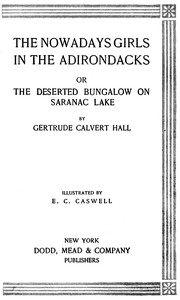
The Nowadays Girls in the Adirondacks — Context and Discussion
(0 User reviews)
144
Project Gutenberg
2025
Not confirmed
Vacations -- Juvenile fiction; Adirondack Mountains (N.Y.) -- Juvenile fiction; Teenage girls -- Societies and clubs -- Juvenile fiction
Readers of public-domain and historical texts
Project Gutenberg digital edition
en
Edition facts
Words
69,923
Reading time
305 min
Text sections
36
This digital edition of The Nowadays Girls in the Adirondacks — Context and Discussion is described by source-level measurements including 69,923 words, 5 hr 5 min estimated reading time, and 36 detected text sections.
The text analysis averages about 12.6 words per sentence, while the detected sections provide another way to judge how the source is divided.
Project Gutenberg metadata also associates the work with “Vacations -- Juvenile fiction,” connecting these edition facts with the source record’s subject description.
Source:
Project Gutenberg record #76084
Four members of the Nowadays Club—Sylvia, Rose, Alice, and Hazel—vacation in the Adirondacks, where a capsized canoe, a mysterious bungalow, and a chance encounter with a bronzed youth test their resourcefulness and camaraderie.
Editorial Edition Score
4.8/5
★★★★★
★★★★★
Calculated from edition completeness, EPUB availability, text structure and catalogue metadata. Not a user rating.
How this score is calculated
- Description quality20 pts
- Title & short description10 pts
- Source metadata20 pts
- Text length15 pts
- Chapters / structure15 pts
- EPUB file integrity20 pts
Total of 100 points, scaled to a 2.5-5.0 range. Editions with an empty description or a missing EPUB file are not scored.
Edition quality
Read the Text
What did concern her was reaching her friend Sylvia Pursell as soon as possible. There were more reasons than one for this, but perhaps the one with which we may now concern ourselves was that Rose had been travelling since early morning, having but just arrived at the Grand Central Terminal from Syracuse.
Travelling in even the best-portered Pullman, in the middle of the "Chicago Special," is very apt to grime one up, especially if the aforesaid one be wearing a particularly light and dainty dress. So Rose, as she was shot upward in the smooth-running elevator, wondered whether the coloured maid at the Grand Central had made sure that there was no cinder dust on the end of her nose.
"For," reflected Rose to herself, "if there is one thing more than another, that makes a girl lose her smartness and dignity, it is a black spot on the end of her nose."
And Rose had her special reasons for wanting to look at least "smart" when she reached Sylvia's apartment. I'll tell you why later. She ventured to glance into the bevelled mirror which made up the whole back of the car, but the electric bulb was shaded with a rose-tinted glass, and while it made a very pretty effect, still it was not conducive to illumination.
"I'm almost sure there's a spot," thought Rose, but she dared not raise her veil to make sure. And just then the elevator lad, who had been favouring his solitary passenger with more than one surreptitious glance, called out, in a most respectful tone of voice, a voice not at all in keeping with his previous facetious wink:
"Your floor! Miss Pursell's!"
"Thank you," said Rose, quietly, and stepped out.
A few moments later, Rose having been ushered into a pretty reception hall, and thence to the drawing-room, she and Sylvia had their arms around each other, and Sylvia was kissing her friend, regardless of whether or not there was a spot on Rose's face--her nose or anywhere else.
"It was so sweet of you to come down from Syracuse, my dear!"
"Nonsense, it was just perfectly lovely of you to ask me. I am _so_ interested!"
"I thought you'd be! Did you have a tiresome trip?"
"Oh, not especially so. We were a little late, but made it up. Mrs. Blake, mamma's friend, you know, came part way with me."
"That was nice. Janet, take Miss Bancroft's things, and then tell Perkins we'll have tea in here."
"Are the other girls here?" asked Rose, as she made sure this time, by a hasty glance in a well-lighted mirror, that there was _not_ a spot on her nose.
"No, they're coming to-night, I presume. Hazel was away when my telegram reached her, but she left Chicago last night, and ought to be here now. I'm not so sure when Alice will arrive. You know her style."
"Indeed I do. If she doesn't arrive to-day, next week will do. But are you really going to carry out your plan?"
"I most certainly _am_, my dear! I don't plan things and then not do them."
"Yes, I know, Sylvia, but this going off to the Adirondacks, all by ourselves----"
"But we'll not be by ourselves. Aunt Theodora Leigh Brownley will chaperon us, and----"
"You didn't leave out any of her name; did you?" and Rose laughed a merry laugh, that sounded like the tinkle of ice in a strawberry-tinted pitcher of lemonade on a hot day.
"She rather likes her whole title," answered Sylvia. "But you knew she was going with us; didn't you?"
"I wasn't sure," and Rose turned at the entrance of the butler with the tray of tea things as though she expected to see some one else.
"Oh, indeed mamma wouldn't consent to my making up the party at all until I had arranged for a chaperon. Of course Aunt Theodora Leigh Brownley is rather a handicap in ways, but she _is_ so good, and she doesn't mind sitting up until all hours at a dance."
"Oh, then we _are_ going to dance!" and the eyes of Rose glistened, while her breath seemed to come faster between her parted lips.
"Of course, my dear! There will be some men up there, I _hope_!"
"Oh, won't it be just perfectly all right!"
"I hope you'll find it so. Let me see--you take lemon?" and Sylvia paused questioningly with a slice held over Rose's cup.
"Lemon, yes. And two lumps, please."
The story opens with Rose Bancroft arriving at Sylvia Pursell's New York apartment, fresh from a train journey that has left her worrying about cinder dust on her nose. This small concern for appearances, set against the chugging taxicab and gold-braided elevator boy, establishes a tone of lighthearted urbanity that will soon give way to wilderness adventure. The girls are members of the Nowadays Club, a name that hints at modern independence, yet their first crisis in the Adirondacks—a canoe upset that leaves Sylvia and Rose dripping and disheveled—forces them to balance poise with practicality. The narrative voice is brisk and observant, noting details like a wink from the elevator man or the way a young stranger's smile seems to illuminate his brown face.
The Art of the Unspoken Introduction
The girls' encounter with a nameless young man who rescues their canoe is a masterclass in indirect courtship. He appears suddenly, offers help with a half-military salute, and disappears without exchanging names. The text lingers on what is not said: Alice hisses at her friends to speak up, Rose frets about her wet hair, and afterward all four deny looking for him along the trails. The youth's voice is described as having a "hopeful" sound, yet he gives no information about himself. This restraint creates a tension between the girls' desire for independence and their curiosity about the stranger—a pattern that recurs throughout the excerpts.
Canoes, Currents, and Controlled Chaos
The physical setting is rendered with precise attention to risk and recovery. The rapids are "hard to traverse up-stream" and "high from the rain"; a canoe floats in a deep eddy; the young man shoulders the boat in the "most approved guide 'carry' position." These details ground the adventure in real outdoor skills. Yet the narrative also undercuts danger with humor: Sylvia declares, "We get used to such things nowadays," after the upset, and the girls' dishevelment is described as "wonderfully becoming." The balance between genuine peril—a canoe could be "dashed to pieces on the rocks"—and the characters' composure gives the story its particular energy.
Club Dynamics and the Weight of a Name
The four girls are differentiated by small behavioral cues: Rose is self-conscious about her appearance, Hazel takes the lead in thanking the stranger, Alice prods the others with blunt asides. Their club name, "Nowadays," suggests a modern, self-reliant identity, yet they rely on adult supervision (Mrs. Brownley) and are visibly flustered by the young man's attention. The chapter titles—"Watch Your Step!," "The Missing Emerald," "A Lonely Night"—promise a mix of mystery and social comedy. The excerpts do not reveal whether the deserted bungalow of the subtitle is connected to the stranger, but the pattern of withheld information (names, motives, the bungalow's secret) is already established.
Readers should pay attention to what the narrator chooses not to explain: the young man's background, the contents of the missing emerald, the purpose of the deserted bungalow. The story's pleasure lies in its gaps and the characters' efforts to fill them—or to pretend they don't care. The brisk, observational prose rewards close attention to gesture and tone.
There’s something about the Nowadays girls’ easy, unspoken trust in one another that stays with me long after the canoe has righted itself and the bungalow mystery has settled. It reminds me of an older, quieter book, The Babes in the Basket; or, Daph and Her Charge — Reading Companion, where responsibility sits just as gently on young shoulders, and the days feel unhurried, almost golden in memory.
There are no reviews for this eBook.
There are no comments for this eBook.
Reader reflection
Take a moment to reflect on this book
Create a short personal record of your experience with this book.
Your progress
0
/
10
2
How much did you enjoy the reading experience?
3
Would you encourage someone else to read it?
4
How demanding did the text feel?
5
How did the reading compare with what you expected?
6
How clear did the writing feel?
7
How much did the book move you?
8
How would you rate its originality?
9
Which lesson or insight stayed with you?
10