1

The Heart of a Dog — Key Ideas to Explore
(0 User reviews)
1438
Project Gutenberg
2020
Not confirmed
Short stories; Dogs -- Juvenile fiction; Collie -- Juvenile fiction
Readers of public-domain and historical texts
Project Gutenberg digital edition
en
Edition facts
Words
65,420
Reading time
285 min
Text sections
12
The catalog record for The Heart of a Dog — Key Ideas to Explore provides practical reading context through 65,420 words, 4 hr 45 min estimated reading time, and 12 detected text sections.
The text analysis averages about 15.8 words per sentence, while the detected sections provide another way to judge how the source is divided.
Project Gutenberg metadata also associates the work with “Short stories,” connecting these edition facts with the source record’s subject description.
Source:
Project Gutenberg record #61429
In eight stories, Terhune contrasts the mental lives of collies and foxes, using precise behavioral detail. The opening tale follows a lost boy and a collie's rescue, while others explore canine loyalty and human cruelty. Illustrated by Marguerite Kirmse.
Editorial Edition Score
4.8/5
★★★★★
★★★★★
Calculated from edition completeness, EPUB availability, text structure and catalogue metadata. Not a user rating.
How this score is calculated
- Description quality20 pts
- Title & short description10 pts
- Source metadata20 pts
- Text length15 pts
- Chapters / structure15 pts
- EPUB file integrity20 pts
Total of 100 points, scaled to a 2.5-5.0 range. Editions with an empty description or a missing EPUB file are not scored.
Edition quality
Read the Text
the National Exhibition of silver foxes. They had spent days at successful fox farms, studying every detail of management and memorising the rigid diet-charts. They had committed to memory every fact and hint in Bulletin No. 1151 of the United States Department of Agriculture—issued for the help of novice breeders of silver foxes.
They had mastered each and every available scrap of exact information concerning the physical welfare of captive silver foxes. But, for lack of half a lifetime’s close application to the theme, their knowledge of fox mentality and fox nature was nil.
Now one may raise chickens or hogs or even cattle, without taking greatly into account the inner workings of such animals’ brains. But no man yet has made a success of raising foxes or their fifth cousin, the collie, without spending more time in studying out the mental than the physical beast.
On the kitchen wall of the Stippled Silver Kennel, Inc., was the printed dietary of silver foxes. On the one library shelf of the kennel was all the available literature on silver fox breeding, from government pamphlets to a three-volume monograph. In the four-acre space within the kennel enclosure were thirty model runways, twenty by twenty feet; each equipped with a model shelter-house and ten of them further fitted out with model brood nests.
In twenty-four of these thirty model runways abode twenty-four model silver foxes, one to each yard at this autumn season—twenty-four silver foxes, pedigreed and registered—foxes whose lump value was something more than $7,400. Thanks to the balanced rations and meticulous care lavished on them, all twenty-four were in the pink of form.
All twenty-four seemed as nearly contented as can a wild thing which no longer has the zest of gambling with death for its daily food and which is stared at with indecent closeness and frequency by dread humans.
But the partners of the Stippled Silver Kennel, Inc., failed to take note, among other things, of the uncanny genius certain foxes possess for sapping and mining; nor that some foxes are almost as deft at climbing as is a cinnamon bear. True, the average silver fox is neither a gifted burrower nor climber. But neither are such talents rare.
For example, King Whitefoot II, in Number 8 run, could have given a mole useful hints in underground burrowing. Lady Pitchdark, the temperamental young vixen in Number 17 run, might wellnigh have qualified as the vulpine fly. Because neither of these costly specimens spent their time in sporadic demonstration of their arts, in the view of humans, those same humans did not suspect the accomplishments.
Then came an ice-bright moonlit night in late November—a night to stir every quadruped’s blood to tingling life and to set humans to crouching over fireplaces. Ten minutes after Rance and Ethan Venner, the kennel partners, finished their perfunctory evening rounds of the yards, King Whitefoot II was blithely at work.
Foxes and other burrowing beasts seek instinctively the corners or the edges of yards, when striving to dig a way out. Any student of their ways will tell you that. Wherefore, as in most fox-kennels, the corners and inner edges of the Stippled Silver yards were fringed with a half-yard of mesh-wire, laid flat on the ground.
Whitefoot chose a spot six inches on the hither edge of a border-wire and began his tunnel. He did not waste strength by digging deep. He channelled a shallow tube, directly under the flat-laid wire. Indeed, the wire itself formed the top of his tunnel. The frost was not yet deep enough or hard enough to impede his work. Nor, luckily for him, did he have to circumnavigate any big underground rock.
In forty-two minutes from the time he began to dig, his pointed black nose and his wide-cheeked stippled black face was emerging into the open, a few inches outside his yard.
Wriggling out of his tunnel, he shook himself daintily to rid his shimmering silver-flecked black coat of such dirt as clung to it. Then he glanced about him. From the nearby wire runs, twenty-three pairs of slitted topaz eyes flamed avidly at him. Twenty-three ebony bodies crouched moveless; the moon glinting bright on their silver stipples and snowy tailtips.
The eyes of his world were on the fugitive. The nerves of his world were taut and vibrant with thrill at his escapade. But they were sportsmen in their own way, these twenty-three prisoners who looked on while their more skilled fellow won his way to liberty. Not a whine, not so much as a deep-drawn breath gave token of the excitement that was theirs. No yelping bark brought the partners out to investigate. These captives could help their comrade only by silence. And they gave him silence to a suffocating degree.
The first story, “Fox!”, opens not with a dog but with a pair of fox farmers who know nothing of fox mentality—a gap Terhune calls “nil.” He immediately draws a parallel: “no man yet has made a success of raising foxes or their fifth cousin, the collie, without spending more time in studying out the mental than the physical beast.” This sets the collection’s recurring concern: understanding animal minds. The excerpt then shifts to a boy, Cyril, lost in a blizzard, and the collie Lad who tracks him. Terhune narrates the boy’s disorientation in precise sensory terms—the fence, the hazel thicket, the ledge over a ravine—before Lad’s bark, which “seemed to fill the world.” The story is as much about the limits of human perception as about canine heroism.
Collie Minds and Fox Instincts
The catalog lists “Dogs — Juvenile fiction” and “Collie — Juvenile fiction,” but the first story’s opening paragraph explicitly compares fox farming to collie raising. Terhune insists that success with either animal depends on studying “the mental than the physical beast.” The foxes are never seen in the excerpt; instead, their unseen presence frames the narrative. This suggests the collection may use foxes as a foil for collies, contrasting wild cunning with domesticated loyalty. The boy Cyril, lost and terrified, is described through his physical sensations—cold, exhaustion, the “edge of the world” of the cliff—while Lad’s actions are purposeful and intelligent: he follows tracks, barks to signal, and seems to understand the futility of noise in a gale. Terhune attributes to Lad a near-human reasoning, but he grounds it in observable behavior: ears cocked, head tilted, the “pealing bark.”
The Landscape of Peril
Terhune builds suspense through the physical environment. The ravine called “Pancake Hollow,” the ninety-foot drop, the ledge “that juts out over the ravine”—these are described with topographic precision. Cyril remembers the ledge from walks with “the Mistress and the Master,” and had once thought it would be fun to imprison someone there. Now he is the prisoner. The setting is not generic wilderness; it is a specific, named place with a history. The blizzard is a “sixty-mile gale laden with tons of flying snow,” and Terhune notes that “the bark of a dog has more carrying power than has any other sound of double its volume”—a factual claim that also serves the plot. The environment is both obstacle and character, shaping what the animals and humans can do.
Human Frailty and Animal Competence
The excerpt contrasts Cyril’s helplessness with Lad’s competence. Cyril is “only eleven,” “fragile,” and “shaking and worn out.” He misreads the terrain, follows the fence in the wrong direction, and falls. Lad, by contrast, follows “the eccentric footsteps of the wanderer” and finds him within minutes. When Cyril sees Lad’s “shaggy dark shape” above him, he shrinks “to a quivering little heap of abject terror”—he mistakes the collie for a threat. Terhune does not sentimentalize the boy; he shows his fear as natural and his errors as logical. The dog’s bark is described as “thunderous,” but the gale defeats it. The rescue is not yet complete in the excerpt, leaving the outcome uncertain. This restraint keeps the focus on the process of tracking and the gap between human and animal perception.
Readers should note that the excerpts come from only the first of eight stories. The table of contents lists titles such as “The Meanest Man,” “The Tracker,” and “One Minute Longer,” suggesting varied conflicts. Terhune’s style mixes adventure with observations on animal behavior; his collies are intelligent but not anthropomorphized beyond what he can show through action. The illustrations by Marguerite Kirmse are not reproduced here, but they likely complement the detailed physical descriptions of the dogs.
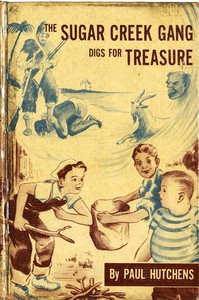
I keep thinking about that collie’s quiet certainty in Terhune’s first story—how he simply knew the boy was lost. It reminded me of evenings flipping through Heart of a Dog while my own dog slept. Then I found myself remembering the unassuming warmth of The Sugar Creek Gang Digs for Treasure — Reading Companion—less about rescue, more about small boys finding their way home in the dark.
There are no reviews for this eBook.
There are no comments for this eBook.
Reader reflection
Before you leave, reflect on the book
Use these questions to collect your thoughts before moving on.
Your progress
0
/
10
2
What was your overall reaction to the book?
3
Would you pass this book on to a friend?
4
How demanding did the text feel?
5
What did you appreciate most?
6
How understandable was the text?
7
Did it raise ideas you would like to talk about?
8
How did the reading compare with what you expected?
9
In one sentence, what did you learn?
10