1

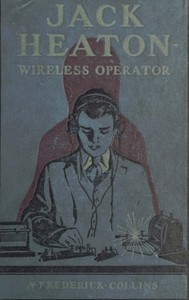
Jack Heaton, wireless operator — A Closer Reading
(0 User reviews)
1047
Project Gutenberg
2024
Not confirmed
Adventure stories; Teenage boys -- Juvenile fiction; Telegraph, Wireless -- Juvenile fiction
Readers of public-domain and historical texts
Project Gutenberg digital edition
en
Edition facts
Words
53,057
Reading time
231 min
Text sections
5
The catalog record for Jack Heaton, wireless operator — A Closer Reading provides practical reading context through 53,057 words, 3 hr 51 min estimated reading time, and 5 detected text sections.
The text analysis averages about 27.7 words per sentence, while the detected sections provide another way to judge how the source is divided.
Project Gutenberg metadata also associates the work with “Adventure stories,” connecting these edition facts with the source record’s subject description.
Source:
Project Gutenberg record #72796
A first-person narrative following a young wireless operator from his early experiments in Montclair through adventures at sea, in the tropics, and during World War I, with technical detail and a conversational voice.
Editorial Edition Score
4.7/5
★★★★★
★★★★★
Calculated from edition completeness, EPUB availability, text structure and catalogue metadata. Not a user rating.
How this score is calculated
- Description quality20 pts
- Title & short description10 pts
- Source metadata20 pts
- Text length15 pts
- Chapters / structure15 pts
- EPUB file integrity20 pts
Total of 100 points, scaled to a 2.5-5.0 range. Editions with an empty description or a missing EPUB file are not scored.
Edition quality
Read the Text
e on his place and he had one of the best amateur outfits in town. A lot of us fellows used to make his operating room a _hang-out_ because we could get into and out of it without disturbing any one or getting called down by anybody. Bob was a mighty good sport even if he did wear spectacles and talk like a college professor and he was always willing to let a fellow listen in if he could read Morse, while for the benefit of those like myself who didn’t know the code he would tell us what the fellows in our own neighborhood were saying or what the operators down in Virginia, over in Ohio, up in New York State, or out in the Atlantic were sending.
It was interesting enough to pick bits of news right out of the air, so to speak, and I noticed that the grown-up folks were always mighty keen to hear any wireless news that might happen to come Bob’s way. In those good old days when amateur wireless was young any fellow could set up his own station, use whatever _wavelength_ he wanted to send with, and blab any news that chanced to come his way; but all this was changed a few years later when the government found that too many amateurs were abusing these privileges. To give them a chance it made every one who operated or owned a wireless station register it, gave him a call letter, limited the sending range of his apparatus, had him use waves of a certain length for sending, and made it an offense for him to give out any news which he might receive. And oh, the wail that went up all over the United States from the amateurs!
I went over to Bob’s one evening after dinner--we always have dinner in the evening in Montclair--and as usual there was Bob sitting at his table listening in. Charlie Langdon, Howard Brice and Johnny James were there and they were all leaning over him looking worried.
“Hello, fellows,” I sang out as I opened the door.
“Shut up,” hissed Howard, while Johnny punched me in the ribs with his elbow and Charlie showed his butter teeth and flapped his open hand, which in kid language means _keep still_.
I sat down sulkily, for no self-respecting boy that can box the way I used to wants to be told to shut up, get a poke in the ribs and the signal to keep his face closed when he has only said, “Hello, fellows.” After a minute or two my curiosity bristled up for I must needs know what was going on. I looked at Bob. His face was a little longer than usual, his eyes were glassy and stared hard and he kept adjusting the detector nervously.
“What’s it all about, Howard?” I whispered in his ear.
Say, you’d think I’d committed a crime the way he scowled at me. Then he deigned to make a whispered reply.
“The _Republic_ is sinking and is sending out C Q D’s.”
I could feel my heart stop beating, the blood leave my head, and my body get rigid, and it’s just about the same kind of a feeling that comes over a fellow when he is on a ship that is going down, as I have since learned.
Other ships were answering the _Republic’s_ distress signals and were headed for her but they were a long, long way off and it seemed very doubtful if they could reach her in time. The _Republic’s_ operator kept on sending C Q D’s and then her latitude and longitude. I stayed at Bob’s station until dad came after me, which was about midnight. At first he was pretty sore, but when he found out what had kept me he relented a little.
Well, the next day we wireless fellows--I had been initiated--did not take a very keen interest in our school work, for when you know a big ship crowded with human freight is sinking you don’t care much whether school keeps or not. As soon as school was out we were all at it again and then after fifty-two hours of hoping against hope, and during all of which time Jack Binns, the first wireless hero, had stuck to his key on the ill-fated ship, help reached her and by so doing his duty sixteen hundred lives were saved.
The narrator opens by locating his hometown of Montclair, New Jersey, not with a map but by measuring distance “as wireless waves fly.” This offhand calibration sets the tone for a book that treats radio as a natural element of the world. The early chapters describe a community of “wireless bugs,” boys who string aerials across houses and trade signals like a shared language. The voice is that of a grown man recalling his teenage self, mixing technical curiosity with a wry awareness of how odd the hobby looked to outsiders—one visitor mistook the aerials for clotheslines. The pace is unhurried, lingering on the culture of amateur radio before the story moves to sea.
A Conversational Guide to Wireless
The narrator addresses the reader directly, assuming little prior knowledge. He explains how he learned Morse code and built his first set, but the instruction is woven into anecdote rather than lecture. When describing Marconi’s transatlantic experiments, he reproduces the full text of President Roosevelt’s 1903 message to King Edward VII—a document that slows the narrative to a historical pause. The effect is deliberate: the reader is meant to feel the weight of that first cableless greeting. Later, when the narrator visits the Glace Bay station, he notes the “four enormously high towers” and the watchmen who halt him, building suspense from bureaucratic friction. The technical details—wavelengths, aerial lengths, spark gaps—are precise but never overwhelm the story of a boy gaining access to a world of grown-up machinery.
Shifts in Pace: From Idyll to Emergency
The early chapters move at a relaxed, observational tempo. The narrator describes Montclair’s wireless craze with the affection of a collector recalling his first finds. But the pace changes sharply when he takes his first job at sea. The chapter titles alone signal a lurch into crisis: “When the ‘Andalusian’ Went Down,” “Catching Seals by Wireless,” “My Adventures in the Tropics.” The excerpts show a narrator who can pivot from explaining how a station is built to reporting a ship’s distress call in the same even tone. The CQD calls—the precursor to SOS—appear without dramatic buildup. The narrator treats them as part of the job, which makes the danger feel more real than any flourish could. The later chapters, set aboard warships and in France, compress time further, with action sequences that rely on the reader’s trust in the narrator’s technical competence.
Voice and the Limits of First-Person Testimony
The narrator’s voice is consistently that of an enthusiast who has been there. He uses the first person to claim authority: “I knew one of the operators there,” “I felt pretty sure I should succeed.” But the excerpts also reveal gaps. When he describes the Glace Bay station, he admits he could not enter the apparatus rooms—only the office. The book does not pretend to omniscience. The narrator is a participant, not a historian, and his knowledge is bounded by what he saw or was told. This limitation gives the prose a documentary feel. He reproduces official messages and names real people (Marconi, Roosevelt, Howard Brice), grounding the fiction in verifiable fact. The reader is left to decide how much of the later adventure—the submarine chases, the artillery signals—comes from experience and how much from the kind of secondhand knowledge any wireless operator might pick up in a mess hall.
The book rewards a reader who pays attention to its technical asides. The narrator often explains how a device works or why a procedure matters, and these explanations are not padding—they are the point. The story is as much about the craft of wireless as about the adventures it enables. For a full reading, note the shift in verb tense when the narrator moves from describing his youth to recounting wartime service; the change is subtle but marks a turn from recollection to reportage. The illustrations by R. Emmett Owen, though not reproduced here, are said to depict key moments of action and may offer a visual counterpoint to the narrator’s steady, technical voice.
There’s something about Jack Heaton’s quiet patience with his equipment—how he listens before transmitting—that reminds me of another kind of listening, the kind those two boys in Hiking Westward Being the Story of Two Boys Whose Ambition Led Them to Face Privations and Hardships in Their Quest of a Home in the Great West — Key Ideas to Explore had to learn for the land itself. Both are really about paying attention when nobody’s watching. I think of that often, now.
There are no reviews for this eBook.
There are no comments for this eBook.
Reader reflection
What was your reading experience?
Capture what you thought, learned, and would like to remember.
Your progress
0
/
10
2
What was your overall reaction to the book?
3
Would you encourage someone else to read it?
4
How demanding did the text feel?
5
Did any part of the book feel personally relevant?
6
Could you apply anything you learned?
7
Is this a title worth rereading?
8
What was the strongest part of the book?
9
Which lesson or insight stayed with you?
10