1

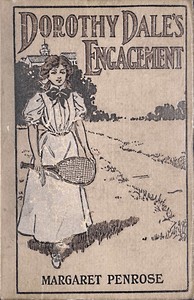
Dorothy Dale's engagement — Reading Companion
(0 User reviews)
693
Project Gutenberg
2023
Not confirmed
Friendship -- Juvenile fiction; Young women -- Juvenile fiction; Man-women relationships -- Juvenile fiction
Readers of public-domain and historical texts
Project Gutenberg digital edition
en
Edition facts
Words
55,345
Reading time
241 min
Text sections
39
For Dorothy Dale's engagement — Reading Companion, the stored edition analysis reports 55,345 words, 4 hr 1 min estimated reading time, and 39 detected text sections.
The text analysis averages about 13.1 words per sentence, while the detected sections provide another way to judge how the source is divided.
Project Gutenberg metadata also associates the work with “Friendship -- Juvenile fiction,” connecting these edition facts with the source record’s subject description.
Source:
Project Gutenberg record #72040
Margaret Penrose's 1917 novel follows Dorothy Dale and her spirited chum Tavia Travers through romantic tensions, misunderstandings, and a mysterious correspondence with a cowboy, as narrative pace shifts between lively dialogue and reflective interludes.
Editorial Edition Score
4.9/5
★★★★★
★★★★★
Calculated from edition completeness, EPUB availability, text structure and catalogue metadata. Not a user rating.
How this score is calculated
- Description quality20 pts
- Title & short description10 pts
- Source metadata20 pts
- Text length15 pts
- Chapters / structure15 pts
- EPUB file integrity20 pts
Total of 100 points, scaled to a 2.5-5.0 range. Editions with an empty description or a missing EPUB file are not scored.
Edition quality
Read the Text
d lose his paper and the better element in the town lose their fight for prohibition; but Dorothy Dale, confident that she could do it, got out the _Bugle_ and did much, young girl though she was, to save the day. In this she was helped by Tavia Travers, a girl brought up entirely differently from Dorothy, and who possessed exactly the opposite characteristics to serve as a foil for Dorothy’s own good sense and practical nature.
Major Dale was unexpectedly blessed with a considerable legacy which enabled him to sell the _Bugle_ and take his children to The Cedars, at North Birchland, to live with his widowed sister and her two boys, Ned and Nat White, who were both older than their cousin Dorothy. In “Dorothy Dale at Glenwood School,” is related these changes for the better in the fortunes of the Dale family, and as well there is narrated the beginning of a series of adventures at school and during vacation times, in which Dorothy and Tavia are the central characters.
Subsequent books are entitled respectively: “Dorothy Dale’s Great Secret,” “Dorothy Dale and Her Chums,” “Dorothy Dale’s Queer Holidays,” “Dorothy Dale’s Camping Days,” “Dorothy Dale’s School Rivals,” “Dorothy Dale in the City,” and “Dorothy Dale’s Promise,” in which story the two friends graduate from Glenwood and return to their homes feeling—and looking, of course—like real, grown-up young ladies. Nevertheless, they are not then through with adventures, surprising happenings, and much fun.
About the time the girls graduated from school an old friend of Major Dale, Colonel Hardin, passed away, leaving his large estate in the West partly to the major and partly to be administered for the local public good. Cattle raising was not so generally followed as formerly in that section and dry farming was being tried.
Colonel Hardin had foreseen that nothing but a system of irrigation would save the poor farmers from ruin and on his land was the fountain of supply that should water the whole territory about Desert City and make it “blossom as the rose.” There were mining interests, however, selfishly determined to obtain the water rights on the Hardin Estate and that by hook or by crook.
Major Dale’s health was not at this time good enough for him to look into these matters actively or to administer his dead friend’s estate. Therefore, it is told in “Dorothy Dale in the West,” how Aunt Winnie White, Dorothy’s two cousins, Ned and Nat, and herself with Tavia, go far from North Birchland and mingle with the miners, and other Western characters to be found on and about the Hardin property, including a cowboy named Lance Petterby, who shows unmistakable signs of being devoted to Tavia. Indeed, after the party return to the East, Lance writes to Tavia and the latter’s apparent predilection for the cowboy somewhat troubles Dorothy.
However, after their return to the East the chums went for a long visit to the home of a school friend, Jennie Hapgood, in Pennsylvania; and there Tavia seemed to have secured other—and less dangerous—interests. In “Dorothy Dale’s Strange Discovery,” the narrative immediately preceding this present tale, Dorothy displays her characteristic kindliness and acute reasoning powers in solving a problem that brings to Jennie Hapgood’s father the very best of good fortune.
Naturally, the Hapgoods are devoted to Dorothy. Besides, Ned and Nat, her cousins, have visited Sunnyside and are vastly interested in Jennie. The girl chums now in New York City on this shopping tour, expect on returning to North Birchland to find Jennie Hapgood there for a promised visit.
At the moment, however, that we find Dorothy and Tavia at the beginning of this chapter, neither girl is thinking much about Jennie Hapgood and her expected visit, or of anything else of minor importance.
The flashily dressed woman who had run after Tavia down the aisle, again screamed her accusation at the amazed and troubled girl:
“That’s my bag! It’s cram full of money, too.”
There was no great crowd in the store, for New York ladies do not as a rule shop much before luncheon. Nevertheless, besides salespeople, there were plenty to hear the woman’s unkind accusation and enough curious shoppers to ring in immediately the two troubled girls and the angry woman.
“Give me it!” exclaimed the latter, and snatched the bag out of Tavia’s hand. As this was done the catch slipped in some way and the handbag burst open.
The novel opens with a brisk exchange between Dorothy Dale and Octavia Travers, debating train routes in New York City. Their banter—punctuated by Tavia's mockery and Dorothy's decisive tone—immediately establishes contrasting voices: Dorothy measured and practical, Tavia impulsive and theatrical. The dialogue drives the scene forward, but the narrator occasionally steps back to note Tavia's expression or Dorothy's gravity, creating a rhythm of action and reflection.
This alternation between quick conversation and quieter observation persists throughout the excerpts. In later chapters, a letter from cowboy Lance Petterby introduces a new register—colloquial, rambling, full of regional color—while the narrator's commentary slows to parse Tavia's hidden motives. The pacing thus shifts between social comedy and moments of withheld revelation, inviting attention to what characters say and what they leave unsaid.
Voices in Counterpoint
The early dialogue between Dorothy and Tavia is marked by playful opposition. Tavia's line “Now, Dorothy!” and her “little face” are met with Dorothy's firm “We must decide immediately.” This pattern recurs: Tavia sighs, Dorothy counters with logic. Yet the narrator undercuts the simplicity of this dynamic by noting that Tavia “could afford to ‘make faces’” because of her natural prettiness—a detail that hints at social privilege shaping character perception.
Later, when Nat White challenges Tavia about her correspondence with Lance Petterby, the dialogue sharpens. Nat's question—“Still at it, are you, Tavia?”—carries an accusation that Tavia deflects with a drawl and “two red spots in her cheeks.” The narrator then steps in to observe that Dorothy apprehended “the fly in the amber,” a phrase that crystallizes the tension between surface banter and underlying unease. These vocal contrasts—Dorothy's earnestness, Tavia's bravado, Nat's bluntness—create a layered social texture.
Pacing Through Letters and Interiors
The narrative pace slows markedly when letters enter the story. Lance Petterby's missive is rendered in a sprawling, dialect-heavy paragraph: “You got this old timer running round in circles… Too bad you can't remember this here Bob's last name.” The shift from crisp dialogue to this meandering voice alters the tempo, immersing the reader in a different world—the Western ranch—while the narrator holds back key information about Tavia's secret.
This withholding is deliberate. The narrator reveals that Tavia “skipped all mention of Lance's romance and his marriage” when reading his letters aloud, and that she corresponded with him “for a reason deeper than mere mischief.” Such pauses for interior explanation contrast with the earlier rapid-fire exchanges, creating a rhythm of revelation and concealment. The reader is left to piece together motives from what is said, what is skipped, and what the narrator chooses to disclose.
Gestures and Unspoken Signals
Physical details often carry emotional weight. Tavia's “little face” and later her “two red spots in her cheeks” signal embarrassment or defiance without explicit statement. Dorothy's observation that Tavia remained “rather serious all that day” after a conversation about honesty and Christmas gifts is a rare moment of narrative interiority, linking a moral discussion to a shift in mood.
Similarly, the scene of mail distribution is choreographed with precise gestures: Nat “hesitated as he picked up a rather coarse envelope,” then “shot a questioning glance at Tavia.” The envelope's scrawled address and the name “L. Petterby” become objects of tension. These small, almost cinematic beats—hesitation, glance, reach—build suspense without dialogue. The narrator's attention to such details suggests that meaning often resides in what bodies do while voices spar.
Readers attentive to narrative rhythm will find that Penrose uses dialogue, letter excerpts, and brief interior commentary to modulate pace and reveal character. The novel rewards those who track not only what is said but how it is said—and what is withheld. Pay particular attention to moments when the narrator steps back from action to offer a single observation, as these often signal the emotional core of a scene.
I finished Dorothy Dale’s engagement the other week, and that quiet ache of wondering what might have been—between Dorothy and the cowboy, between all her choices—stayed with me for days. It reminded me of how Her own way holds that same gentle tension, that fork in the road. Her own way — Context and Discussion felt like a soft echo of that feeling.
There are no reviews for this eBook.
There are no comments for this eBook.
Reader reflection
Take a moment to reflect on this book
Create a short personal record of your experience with this book.
Your progress
0
/
10
2
How did the book work for you overall?
3
Would you pass this book on to a friend?
4
What was the reading difficulty like?
5
How personally connected did you feel to the book?
6
How strongly did the book affect you emotionally?
7
Did you gain anything practical from the text?
8
Could you see yourself revisiting this book?
9
What did this book teach you most?
10