1

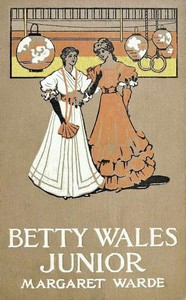
Betty Wales, Junior: A Story for Girls — Background and Themes
(0 User reviews)
30
Project Gutenberg
2020
Not confirmed
Women college students -- Juvenile fiction; Wales, Betty (Fictitious character) -- Juvenile fiction; Universities and colleges -- Juvenile fiction
Readers of public-domain and historical texts
Project Gutenberg digital edition
en
Edition facts
Words
65,922
Reading time
287 min
Text sections
25
Before opening Betty Wales, Junior: A Story for Girls — Background and Themes, the edition data offers a quick orientation: 65,922 words, 4 hr 47 min estimated reading time, and 25 detected text sections.
The text analysis averages about 15.3 words per sentence, while the detected sections provide another way to judge how the source is divided.
Project Gutenberg metadata also associates the work with “Women college students -- Juvenile fiction,” connecting these edition facts with the source record’s subject description.
Source:
Project Gutenberg record #64033
In this third volume of the series, Betty Wales and her friends at Harding College form a secret club, 'The Merry Hearts,' whose schemes include a fictional student named Georgia Ames. The excerpts show the club's influence on campus life and faculty, as well as Madeline Ayres's reflections on loneliness and social barriers.
Editorial Edition Score
4.9/5
★★★★★
★★★★★
Calculated from edition completeness, EPUB availability, text structure and catalogue metadata. Not a user rating.
How this score is calculated
- Description quality20 pts
- Title & short description10 pts
- Source metadata20 pts
- Text length15 pts
- Chapters / structure15 pts
- EPUB file integrity20 pts
Total of 100 points, scaled to a 2.5-5.0 range. Editions with an empty description or a missing EPUB file are not scored.
Edition quality
Read the Text
Wales were freshmen together at Mrs. Chapin's. Mary Brooks, the only sophomore in the house, did her best to make life a burden to them in the amusing but innocent fashion that hazing takes at Harding. The good times they all had together and Betty's trials with Helen Adams, who fell to her lot as roommate, and with Eleanor Watson, whom she admired for her cleverness and over whom she managed to exert a strong influence for good, are recounted in "Betty Wales, Freshman."
When they were sophomores most of the Chapin House girls moved to the campus, where they were distributed among the various college dwelling-houses, there to find new interests and make new friends. Chief among the latter was Madeline Ayres, the girl from "Bohemia, New York," whose original and always artistic ideas for everything from political parades and vaudeville shows to the arrangement of a room and the soothing of an irate editor won her vast popularity. Another important addition was Dora Carlson--Eleanor Watson's freshman she was called, from her dog-like devotion to Eleanor. Dora and Betty between them, with some help from Madeline and some from Miss Ferris, a friend on the college faculty, kept Eleanor from utterly ruining her career at Harding. A story not her own that she printed in the college magazine made no end of trouble for Eleanor and her friends, but in spite of that the sophomore year was a merry one. Indeed I think that Betty Wales and her set entered upon their junior year with the firm conviction that you couldn't help having a good time at Harding--even if you tried.
THE FUN OF JUNIOR YEAR
"Hello, Betty Wales. Please amuse me."
Betty was sitting on the floor of her own long-coveted "single," surrounded by a bewildering array of her possessions, which she had unpacked according to her own particular system of taking everything out at once, and now, as usual, she had no idea where to dispose of them. At the sound of the voice, the unwonted pucker of anxiety left her forehead, and she jumped up, scattering the photographs she had been sorting right and left, and made a rush for the newcomer.
"Oh, Mary Brooks! Maybe I'm not glad to see you. I'm--I think I'm homesick."
Mary grinned cheerfully. "You ought to be used to it by this time--to the joys of being back on time, I mean. It's I that have reasons for feeling like a little lost lamb. Do you know, this is positively my first appearance at the regular opening functions."
"Really?" laughed Betty. "What's going to happen?"
"Nothing new, I hope," said Mary; "but Miss Stuart delicately hinted that the wrath of Jove would descend upon me if I didn't get here on time. Where's everybody?"
"I don't know," said Betty sadly. "Didn't you come on the eight-fifteen?"
"I did," returned Mary with decision. "Ever since I entered college I have heard about the joyousness of coming up on the eight-fifteen on an opening night. And now I get here on time for once, and the New York and the western trains are all fiendishly late. So I come up alone in my glory on that famous eight-fifteen, and instead of a gay and festive occasion such as I have been led to expect, I find an empty house--not a soul but you to talk to, and positively nothing doing. They seem to be all new girls on my corridor."
"I don't think you ought to refer to freshmen as an empty house," said Betty severely, "and anyhow it serves you right for all the times you have cut over."
"When did you come?" asked Mary, apparently considering that one topic had been pursued far enough. "You haven't done all this"--she indicated the miscellaneous results of Betty's unpacking by a sweeping gesture--"in just this one evening?"
"Rather not," said Betty. "Mary, I've been here two whole days--not in the Belden of course, because it wasn't open, but in Harding; and I think that if you hadn't come just when you did, I should have--cried," ended Betty, in a sudden burst of confidence.
"You poor thing!" said Mary sympathetically. "I suppose it was a freshman cousin or something."
The catalog subjects label Betty Wales, Junior as fiction about women college students, but the excerpts reveal that the story's engine is not academic life but a sustained, elaborate prank. The central plot device—a club called 'The Merry Hearts' that invents a nonexistent student named Georgia Ames—drives most of the action shown in the available text. Faculty members Dr. Eaton and Miss Stuart are drawn into the joke, with Dr. Eaton even submitting a report for the imaginary Georgia. The club's activities, not coursework or dormitory routines, dominate the narrative.
The Club as Social Engine
The excerpts treat 'The Merry Hearts' as the primary vehicle for plot and character interaction. The club's aims are described as 'booming of Georgia Ames,' and its members include Betty, Madeline, Mary, and others. The club's influence extends beyond the student body: Dr. Eaton is elected an honorary member, and Miss Stuart later accepts membership, noting that the club has 'a real influence in the college' and has reduced snobbishness. The club's schemes—such as the 'Japanese tea' mentioned by Miss Stuart—are presented as successful interventions in campus social life. Notably, the excerpts do not show any classroom scenes, examinations, or academic struggles; the mid-year exams are mentioned only in passing as having 'few terrors for clear-headed juniors.' The club, not the curriculum, provides the story's momentum.
Madeline Ayres and the Question of Loneliness
One of the more reflective passages comes from Madeline Ayres, the 'girl from Bohemia, New York,' who speculates about the inner lives of seemingly self-sufficient people. After Miss Stuart accepts the club's invitation with 'eager gratitude,' Madeline wonders whether quiet, self-contained individuals are truly happy. She extends this to a classmate, Miss Case, who is wealthy, lives in a suite of rooms, and spends her time buying and reading new books. Betty responds that 'books and lovely things and all the money you want' could not compensate for the loss of parents. Madeline then resolves to invite Miss Case to join the club, and Miss Case eventually confides that she was 'always lonely' and 'afraid of intruding.' This subplot—a shy, wealthy student finding connection through the club—offers a counterpoint to the prank-heavy main plot and suggests a thematic interest in social isolation and belonging.
Voice and Structure: The Narrator's Role
The narrator of Betty Wales, Junior adopts a direct, slightly conspiratorial tone, addressing readers who may not have read the earlier books. The introduction explicitly summarizes previous volumes, naming characters and their traits: 'Jolly, happy-go-lucky Katherine Kittredge; Rachel Morrison, as steady and dependable as Katherine was volatile.' This framing suggests the book is part of a series and assumes some familiarity with the cast. The narrative voice also editorializes, as when it describes mid-years as having 'few terrors for clear-headed juniors' who know how to arrange their work for maximum freedom. The excerpts include dialogue that advances the plot—such as the night-watchman's confrontation with a 'ghost' (actually a student in disguise)—and occasional reflective exchanges, like Madeline's musings on Miss Case. The structure alternates between club schemes and character moments, with the invented Georgia Ames serving as a unifying thread.
Readers coming to this third volume without having read Betty Wales, Freshman and Betty Wales, Sophomore will find the introduction helpful but may miss earlier character dynamics. The excerpts suggest that the book rewards attention to the club's internal logic and to Madeline's observations, which occasionally cut against the lighthearted tone. The invented Georgia Ames is not a character but a device; the real story lies in how the club's members and their faculty allies respond to the fiction they have created.
I have often mused on how Betty’s secret club, with its playful invention of Georgia Ames, let the girls test their own power over loneliness. That quiet, almost shy experimentation with identity feels akin to the bonds forming in Captains of Harley: A School Story — Themes and Context. Both understand that friendship is a fortress built from shared, unspoken fears.
There are no reviews for this eBook.
There are no comments for this eBook.
Reader reflection
What did you think of this book?
Answer a few questions and save a private reflection on this device.
Your progress
0
/
10
2
How much did you enjoy the reading experience?
3
Would you recommend this book to another reader?
4
How much effort did this book require?
5
Did you relate to its people, ideas, or situations?
6
Would a second reading be valuable?
7
How original did the book feel?
8
Did the book meet your expectations?
9
In one sentence, what did you learn?
10