1

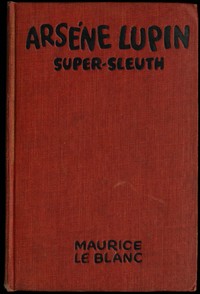
Arsène Lupin, super-sleuth — A Closer Reading
(0 User reviews)
1390
Project Gutenberg
2024
Not confirmed
Detective and mystery stories; Burglars -- Fiction; Lupin, Arsène (Fictitious character) -- Fiction
Readers of public-domain and historical texts
Project Gutenberg digital edition
en
Edition facts
Words
76,147
Reading time
332 min
Text sections
16
The catalog record for Arsène Lupin, super-sleuth — A Closer Reading provides practical reading context through 76,147 words, 5 hr 32 min estimated reading time, and 16 detected text sections.
The text analysis averages about 14.4 words per sentence, while the detected sections provide another way to judge how the source is divided.
Project Gutenberg metadata also associates the work with “Detective and mystery stories,” connecting these edition facts with the source record’s subject description.
Source:
Project Gutenberg record #74269
Maurice Leblanc's Arsène Lupin, super-sleuth follows Ralph de Limézy as he investigates a murder linked to a villa, a former partner named Jodot, and a set of black cloth masks. The narrative moves between Paris streets, a restaurant, and the villa, with clues emerging from careful observation and chance discoveries.
Editorial Edition Score
4.8/5
★★★★★
★★★★★
Calculated from edition completeness, EPUB availability, text structure and catalogue metadata. Not a user rating.
How this score is calculated
- Description quality20 pts
- Title & short description10 pts
- Source metadata20 pts
- Text length15 pts
- Chapters / structure15 pts
- EPUB file integrity20 pts
Total of 100 points, scaled to a 2.5-5.0 range. Editions with an empty description or a missing EPUB file are not scored.
Edition quality
Read the Text
s: the natural gayety of her expression, and the profound seductiveness of her large green eyes, the color of jade, and streaked with gold, from which one could not tear one’s own eyes once one had fixed them on them.
As a rule such eyes are filled with strangeness, thoughtful and melancholy; and that was perhaps the habitual expression of those eyes. But at the moment they diffused the same radiance of intense life as the rest of the face, the mischievous mouth, the dilated nostrils, and the warmly-colored cheeks with smiling dimples.
“Extravagant joys or excessive griefs: there is no mean for creatures of that kind,” said Ralph to himself; and he felt spring to sudden birth in him the desire to play a part in those joys and fight those sorrows.
He turned to the English girl again. She was really beautiful, with a powerful beauty compounded of balance, poise, and quietness. But he found the girl with the green eyes, as he called her, far more fascinating. If one admired the former, one desired to know the latter, to discover the secret of her existence.
Nevertheless, when she had paid her bill and left the confectioner’s with the three children, he hesitated. Should he follow her? Or should he stay where he was? Which should carry the day? Green eyes? Blue eyes?
He rose hastily, dropped some money on the counter and went out into the street. The green eyes had their way with him.
As he came out his eyes fell on an unexpected sight. The girl with the green eyes stood on the curb talking to the lady-killer who, a little while before, had been following the English girl, with the air of a timid or jealous sweetheart. It was animated, heated talk too, on both sides—more like a dispute than a talk. It was evident that the young girl was trying to pass the lady-killer and that the lady-killer would not let her; and this was so evident that Ralph was, contrary to every convention, on the point of interposing.
He had no time to do so. A taxi stopped in front of the confectioner’s; a man sprang out of it who seemed to have already taken in the altercation on the curb, for he stepped up to the squabbling pair, raised his stick and with a hearty whack sent the lady-killer’s hat flying off his pomaded head.
Dumfounded, he started back, then, careless of the people hurrying up, sprang forward and howled: “You’re mad! Absolutely mad!”
The newcomer, who was smaller and older, threw himself into a posture of defense, and, ready to strike, shouted:
“I’ve forbidden you to speak to this young lady! I’m her father and I tell you that you’re nothing but a rotter—a miserable rotter!”
Both of them were fairly shaking with spasms of hate. The lady-killer, stung by the insult, drew himself up to spring on the newcomer, whom the young girl had gripped by the arm and was trying to drag to the taxi. He had succeeded in separating them and snatching the newcomer’s cane, when he found himself glaring into a face which had suddenly interposed between him and his adversary, an unknown, curious face, the right eye of which was winking nervously, and the mouth, curved into an expression of the grimmest irony, holding a cigarette.
It was Ralph who had thus risen before him; and he said in harsh accents:
“Could you oblige me with a light?”
A truly inopportune request. What was this interloper up to? The pomaded one bristled.
“Clear off! I haven’t any matches!” he snapped.
“But you have. A minute ago you were smoking,” the interloper asserted.
Beside himself, the lady-killer tried to thrust him away. Not succeeding in doing so and being unable even to move his arms, he looked down to see what was paralyzing them. He appeared thunderstruck. The two hands of the interloper gripped his hands in such a manner that it was impossible to move them. An iron band could not have paralyzed them more thoroughly. And the interloper did not cease to repeat in obstinate, worrying accents:
“Please oblige me with a light. It would be most unfortunate if you were to refuse me a light.”
The group that had gathered round them began to laugh. The exasperated lady-killer snarled:
“Will you leave me alone? I tell you I haven’t got a light!”
The interloper shrugged his shoulders with a melancholy air.
“Most uncivil, I call it,” he said mournfully. “I never heard of any one refusing a light when he was asked for it politely. But since you make such a fuss about rendering me this slight service—”
The story opens with Ralph de Limézy strolling along the boulevards on a luminous April day, his attention caught by a man following a woman. This seemingly trivial observation sets the tone for a narrative built on close scrutiny of appearances: the impeccable back-parting of the follower, the Englishwoman's blue eyes and noble bearing. The excerpt reveals a detective who reads people through their physical details—a coat, a gait, a gold-tipped cigarette—and who finds amusement in the spectacle of pursuit. The setting shifts from the public boulevard to a restaurant and then to a villa, where the investigation deepens through material evidence: a book covered with photographer's cloth, three round cutouts, and a sack left by a man named Jodot. The structure moves from casual observation to methodical deduction, with Ralph often laughing aloud at the simplicity of the truth once it emerges.
From Boulevard to Villa: The Shifting Scene
The narrative moves fluidly between public and private spaces, each offering different kinds of information. The opening on the boulevard emphasizes visual detail and social observation: the crowd, the walk, the half-turned heads. The restaurant provides a setting for conversation, where the proprietor reveals that Jodot was once a partner of the Loubeaux brothers. The villa, by contrast, is a space of stillness and secrecy. Ralph enters through a window, settles in an easy chair, and reads by electric torch. The shift from the bustling street to the silent house mirrors the detective's movement from surface impressions to hidden truths. The villa itself has been searched by unknown hands, and its rooms hold clues that the police have missed. This movement between scenes is not merely geographical; it represents a progression from the visible to the concealed, from the casual to the deliberate.
Recurring Objects and Their Meanings
Several objects recur across the excerpts, each carrying investigative weight. The black cloth used by photographers appears first as a book cover, then as a square with three round cutouts. Ralph recognizes it as the source of the train-robbers' masks. The sack that Jodot carries each Sunday is another recurring object, set against the wall during his meal. The brass plate on the villa door bears the names 'Loubeaux Frères, et Jodot'—a detail that links past partnership to present crime. Even the cigarette with a gold tip, noted early on, contributes to the portrait of the follower. These objects are not merely decorative; they are the material anchors of the plot. Ralph's method is to let them accumulate and then arrange themselves 'in the full light of day.' The narrative rewards attention to such details, as they often reappear with new significance.
The Detective's Voice and Method
Ralph de Limézy's voice is marked by a blend of amusement and confidence. He finds the situation 'comic and amusing,' laughs aloud in the silent villa, and declares that 'fortune itself will supply me with the missing facts.' His method combines patient waiting with active intrusion: he climbs walls, enters through windows, and spends the night in an easy chair. He reads a book that sends him to sleep, only to wake and notice the cloth cover. The narrative presents deduction as a process of preparation and chance: 'The truth is only revealed to those who compel it to emerge from the darkness.' Ralph's merit lies in the quality of his preparation—the careful observation, the willingness to wait, the readiness to see what others have overlooked. His confidence is not arrogance but a calculated assurance based on method.
Clues in the Dark: Light and Vision
Light and darkness play a structural role in the excerpts. Ralph reads by electric torch in the villa, and his discovery of the cloth comes upon waking, when his eyes fall on the book. The narrative contrasts the full daylight of the boulevard with the dim interiors of the villa. Jodot sits in the shade of closed shutters, and Ralph observes him from above, unseen. The three round cutouts from the black cloth suggest masks that hide faces—a literal use of darkness. The phrase 'in the full light of day' signals the moment when truth becomes visible. The detective's work is partly about bringing hidden things into light: the cloth, the cutouts, the connection between Jodot and the brothers. The recurring image of light—electric torch, daylight, the luminous April day—underscores the theme of revelation.
Readers attentive to physical detail and spatial shifts will find the narrative rewarding. The story does not announce its clues; it embeds them in descriptions of coats, cigarette tips, and cloth squares. The movement between Paris streets and the silent villa mirrors the detective's own trajectory from casual observer to active investigator. The excerpts suggest a work that rewards rereading, where early details gain meaning as the plot unfolds.
There’s something about the way Lupin’s clues surface from chance, not design, that reminds me of old motion-picture serials, where a tilted hat or a forgotten ticket mattered so dearly. I found myself thinking of The motion picture chums at the fair — Reading Companion the other evening, half-remembering its sunny, improvisational sleuthing, far from masked villas but quietly kindred.
There are no reviews for this eBook.
There are no comments for this eBook.
Reader reflection
Take a moment to reflect on this book
Create a short personal record of your experience with this book.
Your progress
0
/
10
2
Did this book hold your interest?
3
How likely are you to recommend this book?
4
How easy was the book to follow?
5
Was the book what you thought it would be?
6
How would you describe its reading pace?
7
Did you gain anything practical from the text?
8
How would you rate its originality?
9
What is the main idea you are taking away?
10