1

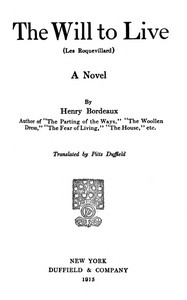
The will to live (Les Roquevillard) — Key Ideas to Explore
(0 User reviews)
2575
Project Gutenberg
2023
Not confirmed
France -- Fiction; Elopement -- Fiction; French fiction -- Translations into English; Families -- Fiction
Readers of public-domain and historical texts
Project Gutenberg digital edition
en
Edition facts
Words
79,622
Reading time
347 min
Text sections
20
Before opening The will to live (Les Roquevillard) — Key Ideas to Explore, the edition data offers a quick orientation: 79,622 words, 5 hr 47 min estimated reading time, and 20 detected text sections.
The text analysis averages about 14.5 words per sentence, while the detected sections provide another way to judge how the source is divided.
Project Gutenberg metadata also associates the work with “France -- Fiction,” connecting these edition facts with the source record’s subject description.
Source:
Project Gutenberg record #71923
In Henry Bordeaux's novel, a Savoyard family confronts disgrace after a son's elopement and imprisonment. The narrative contrasts the father's stern legal mind with his private anguish, and the son's return sparks a tense negotiation between honor, forgiveness, and the 'will to live' rooted in tradition.
Editorial Edition Score
4.8/5
★★★★★
★★★★★
Calculated from edition completeness, EPUB availability, text structure and catalogue metadata. Not a user rating.
How this score is calculated
- Description quality20 pts
- Title & short description10 pts
- Source metadata20 pts
- Text length15 pts
- Chapters / structure15 pts
- EPUB file integrity20 pts
Total of 100 points, scaled to a 2.5-5.0 range. Editions with an empty description or a missing EPUB file are not scored.
Edition quality
Read the Text
ving eye all the fine land that stretched about him: the disburdened vines, whose purple and gold would live for him again in his joyful wines, the fields twice tilled, the orchards, the little nameless stream beyond them that separated the cantons of Coquin and Saint Cassin, the woods of oak and beeches, red and white, their colours shaded off by autumn into a pale bouquet. In these lands and the varied cultivation of them he read in this quiet hour a history not of the seasons, but of his own family. Such and such an ancestor had bought this field here, another had planted that vineyard; and he himself, had he not passed the boundaries of the canton when he acquired those woods that were so crowded now they called for cutting? Turning toward the farm buildings, he could see the first primitive cabin, changed now into a stable, which the first Roquevillards, honest peasants, had built. He contrasted it with the present large and substantial dwelling blazing with Virginia creeper. It was the same race, abiding in the same place, fortified by a past of honest labour and economy. He paid homage to it, recalling the words of old Fauchois:
“It’s always the fault of the family.”
His own race, moreover, had given the country men capable of serving the republic, as useful there as they had been in the administering of their own affairs. Thus the generations helped each other to a common prosperity. Had not the earliest of them all prepared his work for him? This land that he was treading on they had coveted and earned before him. This wide view had thrilled and exalted them as it thrilled him. With some difficulty he detached his gaze from his own domain and prefigured things as they must have seen it, the combination of lines and tints that made up the landscape, and on which their sense of it, like his own, must have depended. For though cultivatism may modify the immediate appearance of the land, men’s hands change nothing of its splendour and extent: they add only certain human marks, a roof with smoke above it, telling of the sweetness of a hearth, a path or hedge, memorials of the social life, a bell tower that speaks of prayer.
Alone on the hillside he joined to the beauty of the evening the pleasure of communion with his race. He felt that the obscure past had given an importance to this corner of the earth. Opposite to him, the chain of Lepine, its monotony broken by the summit of the Signal, was edged with red. His gaze descended to the plain, followed a moment the graceful, flowing range of the Echelles, to which the last spurs of the mountains seemed to act as escorts on either side, then rose again to the indentations of the Corbelet, Joigny and Granier, and returned again to the hills nearer by, to the storeyed valleys and their more harmonious curves. In this bit of broken nature, hard and soft by turns, he retraced the characters of his parentage--the audacity of his grandfather, who bore arms during the Revolution, the nonchalance of his father, lapsing into mere philosophy and contemplation, and letting his sacred patrimony become compromised almost unawares.
“Not one of them,” he was thinking, “but could thus behold the spectacle of the setting sun from this place. One day, when I am no more, one of my children will take up these comparisons again--my children, who will continue our work, people of means and worth.”
From the past that buttressed him he made out the future in security.
Absorbed in these reflections, he did not see the woman’s form that had left the house and was now coming toward him. It was a woman already aged, with a dark shawl thrown over her shoulders, and using a cane as she walked, with an air of great lassitude and exhaustion. Her face, as you saw it in the evening light, must once have been beautiful. The years had chastened it without taking from it a certain expression of purity, which surprised one at first and then attracted. It was the visible imprint of an upright soul, purged of all evil, even a little mystical.
“Are they not coming yet?” asked Mrs. Roquevillard of her husband.
“Yes, Valentine; there they are.”
Both understood that they were speaking of their children. He pointed but for her at the foot of the declivity, on the upward path, a numerous group. At the head of it came two babies, whom their grandmother recognised at once:
“Peter and Adrienne. They are taking the short cut. I don’t see little Julian.”
The novel opens with a vineyard scene: Francis Roquevillard's voice, 'benevolent' yet commanding, drives the grape-gatherers as dusk falls. This image of authority and communal labor sets the stage for a family drama where the soil and the law intertwine. Bordeaux, in his dedication, frames the story as an illustration of tradition as 'that which lives, that which survives in the present from the past'—a principle tested when the son Maurice elopes and faces prison.
The excerpts reveal a father who, despite his grief, cannot immediately forgive: 'I can’t forget the wrong he did to us in going away.' Yet he creeps to his son's door at night, listening to his breathing, whispering 'I’ll save him, and with him all our race.' This tension between public rectitude and private love drives the narrative.
The Father's Two Faces
Francis Roquevillard is presented through contrasting actions. In the vineyard, his voice is 'benevolent' but carries 'an accent of command,' spurring workers to greater effort. At home, he is a man of controlled emotion: when Margaret announces Maurice's return, he 'raised his head, abruptly, with an involuntary movement; but in a moment he had got possession of himself again.' He refuses to see his son that evening, insisting on meeting him 'to-morrow, in the gaol.' Yet later, he steals to Maurice's door, 'his hand shading the flame of his candle,' listening 'for a moment to the light and regular breathing.' The smile that 'lit up his forceful features' reveals a father's relief, but his words remain stern: 'I want him to understand this and realise it fully.'
This duality—public severity versus private tenderness—is central. Bordeaux uses small physical details (the involuntary movement, the shaded candle) to show a man who disciplines his own heart as strictly as he disciplines others.
The Weight of Professional Honour
When Margaret suggests her father defend Maurice himself, he refuses: 'That wouldn’t do at all.' The reason lies in professional tradition: Maurice is a member of the bar, so the president of the benchers, Mr. Hamel, must conduct the case. The father defers to Battard, 'the highest reputation of any member of our bar in jury trials,' even though Margaret protests that her father speaks better. Francis replies, 'I don’t speak well, little girl. I simply say what I have to say.'
This exchange highlights the code of the legal profession, which overrides personal desire. The father's role as advocate is subordinated to the collective honour of the bar. Margaret's 'little face' at Battard's name suggests a family's private judgment of competence versus the public necessity of protocol. The novel thus explores how institutional loyalty can both constrain and protect.
The Son's Silence and the Mother's Memory
Maurice, upon returning, is 'hungry' but 'dared not eat.' He asks Margaret, 'Has he changed much?' and receives a single word: 'Yes.' His father later tells Margaret, 'He hasn’t asked me' for forgiveness. The son's silence is a wall; the father's forgiveness is conditional on that request. Margaret acts as intermediary, pleading 'Remember mamma' to soften her father. He kisses her forehead but insists, 'Don’t ask me to be weak.'
The absent mother—invoked only through Margaret's plea—hovers over these scenes. Her memory is a moral lever, but not yet sufficient to bridge the gap. The father's final whispered resolve, 'I’ll save him, and with him all our race,' suggests that the family's continuity depends on more than individual emotion; it requires a ritual of contrition and restoration that has not yet occurred.
Readers attentive to the novel's title will watch for how the 'will to live' manifests not as mere survival but as a deliberate, often painful, reassertion of family bonds. The excerpts offer no resolution—only a father's nocturnal vigil and a son's unspoken shame. Bordeaux's interest lies in the slow, legalistic process of repair, where tradition is not a dead weight but a living force that demands both justice and mercy.
There’s something about the Roquevillard father—how his sternness hides a wound—that makes me think of old afternoons at the fair, those bright, careless hours we half-remember. Honor and escape, both pulling. I keep a worn copy of The will to live near my chair, and sometimes, without meaning to, I reach for The motion picture chums at the fair — Reading Companion instead, just to feel that lighter light again.
There are no reviews for this eBook.
There are no comments for this eBook.
Reader reflection
What was your reading experience?
Capture what you thought, learned, and would like to remember.
Your progress
0
/
10
2
Did this book hold your interest?
3
Would you pass this book on to a friend?
4
How demanding did the text feel?
5
Did you gain anything practical from the text?
6
Did you relate to its people, ideas, or situations?
7
Was the book easy to understand?
8
What did you think about the pace?
9
What changed or sharpened your thinking?
10