1

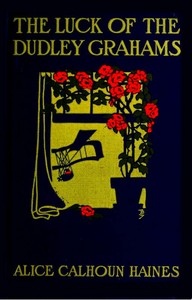
The Luck of the Dudley Grahams As Related in Extracts from Elizabeth Graham's Diary — Key Ideas to Explore
(0 User reviews)
70
Project Gutenberg
2018
Not confirmed
Diary fiction; Airships -- Juvenile fiction; Fatherless families -- Juvenile fiction; Boardinghouses -- Juvenile fiction
Readers of public-domain and historical texts
Project Gutenberg digital edition
en
Edition facts
Words
52,473
Reading time
229 min
Text sections
37
Before opening The Luck of the Dudley Grahams As Related in Extracts from Elizabeth Graham's Diary — Key Ideas to Explore, the edition data offers a quick orientation: 52,473 words, 3 hr 49 min estimated reading time, and 37 detected text sections.
The text analysis averages about 14.5 words per sentence, while the detected sections provide another way to judge how the source is divided.
Project Gutenberg metadata also associates the work with “Diary fiction,” connecting these edition facts with the source record’s subject description.
Source:
Project Gutenberg record #57301
The diary of Elizabeth Graham chronicles her family's boarding-house life, their late father's unfinished flying-machine, and the small joys and struggles of four children and their mother in early 1900s New York.
Editorial Edition Score
4.8/5
★★★★★
★★★★★
Calculated from edition completeness, EPUB availability, text structure and catalogue metadata. Not a user rating.
How this score is calculated
- Description quality20 pts
- Title & short description10 pts
- Source metadata20 pts
- Text length15 pts
- Chapters / structure15 pts
- EPUB file integrity20 pts
Total of 100 points, scaled to a 2.5-5.0 range. Editions with an empty description or a missing EPUB file are not scored.
Edition quality
Read the Text
ly brother. He was an inventor, and a true genius; but, unfortunately, nobody ever discovered this, except just us. He knew all about air-currents, the contractile bladders of fish, and the flight of birds. There is a great, ghostly, flying-machine in the workshop in the attic with dusty yellow sails, and a really wonderful motor. Haze, who sleeps in the workshop since he was obliged to give up his room to the boarders, often dreams that he is taking trips at night. He says the dreams are quite horrible, and calls them “nightmares”; but if only dear father had lived to perfect the machine, we are sure it would have been a success. And that would have been so pleasant, for father never had any successes, except just once,—which we did not profit by, as I will tell later.
Haze is my chum. He is fifteen, and I am seventeen; but sometimes we feel a hundred, because there are so many things to worry about. Dearest mother never worries. She is too Irish for that;—all she cares for, she says, is that her children shall be happy, and good, and clever, and have everything they want. Somehow she seems to believe that we are what she wishes us to be, too,—so that one would feel ashamed to appear discontented. But, oh, if you love your family the way I do, it is hard, hard, hard to be poor!
However, to return to our _mutton_,—in this instance Haze,—his real name is John Hazard, though he is never called John or Jack, only Hazard, or Haze, or Hazey, especially the last two, because they fit so well. For, though he is very clever and half through High School already, he is not a bit practical, never sees what goes on about him, and is always forgetting things. He does not care about athletics, either. He hasn’t the build, he says (his legs being too thin), nor the time nor the money. He is in his Junior year this term, the youngest in his class, and at present he is cramming like mad, so that he can take the final examinations next fall, and “begin to help the family.” That means giving up college, his fondest dream. It is mighty noble of Hazey; but, I must confess, not at all becoming. His face seems to grow smaller day by day, and his eyes, behind his goggly glasses, bigger. Dear Haze! he doesn’t even have time to talk to me any more, and that is why I thought of starting a diary. My cousin Meta has kept one for over a year,—a dainty little volume with gold clasps and a red morocco binding. This is just an ugly old account book of father’s that I found in the workshop. The first few pages are full of the most amazing aërial computations; but there is plenty of room left for writing,—and one must have somebody to confide in!
After Hazard comes Ernestine. She is twelve, and is frequently called Ernie,—which name suits her just as well as Haze’s names do him; for she is really more of a boy than a girl, we think, despite her charming blue eyes and rose-leaf complexion. Ernie is very, very pretty, has sweet ways and a really lovely disposition; but, for all this, she is rather a trying child, for she is continually getting into scrapes, tearing her frocks, breaking the furniture, etc.,—and she always means so well that it is hard to scold her.
Geof is Ernestine’s chum, just as Hazard is mine. He is Uncle George’s son, but so much more like a brother than a cousin that I am going to describe him here. He is fourteen years old, and the direct opposite of Haze in nearly every way. He is a handsome fellow, big for his age, and rather sullen sometimes. That, I think, is because he is not happier at home. He goes to a fashionable school, plays football and hockey, and is perfectly hopeless in his studies. Uncle George maintains he _could_ do better if he would. Aunt Adelaide, who is Geoffrey’s stepmother, says it is a case of “inherent stupidity.” Mother thinks neither is right, and that there is something radically wrong with the school methods. Altogether it is not pleasant for Geof, who wants to give up studying and go into business. This enrages Hazard.
“A fellow with _your_ chances!” he says.
“I’d swap them for yours,” answers Geof, who is not brilliant at an argument. And Haze snorts derisively.
The novel opens with Elizabeth Graham introducing her family as "the Dudley Grahams—four children and a mother" who keep a boarding-house out of necessity after their father's death. The diary format immediately establishes a personal, confiding tone. Elizabeth recounts the family's financial straits with a blend of frankness and wry humor: the three-thousand-dollar life insurance was quickly consumed by debts, and they had to repaper the library and carpet the hall to attract boarders. Her brother Ernie's suggestion to "talk as hard as we can all the time" to distract from shabby furnishings reveals the family's resourceful, slightly self-mocking approach to their predicament.
The attic workshop, where the late father's flying-machine sits "with dusty yellow sails," is introduced as a ghostly presence. Haze, who sleeps there, dreams of trips—"nightmares" he calls them—but the family remains convinced the machine would have succeeded. This blend of domestic struggle and unfulfilled invention sets up a central tension between practicality and dream.
A Family of Inventors and Pragmatists
The Graham children are defined by their father's legacy as an inventor who "knew all about air-currents, the contractile bladders of fish, and the flight of birds." Elizabeth's diary entries show how this inventive spirit manifests in each child. Ernie, the practical one, manages the household finances and orchestrates Christmas gifts with fifty cents. Haze, who occupies the workshop, endures nightmares of flying but also helps with chores. Geoffrey, a friend or relative, brings white mice as a gift, and Robin, the youngest, names them "Open, O Buds, O Open, and Sweet Fern"—a whimsical, poetic touch that echoes the father's imaginative bent.
The family's poverty is never sentimentalized. When Robin receives a toy Abraham Lincoln, he declares it "what I wanted more than anything in the world"—a line that captures both childish sincerity and the modest scale of their desires. The diary records small economies: patching up toys for the Kern family, who are even poorer, and using molasses-candy figures as Christmas stocking stuffers. These details ground the narrative in concrete, everyday life.
The Boarding-House as Stage
The boarding-house is both a financial necessity and a social arena. Elizabeth notes that it took over two months to secure their first boarder, Miss Brown, and that Uncle George, the executor, grew "grim and disapproving" during that time. The family's efforts to appear respectable—repainting, carpeting, and being "very polite and charming"—are presented with a knowing irony. The boarders themselves remain shadowy in the excerpts, but their presence shapes the household's rhythms: children give up rooms, and the attic workshop becomes Haze's bedroom.
The diary format allows for intimate glimpses of family dynamics. Mother is a steady presence, concerned about Robin's health after Christmas excitement. Ernie's enthusiasm for the white mice leads her to skip church, and the three "enthusiasts" spend hours watching the mice. These scenes convey a household where children's interests are indulged despite straitened circumstances. The Kern family, former washerwoman and her children, receive a Christmas package of patched toys and beef extract—a reminder that the Grahams, though poor, see themselves as relatively fortunate.
Christmas in the Diary: A Microcosm of Tone
The extended Christmas excerpt illustrates the diary's blend of humor, tenderness, and economic reality. Robin's delight in his presents—a paper menagerie, tin soldiers, a dressing-gown—is described with affectionate detail. The white mice, a gift from Geoffrey, prompt Ernie to exclaim "How jolly!" and hop "about on her little pink toes." Yet the scene is undercut by mother's murmured dismay at the prospect of a new litter every three weeks. The family's Christmas is modest: an orange, apple, molasses-candy figures, sugar-plums, slippers, and a flannel rabbit. Elizabeth and mother play Santa Claus by candlelight, watching Robin sleep "feverishly" after the excitement.
The diary voice remains consistent: observant, slightly wry, and never mawkish. When Robin says he need never be lonely because of Abraham Lincoln, the sentiment is genuine but not overplayed. The Kern family's poverty is acknowledged without melodrama: "poor lambs" is the extent of pity. This restraint gives the narrative a quiet dignity.
The Flying-Machine as Unfulfilled Promise
The father's flying-machine is introduced early as a "great, ghostly" presence in the attic, with "dusty yellow sails" and a "really wonderful motor." Haze's nightmares of taking trips at night suggest the machine's haunting quality. The family's conviction that "if only dear father had lived to perfect the machine, we are sure it would have been a success" is stated without irony, yet the diary's practical tone undercuts any grandiosity. The machine is a symbol of unrealized potential, but it is also a physical object that occupies space and influences daily life.
The excerpts do not reveal whether the machine ever flies or becomes central to the plot. Instead, it functions as a backdrop—a reminder of the father's genius and the family's lost hopes. The diary's focus remains on the present: boarders, Christmas, patched toys. This tension between the mundane and the visionary gives the novel its distinctive texture. Readers may wonder whether the machine will be activated, but the diary's primary interest is in how the Grahams navigate their immediate circumstances.
The diary form invites readers to piece together the Grahams' world from Elizabeth's selective entries. Pay attention to what she chooses to record—small triumphs, financial anxieties, children's games—and what she omits. The flying-machine, though mentioned early, may or may not become a plot device; its significance lies in how it colors the family's self-perception. The novel rewards a slow reading that savors the specific details of early twentieth-century domestic life and the quiet resilience of its narrator.
That rainy afternoon, the Grahams’ clattering boarding-house felt like a warm blanket against the window’s gray. Elizabeth’s quiet note about her mother’s stubborn hope lingered with me long after closing the diary. It drifted, almost by accident, to another kind of endurance—a revolution’s desperate tenderness. I found myself reaching for Le chevalier de Maison-Rouge — Context and Discussion. Different city, different century, yet the same quiet pulse: ordinary people holding onto small loves while the world shifts beneath them.
There are no reviews for this eBook.
There are no comments for this eBook.
Reader reflection
Record your reading impressions
A brief reflection can help important ideas stay with you longer.
Your progress
0
/
10
2
Was reading this book enjoyable?
3
Would you encourage someone else to read it?
4
How demanding did the text feel?
5
Did any part of the book stay with you emotionally?
6
Is this a title worth rereading?
7
How would you rate its originality?
8
What did you appreciate most?
9
Which lesson or insight stayed with you?
10