
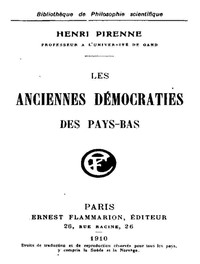
Les anciennes démocraties des Pays-Bas by Henri Pirenne
Henri Pirenne's Les anciennes démocraties des Pays-Bas isn't a novel with a plot, but it tells one of the most important 'stories' in Western history. It's about the rise of self-government in the Middle Ages.
The Story
Pirenne starts with a simple observation: after the Roman Empire fell, real power in Europe was about land and knights—the feudal system. Kings and lords called the shots. But in the Low Countries (modern Belgium and the Netherlands), something different happened. As trade exploded in the 1100s, cities grew rich from cloth-making and commerce. These merchants and craftsmen weren't nobles, but they had money and needed to protect it. They banded together in guilds and, town by town, began wresting freedoms from their local counts and dukes. They bought charters that gave them the right to run their own courts, collect their own taxes, and defend their own walls. Pirenne walks us through this slow, messy, and often violent process, showing how these urban communes became little republics in the middle of a feudal world.
Why You Should Read It
This book flips the script on how we see democracy. We often view it as a top-down gift from enlightened philosophers. Pirenne argues it was a practical, bottom-up solution built by butchers, bakers, and candlestick makers who were sick of arbitrary rules messing with their business. His focus on economic and social forces—the power of a trade network, the solidarity of a guild—makes history feel immediate and human. You see how everyday needs for fair contracts, safe travel, and predictable taxes forced the creation of new political rules. It’s a powerful reminder that our institutions often grow from the messy realities of daily life, not just lofty ideals.
Final Verdict
This is a classic for a reason, but it's not light beach reading. It's perfect for history buffs who want to go deeper than kings and battles, and for anyone curious about where our modern ideas of citizenship and self-rule actually come from. If you enjoy books that connect economics to politics, or if you've ever wondered 'how did we get here?', Pirenne's masterful argument is essential. Be prepared for dense detail, but the payoff is a completely new perspective on the foundations of the free world.
This digital edition is based on a public domain text. It is now common property for all to enjoy.
William Martinez
8 months agoThe peer-reviewed feel of this content gives me great confidence.
Jennifer Johnson
4 months agoWhile browsing through various academic sources, the footnotes provide extra depth for those who want to dig deeper. The price-to-value ratio here is simply unbeatable.
Sarah Garcia
9 months agoI've been looking for a reliable source on this topic, and the practical checklists included are a great touch for real-world use. I appreciate the effort that went into this curation.
Kimberly Moore
5 months agoI started reading this with a critical mind, the logic behind each conclusion is easy to follow and verify. This should be on the reading list of every serious professional.





Joseph Davis
10 months agoThe clarity of the introduction set high expectations, and the language used is precise without being overly academic or confusing. A rare gem in a sea of mediocre content.